
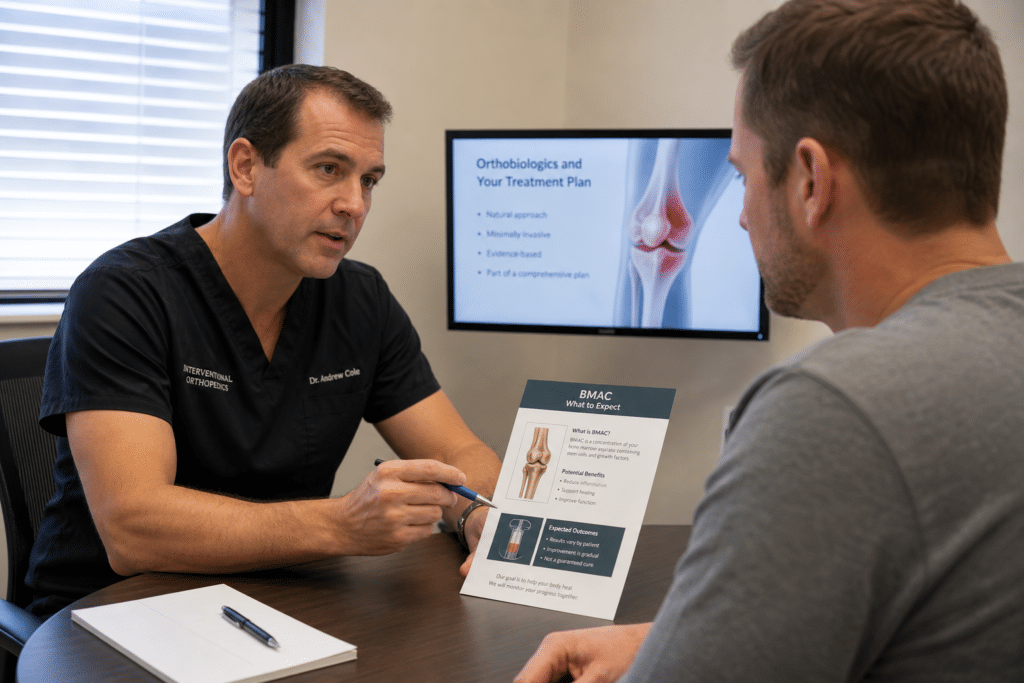
Bone Marrow Aspiration Concentrate (BMAC): What It Is—and What It Is Not
Bone Marrow Aspiration Concentrate (BMAC) is increasingly recognized for its potential benefits in various treatments.
Understanding BMAC’s role in regenerative medicine can bridge the gap between expectation and reality.
Did you ever wonder why “stem cell therapy” feels definitive online—but conditional in real clinical practice?
That tension is not accidental. It reflects a gap between narrative and biology.
Integrating BMAC into treatment plans enhances patient outcomes.
Bone marrow aspiration concentrate sits directly inside that gap—often described as regenerative, yet more accurately understood as an orthobiologic system input. Not a cure. Not a guarantee. And not a replacement for structural care when structure is the problem.
When discussing treatments, it’s essential to understand the role of bone marrow aspiration concentrate in the overall recovery process.
Understanding the role of bone marrow aspiration concentrate is vital in the broader context of regenerative therapies.
In the United States, bone marrow aspiration concentrate exists within a regulated procedural framework—not a pharmaceutical one.
Under federal guidance, its use typically involves:
• autologous bone marrow harvest
• minimal manipulation
• same-day application within compliant clinical settings
This distinction matters.
Bone marrow aspiration concentrate is not classified as an FDA-approved drug, and it is not positioned as a predictable tissue-regenerating intervention. It is a biologic concentrate used within defined boundaries—where safety, sourcing, and handling remain central to compliance.
Systems-Based Explanation
The common misconception is that bone marrow aspiration concentrate “builds tissue.”
BMAC may influence:
• inflammatory signaling
• cellular communication pathways
• local tissue environment conditions
But influence is not outcome.
What ultimately unfolds depends on how the system responds—specifically:
• delivery accuracy (placement defines exposure)
• mechanical loading patterns (movement defines adaptation)
• rehabilitation strategy (input defines direction)
• overall system health (capacity defines response)
In isolation, BMAC does very little.
Within a coordinated system, it may alter the trajectory of recovery.
Clinical Visualization
Imagine a joint that has shifted from balance to compensation.
The tissue is not simply “damaged”—it is operating under distorted signals:
• load distributed unevenly
• inflammation persisting beyond usefulness
• communication between cells becoming inefficient
BMAC can be a valuable component in a multifaceted recovery strategy.
Now introduce BMAC into that environment.
It does not rebuild the structure directly.
Instead, it may change the conversation happening inside the tissue.
But if movement patterns remain dysfunctional…
If loading remains excessive or misdirected…
The system returns to its prior state.
This is where expectation often breaks from reality.
Historical / Scientific Grounding
In the 1990s, Arnold Caplan, PhD (Case Western Reserve University) reframed how mesenchymal stem cells should be understood.
Rather than acting as direct builders of tissue, he described them as:
• medicinal signaling cells
• coordinators of cellular behavior
• modulators of local environments
This distinction reshaped the conversation.
It shifted the focus from “replacement” to regulation—from rebuilding tissue to influencing how tissue behaves.
🧠Clinical Insight
Orthobiologics influence conditions. Rehabilitation determines outcomes.
Without mechanical correction, biologic input has nowhere to anchor.
Clinical Use
When bone marrow aspiration concentrate is considered within responsible care models, it is not used in isolation.
It is integrated into a structured process that includes:
• precise diagnostic clarity (what is actually driving symptoms)
• image-guided delivery when indicated (accuracy over approximation)
• progressive rehabilitation design (restoring load tolerance)
• expectation alignment (removing promise-based thinking)
The intention is not regeneration as a guarantee.
The intention is biologic support within a controlled recovery system.
E-E-A-T (Experience · Expertise· Authority· Trust)
Clinical use of orthobiologics requires more than access—it requires systems-level decision-making.
In cases where traditional methods fall short, bone marrow aspiration concentrate can provide a supplemental approach to healing.
Responsible implementation prioritizes:
• evidence-aligned application
• regulatory compliance
• integration with rehabilitation science
• avoidance of outcome claims
General medical reference:
• Mayo Clinic — regenerative medicine overview
Specific scientific context:
• Caplan AI, “Mesenchymal Stem Cells: Time to Change the Name!” (Stem Cells Translational Medicine)
Did You Know?
BMAC contains a small percentage of stem cells, but the majority of its activity comes from:
• signaling molecules
• growth factors
• supporting cellular components
Its role is less about quantity—and more about how those signals are interpreted by the body.
Local Care, Global Science
Across Northeast Indiana, interest continues to rise around biologic therapies—often driven by the desire to avoid surgery.
Common search patterns include:
• “BMAC explained”
• “bone marrow concentrate therapy”
• “regenerative medicine without surgery”
What remains consistent is the need for clarity over marketing language—and structure over assumption.
FAQ
It’s essential to evaluate the role of BMAC in personalized treatment approaches.
No. While it contains stem cells, BMAC is a broader biologic concentrate and is not equivalent to how “stem cell therapy” is often marketed.
It is not positioned as a predictable tissue-regenerating intervention. Its role is to influence the local environment, not guarantee structural change.
BMAC is not an FDA-approved drug. It is used within regulated procedural frameworks involving minimal manipulation and autologous use.
Candidacy depends on diagnosis, structural integrity, and whether biologic support fits within a larger rehabilitation strategy.
It is not represented as a replacement for surgery. In some cases, it may be considered as part of a non-surgical management approach.
Prior discussion about the use of BMAC can lead to more informed decisions about regenerative options.