
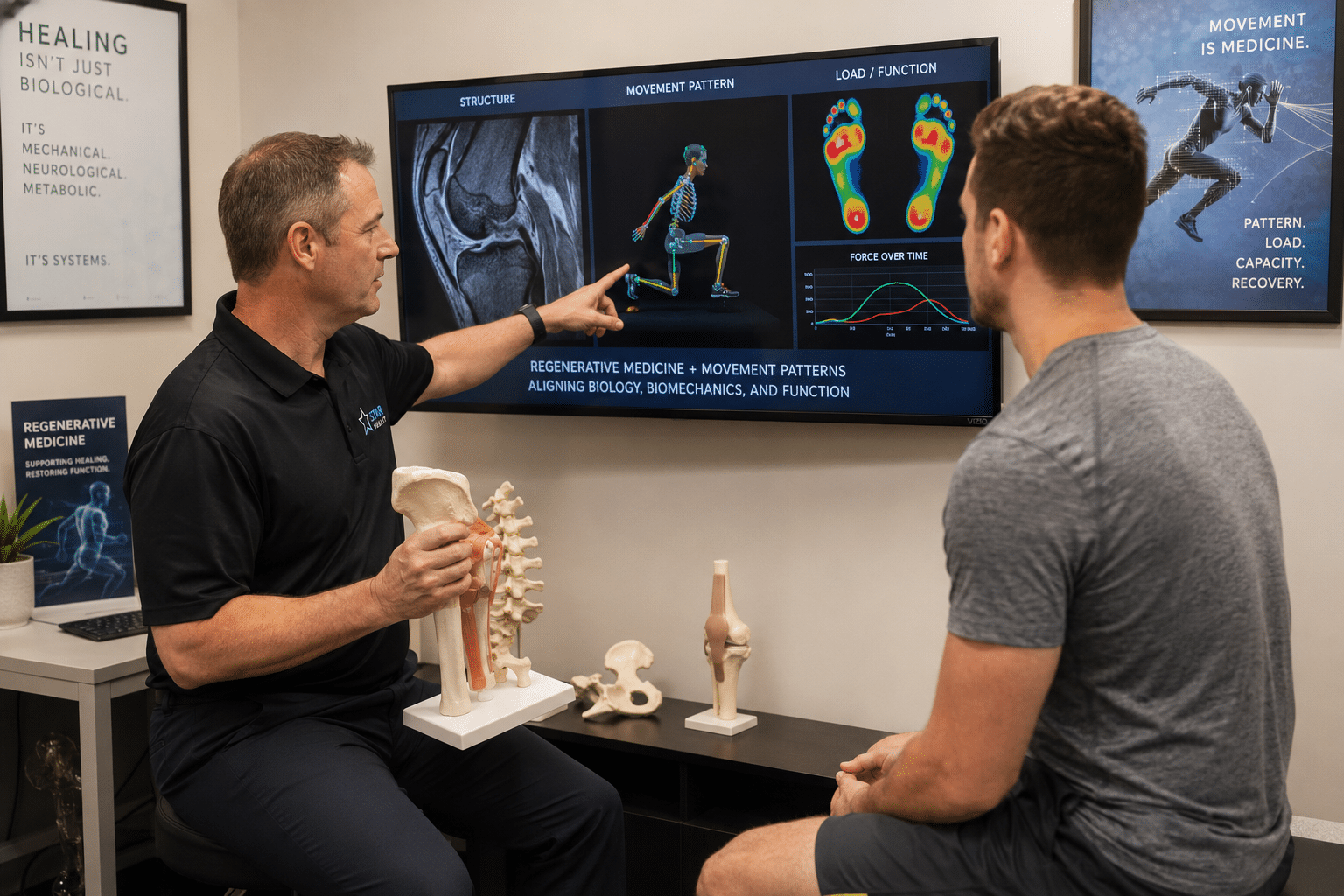
Heal with biology — guided by science, structure, and judgment.
The promise of regenerative medicine is not novelty. It is not speed. It is not the language of miracle repair.
Its real promise is quieter: the possibility of supporting healing by working with the body’s biology rather than overriding it.
At STAR Health, regenerative medicine is practiced as a diagnostic-first medical discipline. Care is physician-led, systems-based, and grounded in evidence, biomechanics, imaging, regulatory clarity, and clinical judgment.
Not every painful joint needs an injection.
Not every MRI finding explains the pain.
Not every biologic belongs in every tissue.
That is where the work begins.
Care Leadership & Philosophy
• Physician-directed, systems-based evaluation
• Evidence-respecting, FDA-compliant biologic strategies
• Imaging, biomechanics, and rehabilitation integrated — not siloed
• Regenerative options considered only after diagnosis
🟦Why STAR Health Is Different
Most regenerative clinics start with a product.
STAR Health starts with a question:
Why is this tissue not healing?
Pain and delayed recovery often appear simple from the outside. A tendon hurts. A joint swells. A disc looks abnormal. A shoulder fails to regain strength.
But the body rarely fails in isolation.
A painful structure may be overloaded. A tendon may be under-recovered. A joint may be irritated by mechanics upstream or downstream. A nerve may be amplifying pain long after the original injury has changed.
That is why regenerative medicine at STAR Health is not applied by diagnosis name alone.
Care may include:
• Time-rich physician evaluations, often lasting 1–2 hours
• Movement and load analysis alongside imaging
• Neurologic input and tissue environment assessment
• MRI or CT findings interpreted in clinical context
• Regenerative strategies considered only when the diagnosis supports them
This approach helps reduce misdirected care, unnecessary procedures, and biologic misuse.
🟦The Pain Detective Approach
Healing is not a single event.
It is a biological conversation between structure, signaling, and load.
Pain, injury, and delayed healing can emerge from the interaction of:
• Tissue biology
• Mechanical loading
• Neural signaling
• Structural integrity
• Inflammatory balance
• Recovery capacity
An MRI may show a tear. A CT may show degeneration. Ultrasound may show tissue change in real time.
But structure alone does not explain pain.
At STAR Health, imaging findings are weighed alongside movement patterns, neurologic input, tissue behavior, and functional demands. The goal is not to chase the image. The goal is to understand the system.
🟦Conditions We Treat
After comprehensive evaluation, regenerative medicine may be considered for conditions involving impaired tissue recovery, including:
• Tendon and ligament injuries
• Joint degeneration or cartilage irritation
• Osteoarthritis-related pain patterns
• Muscle and soft-tissue injury
• Chronic overuse or load-related conditions
• Situations where surgery is being discussed, but alternatives may exist
Regenerative strategies support tissue biology. They do not replace diagnosis.
Common Applications by Region
• Shoulder: rotator cuff, labral, and tendon pathology
• Elbow / Wrist / Hand: tendinopathy and joint degeneration
• Spine & Pelvis: discogenic pain and SI joint dysfunction
• Hip & Knee: osteoarthritis and tendon overload
• Ankle & Foot: Achilles and plantar fascia disorders
Biologic treatments are integrated with rehabilitation and load management, not used in isolation.
Appropriateness is determined clinically. Regenerative medicine is never applied by diagnosis name alone.
🟦Advanced Diagnostics and Precision Methods
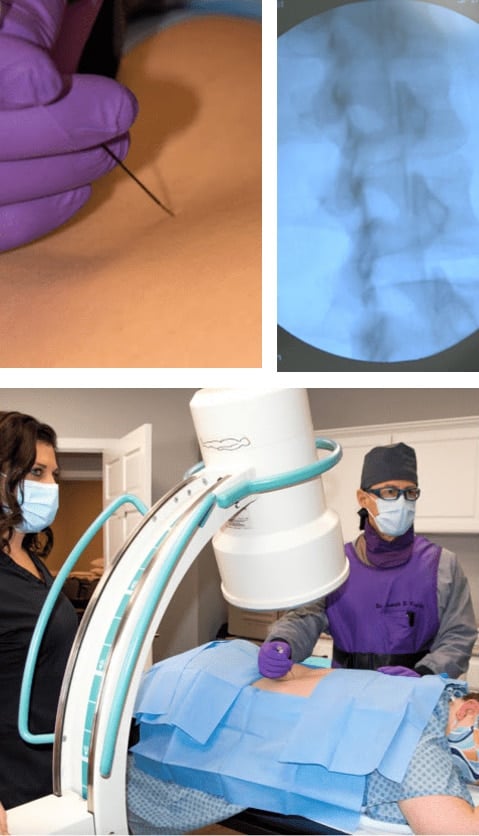
Regenerative care at STAR Health emphasizes verification before intervention.
That means asking whether the suspected pain generator is truly responsible — and whether the tissue environment can reasonably respond.
Diagnostic tools may include:
• Ultrasound imaging for dynamic, real-time tissue assessment
• MRI / CT review interpreted after clinical examination
• Diagnostic injections to confirm pain generators
• Neurologic and electrodiagnostic evaluation when indicated
• Movement, gait, and load analysis
Biologic support is considered only when tissue environment, mechanics, and diagnosis align.
🟦Integrated Healing Options
Regenerative medicine functions within a coordinated treatment spectrum:
Strategy
Load modification & movement correction
Targeted rehabilitation
Image-guided procedures
FDA-compliant biologics (PRP, orthobiologics, bioscaffolding)
Integrative strategies
Why It Matters
Reduces ongoing tissue overload
Reinforces organized healing
Helps biologics reach verified targets
Supports signaling and structure
Addresses nervous system amplification
Platelet-rich plasma has been studied across musculoskeletal conditions, including tendinopathy and osteoarthritis, with evidence varying by diagnosis, preparation method, and patient factors.
Biology is supported only when structure, mechanics, and diagnosis align.
Clinical Authority and Credential Signals
Dr. Joseph Fortin practices at the intersection of osteopathic medicine, Physical Medicine & Rehabilitation, interventional pain management, regenerative medicine, sports medicine, integrative medicine, and applied imaging science.
His background includes board certification in Physical Medicine & Rehabilitation, subspecialty certification in Interventional Pain Management, board certification in Electrodiagnostic Medicine, certification in Clinical Densitometry, formal training and compliant clinical application of regenerative medicine, and integrative medicine expertise addressing nervous system amplification, recovery biology, and load tolerance.
He is a sports medicine physician, editor of a sports medicine text, author of peer-reviewed medical literature, patent holder for a biomechanically focused surgical table design, and a national and international speaker on biomechanics, human movement, MRI and CT imaging physics, interventional pain management, and regenerative medicine.
This convergence allows clinical decisions to be made at the system level — integrating imaging, movement, tissue biology, and neural signaling to reduce misdiagnosis and misdirected care.
Did You Know?
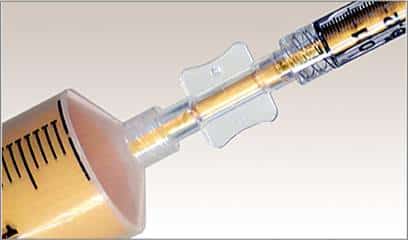
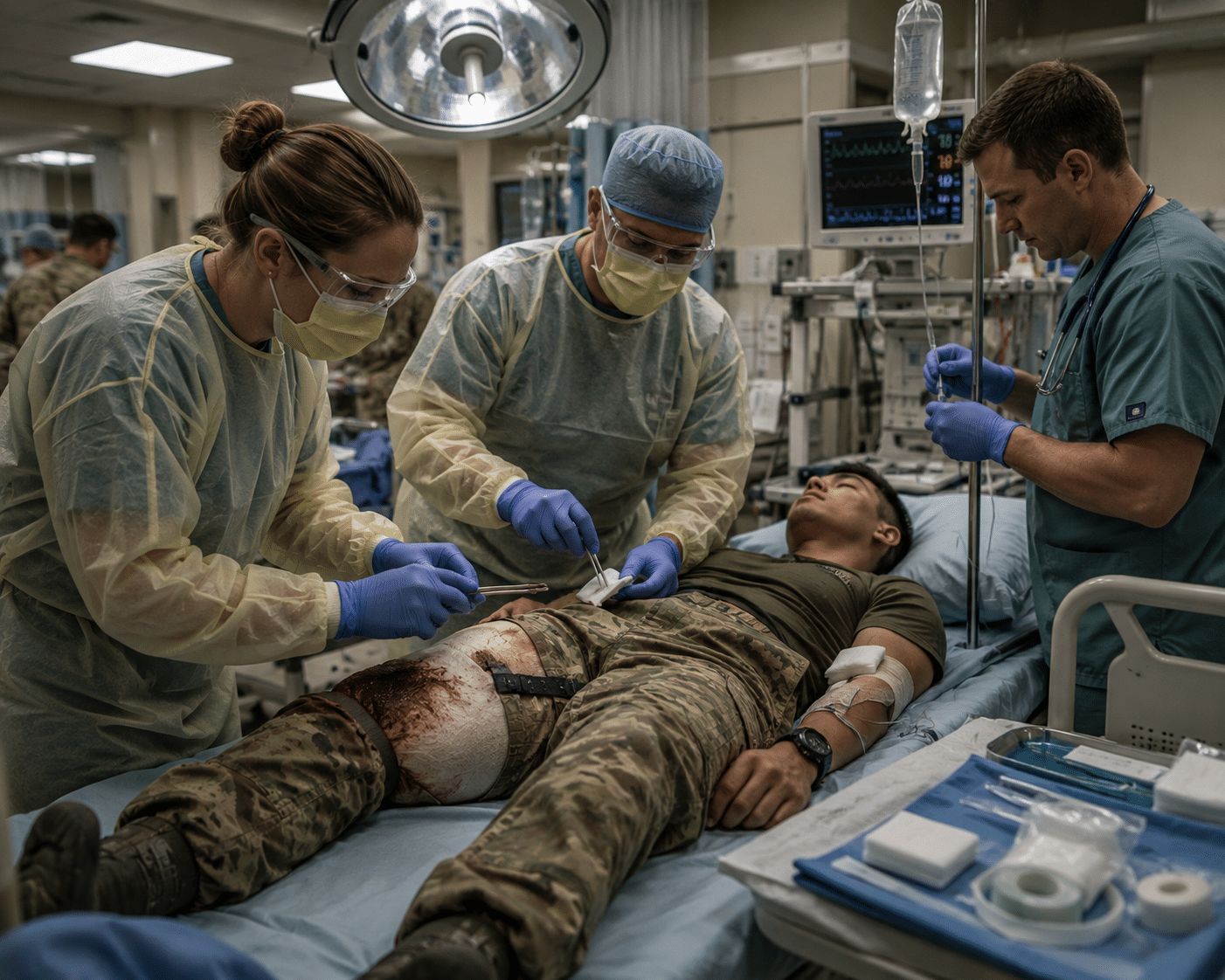
Military and wound-care research has explored extracellular matrix bioscaffolding as a way to provide structural guidance for tissue repair. These approaches do not depend on cultured or expanded stem cells; instead, they use scaffold-like materials to influence the local healing environment.
That distinction matters.
Regenerative medicine is not a single product category. It includes different biologic strategies with different regulatory, scientific, and clinical considerations.
A Historical Perspective
Medicine has long tried to force healing from the outside: immobilize, inject, cut, replace.
Regenerative medicine asks a different question.
What if the body’s repair systems are present, but the environment is wrong?
Too much load.
Too much inflammation.
Too much neural amplification.
Too little structural guidance.
Too little recovery time.
The modern opportunity is not to promise regeneration. It is to identify where the healing system is failing — and whether it can be supported with precision.
That requires discipline.
FAQ
No. STAR Health does not culture, expand, or manipulate stem cells. Therapies are selected within compliant orthobiologic or bioscaffolding approaches.
Some regenerative concepts remain actively studied. At STAR Health, treatments are selected based on available evidence, regulatory guidance, and clinical judgment.
Sometimes regenerative strategies may be considered before surgery. Avoiding surgery is never promised.
Rarely. Outcomes depend on diagnosis, rehabilitation, biomechanics, load management, and ongoing medical oversight.
No. Effectiveness depends on diagnosis, tissue environment, mechanics, severity, biology, and patient-specific factors.
Healing timelines vary. Regenerative care is typically evaluated over weeks to months, not days, because tissue remodeling and load tolerance develop gradually.
For joint conditions or soft-tissue injuries, Dr. Fortin offers an injection to ease pain, inflammation, and swelling. These injections are typically done under ultrasound guidance.
Ready to find out more?
Regenerative medicine deserves discipline — not hype.
At STAR Health, care is deliberate, compliant, and guided by experience.
📍 STAR Health — Fort Wayne, Indiana
📞 Schedule a comprehensive regenerative evaluation
🕒 Time-rich, physician-led care