
Focused Shockwave Therapy Reconditioning Connective Tissue Through Targeted Mechanical Signaling
Why does tendon or ligament pain sometimes return after rest, injections, or conventional therapy?
The problem may not be pain alone. Chronically symptomatic connective tissue can become mechanically disorganized, biologically quiet, or poorly prepared for the forces placed upon it. Rest may reduce irritation without restoring load tolerance. An injection may change symptoms without correcting tissue behavior.
Focused shockwave therapy is designed to reintroduce a controlled mechanical signal into an area where normal remodeling may have stalled.
At STAR Health in Fort Wayne, it is used as a precision adjunct—not a stand-alone cure. Treatment is guided by diagnosis and coordinated with rehabilitation or regenerative care when appropriate. The goal is to help tissue become more responsive to the inputs required for durable function.
🟦 The System Behind Persistent Connective-Tissue Pain
Tendons, ligaments, and fascia are not passive straps. They continuously sense force, transmit it, and adapt to repeated demand.
A connective-tissue problem may persist when three parts of that system lose alignment:
- Structure: Collagen organization, tissue stiffness, or local vascular conditions have changed.
- Signaling: Cells no longer receive—or respond normally to—the cues associated with remodeling.
- Load: Activity exceeds current capacity, or rehabilitation provides too little, too much, or poorly timed stress.
This explains why imaging findings and pain intensity do not always match. A tendon can look abnormal yet function well. Another may appear relatively intact while producing significant symptoms under acceleration, jumping, gripping, or prolonged standing.
Diagnostic reasoning must therefore come first. The clinician needs to identify which structure is involved, what loads provoke the problem, and whether another condition is referring pain into the area.
Shockwave does not replace progressive loading. It may help restore the biological conversation that allows appropriately dosed loading to become productive again.
🟦 Clinical Visualization: What Does Focused Shockwave Do?
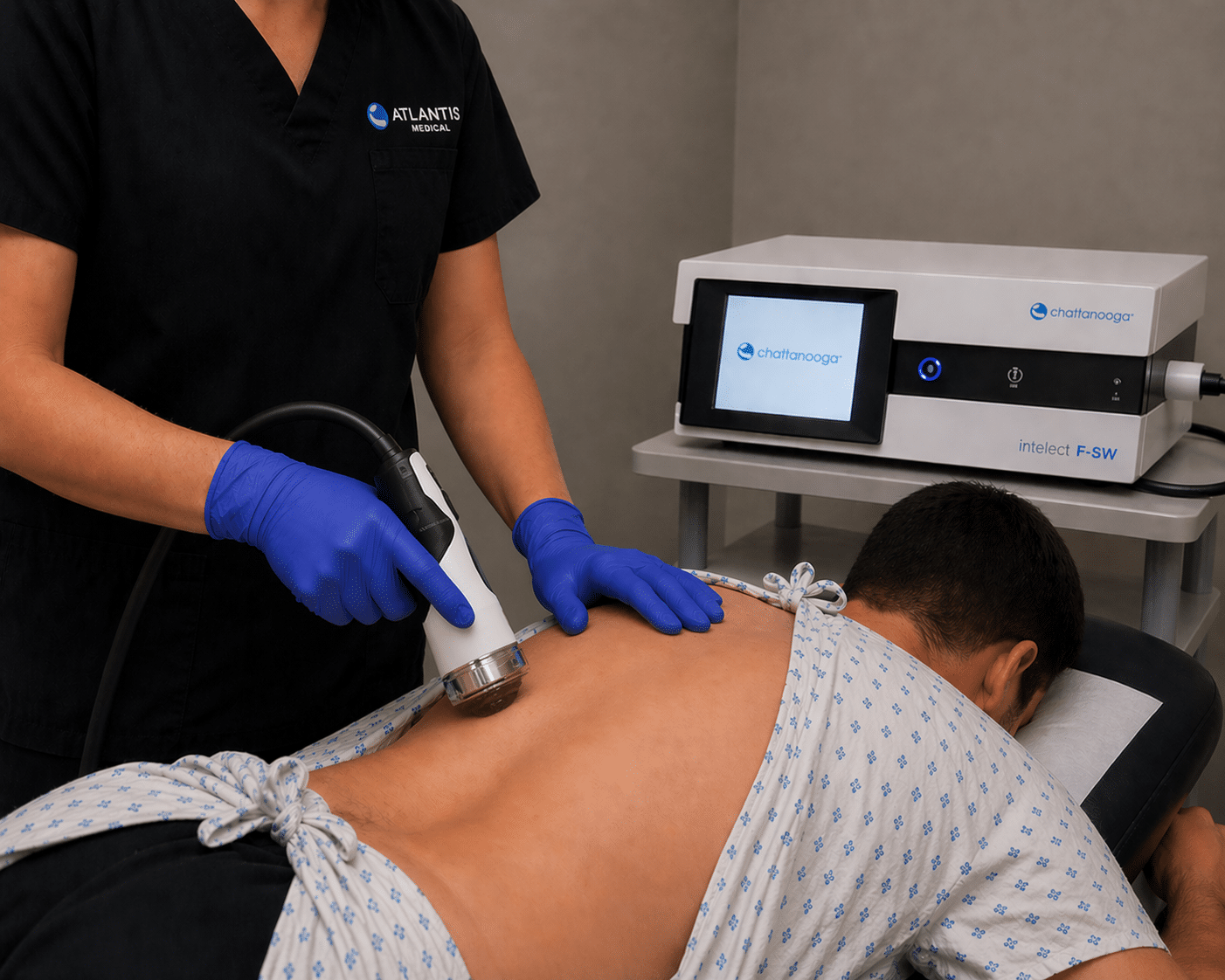
Imagine a beam of acoustic energy traveling through superficial tissue before converging within a selected focal zone. The greatest energy is concentrated near the intended treatment depth rather than dispersed primarily across the skin.
Focused shockwave systems produce rapid acoustic pressure pulses. Depending on the equipment and applicator, clinicians can adjust variables such as:
- Treatment depth
- Energy flux density
- Pulse frequency
- Number of impulses
- Location of the focal zone
This differs from radial pressure-wave therapy, which produces a more superficial, spreading pressure field. Both technologies may have clinical applications, but they deliver energy differently and should not be treated as interchangeable.
The energy used for musculoskeletal care is selected to stimulate rather than intentionally destroy tissue. Treatment intensity should reflect the diagnosis, tissue irritability, treatment target, and the patient’s response.
STAR Health is proud to use the Intelect® Focus Shockwave device as it boasts Greater Power & Depth for Better Treatment than its competitors.
In Extracorporeal Shock Wave Therapy (ESWT), a cylindrical wave is generated underwater inside the handpiece. This wave is focused through the reflector and transmitted into the tissue.
🟦 Clinical Insight: What the Tissue May “Hear”
Mechanical signals can be translated into cellular activity through a process called mechanotransduction. Laboratory and clinical research suggests extracorporeal shockwave exposure may influence local vascular signaling, growth-factor activity, inflammatory mediators, fibroblasts, tenocytes, and collagen remodeling.
In practical terms, focused shockwave may help change the environment around a chronically symptomatic tissue. It does not manufacture a new tendon or ligament during the appointment. Instead, it may create conditions in which the tissue becomes more capable of responding to subsequent rehabilitation.
That sequence matters:
- The painful structure and contributing load pattern are identified.
- Mechanical signaling is applied at a clinically selected dose.
- The tissue is given an appropriate recovery interval.
- Progressive loading teaches it to tolerate force again.
- Function and irritability are reassessed before treatment advances.
A biological signal without useful loading may accomplish little. Aggressive loading without sufficient capacity can aggravate the system. STAR Health therefore coordinates focused shockwave with physical rehabilitation and, when indicated, regenerative medicine.
Conditions that may be considered include chronic plantar fasciopathy, Achilles or patellar tendinopathy, certain elbow and shoulder tendon disorders, and selected ligament or fascial problems. Eligibility depends on the diagnosis—not simply the location of pain.


🟦 Evidence, Experience, and Appropriate Selection
Focused shockwave therapy is supported by a growing body of musculoskeletal research, but results vary by condition, protocol, device, and patient selection. The Cleveland Clinic overview of extracorporeal shockwave therapy provides a general clinical explanation of the technology and its uses.
A peer-reviewed review published in the Journal of Orthopaedic Surgery and Research describes proposed biological mechanisms and clinical applications in musculoskeletal disorders (Wang, 2012).
Evidence does not justify treating every painful tendon. It supports matching the technology to a defensible diagnosis, realistic expectations, and an appropriate rehabilitation plan.
Focused shockwave may not be suitable over certain tumors, active infections, developing growth plates, air-filled tissue, or areas where bleeding risk or other medical factors create concern. A physician-directed evaluation should identify relevant precautions.

"As Evidence Based Practitioners, clinicians will find it hard to ignore the efficacy of ESWT given the quantity and quality of the research evidence. Once incorporated into patient management for Plantar Fasciitis, clinicians will find the results even more compelling."
Cliff Eaton MSc PGc MSCP SRP
"The Chattanooga® Focus Shockwave treats deeper conditions with good results, such as plantar fasciitis*, rotator cuff pains, gluteal muscles/tendons and deep lying triggerpoints with fewer standoffs than other ESWT devices. The focal zone of 30mm ensures that the targeted area is treated with precision and accuracy making it easier to find the painful spots as well as implement in everyday clinical practice."
Jan Vinding, BSc physiotherapy, Exam OMI
🟦 From Stone Fragmentation to Connective-Tissue Signaling
Modern shockwave medicine developed from extracorporeal lithotripsy, which was introduced clinically to fragment kidney stones without open surgery. Physicians later observed biological effects in tissues exposed to lower-energy acoustic pulses.
During the late twentieth century, orthopedic research expanded into delayed bone healing, enthesopathies, and chronic tendon disorders. Technology evolved from broad mechanical exposure toward devices capable of controlling focal depth, energy, frequency, and treatment location.
This history reveals an important shift. Early medical shockwaves were used to break a physical target. Musculoskeletal protocols use carefully selected energy to influence a biological system.
The underlying principle is older than the equipment: connective tissue adapts to meaningful mechanical input. Focused shockwave therapy makes that input measurable and targetable, but rehabilitation remains responsible for translating the signal into functional capacity.
🟦 Local Care, Global Science
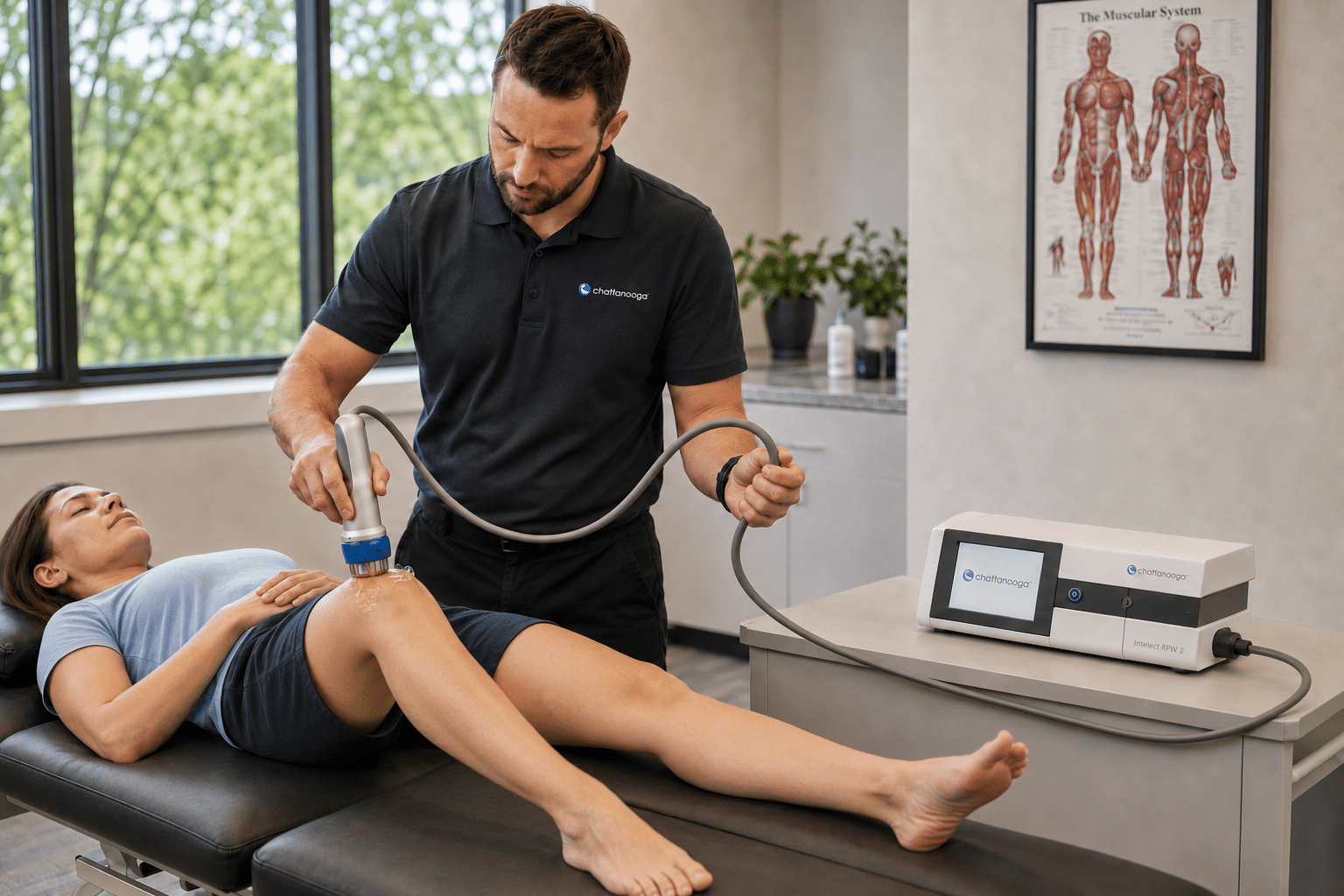
Patients throughout Fort Wayne and Northeast Indiana often arrive after months of heel, tendon, shoulder, knee, or elbow symptoms that return whenever activity increases.
STAR Health applies internationally studied shockwave principles within a local, physician-led model. Evaluation considers the painful structure, movement demands, prior treatment, imaging when relevant, and the gap between current capacity and desired activity.
The objective is not temporary analgesia at any cost. It is a clearer diagnosis and a coordinated path toward better tissue behavior.
Frequently Asked Questions
No. Focused systems concentrate acoustic energy at a selected depth and focal zone. Radial devices create pressure waves that spread from the applicator and are generally strongest near the surface. The appropriate technology depends on the target tissue and clinical objective.
Patients may feel tapping, pressure, or brief discomfort, particularly over an irritable structure. Treatment intensity can usually be adjusted. Sensation during the session does not determine whether treatment will be effective.
There is no universal treatment count. The plan depends on the diagnosis, symptom duration, tissue response, rehabilitation needs, and device protocol. Progress should be reassessed rather than assumed from a predetermined package.
Activity recommendations depend on tissue irritability and the demands of the sport or job. Some patients continue modified activity, while others need a temporary reduction in high-load movements. Return to activity should follow demonstrated capacity rather than pain relief alone.
Sometimes it may be considered before a more invasive intervention, but it is not an automatic substitute. Some conditions require medication, injection, surgery, or a different rehabilitation strategy. The diagnosis should determine the treatment sequence.
No. It may also be considered for selected Achilles, patellar, elbow, shoulder, ligament, and fascial disorders. Similar symptoms can arise from nerve, joint, bone, or referred-pain conditions, so candidacy requires evaluation.
Restore the Signal. Rebuild the Capacity.
Schedule an evaluation at STAR Health to determine whether focused shockwave therapy belongs in a physician-directed plan for restoring connective-tissue responsiveness, load tolerance, and function.