
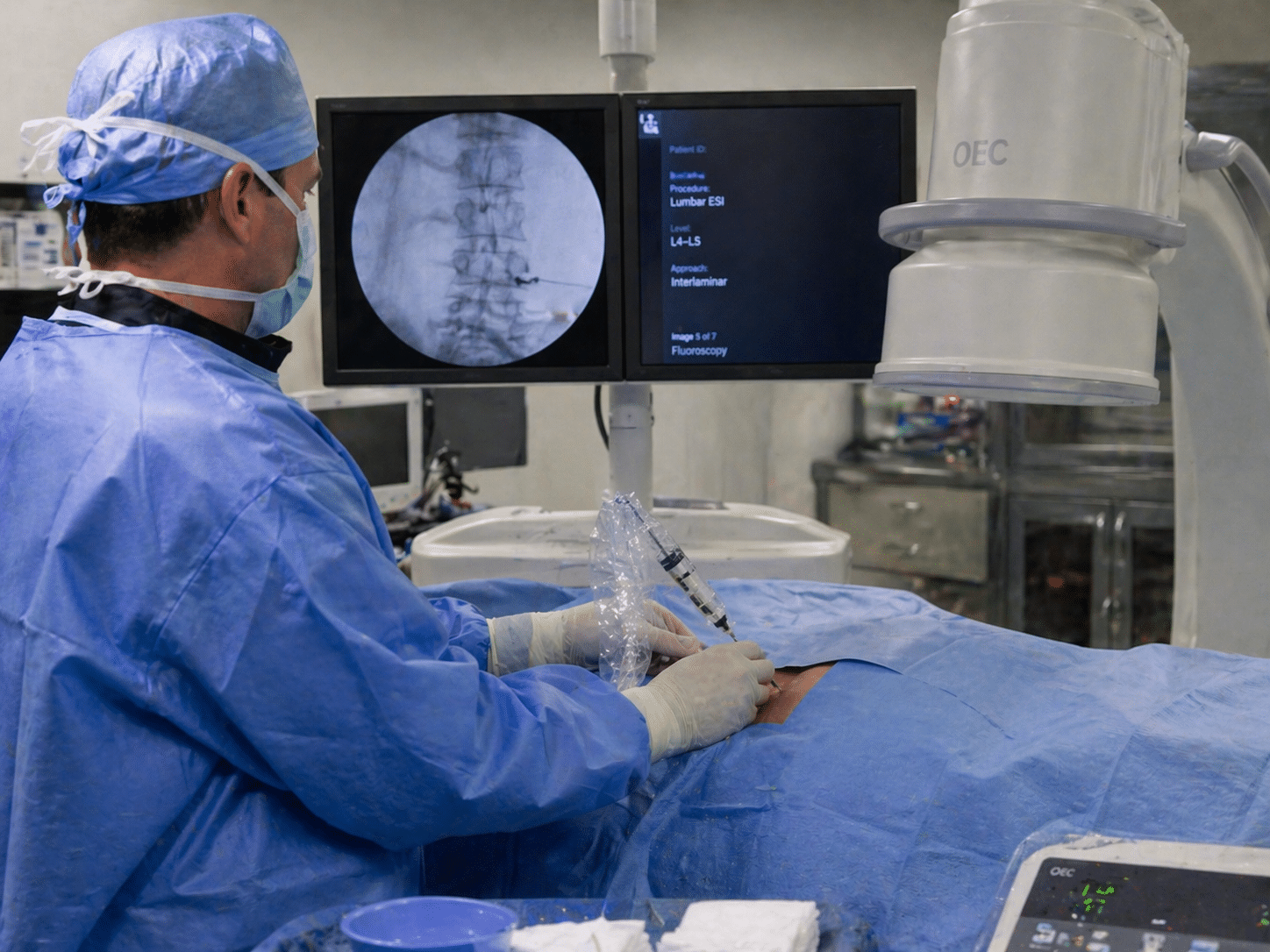
IMAGE-GUIDED INJECTIONS & INTERVENTIONAL PROCEDURES AT STAR HEALTH Fort Wayne, Indiana
Pain is not the diagnosis—it is the signal.
One of the most common misconceptions in musculoskeletal medicine is that pain automatically originates from the structure that appears most abnormal on an MRI or X-ray. In reality, many imaging findings—including disc bulges, arthritis, tendon degeneration, and meniscal tears—may exist without causing symptoms at all.
At STAR Health, image-guided injections are used as both diagnostic and therapeutic tools within a systems-based model of care, helping identify true pain generators before treatment progresses toward more invasive options. Every procedure is performed with a clear diagnostic purpose, integrating imaging, biomechanics, tissue biology, neural signaling, and functional movement rather than treating isolated symptoms.
Care is physician-led and guided by a philosophy of verification before intervention, emphasizing careful clinical reasoning over procedural escalation.
Care Leadership
- Dr. Joseph Fortin, DO
- Board-Certified Physical Medicine & Rehabilitation Physician
- Subspecialty Certified in Interventional Pain Management
- Physician-led diagnostic and image-guided care
- Precision-focused, systems-based clinical decision making
🟦 WHY STAR HEALTH IS DIFFERENT
Many practices ask one question:
"Where does it hurt?"
At STAR Health, the first question is different:
"Why does it hurt?"
That distinction changes everything.
Pain rarely develops because of a single structure. Instead, it emerges from interactions among tissue health, mechanical loading, nervous system signaling, movement efficiency, inflammation, and healing capacity. Treating one abnormal image without understanding the surrounding system may provide incomplete answers.
Our approach emphasizes:
- Diagnostic-first use of injections to verify true pain generators
- Navigation-controlled precision using fluoroscopy and ultrasound
- Whole-body assessment of biomechanics and load transfer
- Integration with rehabilitation and movement correction
- Conservative escalation based on objective findings—not routine protocols
This philosophy helps reduce:
- Treatment directed toward incidental MRI findings
- Procedures performed without diagnostic confirmation
- Cascading interventions that fail to address the underlying problem
- Unnecessary surgery based solely on structural imaging
Verification guides intervention. Intervention never replaces diagnosis.
🟦 THE SYSTEMS-BASED "PAIN DETECTIVE" FRAMEWORK
Pain behaves like a message traveling through an integrated biological system.
Structural findings alone rarely tell the entire story.
For example, research has demonstrated that many individuals without pain have:
- Rotator cuff tears
- Degenerative meniscal tears
- Lumbar disc bulges
- Facet joint arthritis
- Tendon degeneration
Meanwhile, someone with relatively mild imaging findings may experience significant pain because mechanical loading, nervous system sensitization, tissue inflammation, and movement dysfunction interact to amplify symptoms.
STAR Health evaluates pain through multiple interconnected systems:
- Neural signaling
- Mechanical loading
- Force transfer
- Movement efficiency
- Tissue healing capacity
- Inflammatory biology
Rather than chasing abnormalities on imaging, diagnostic injections function as clinical hypothesis tests, helping determine whether a suspected structure is truly responsible for symptoms.
🟦 IMAGE-GUIDED INJECTIONS — CONDITIONS WE EVALUATE & TREAT
Image-guided injections may be used for diagnostic clarification, symptom management, or both, depending on the clinical situation.
- Migraine
- Occipital neuralgia
- Trigeminal nerve pain
- Temporomandibular (TMJ) disorders
- Facial pain syndromes
- Cervical disc-related pain
- Facet joint pain
- Cervical radiculopathy
- Nerve irritation
- Whiplash-related conditions
- Rotator cuff disorders
- Arthritis
- Tendinopathy
- Bursitis
- Peripheral nerve entrapment
- Joint instability
- Intercostal neuralgia
- Abdominal wall pain
- Peripheral nerve disorders
- Lumbar disc pain
- Radiculopathy
- Facet-mediated pain
- Sacroiliac joint pain
- Post-surgical spine pain
- Hip osteoarthritis
- SI joint dysfunction
- Tendon disorders
- Gluteal tendinopathy
- Pelvic nerve entrapment
- Bursitis
- Muscle injuries
- Osteoarthritis
- Meniscal pathology
- Persistent pain following joint replacement
- Tendon disorders
- Ligament-related pain
- Achilles tendon disorders
- Plantar fascia disorders
- Peripheral nerve entrapment
- Post-surgical pain
- Tendon injuries

Symptoms identify where pain is felt. Diagnostic injections help determine where the signal originates.
Suggested Internal Links
- Where Does It Hurt?
- Pain Management
- Rehabilitation

🟦 ADVANCED DIAGNOSTICS & PRECISION NAVIGATION
Every image-guided procedure is designed around one principle:
Accuracy improves diagnostic confidence.
Depending on the anatomy being evaluated, STAR Health utilizes:
- Fluoroscopy
- Ultrasound
- MRI review
- CT review
- Digital X-ray review
This comprehensive approach helps support:
- Precise target localization
- Improved procedural accuracy
- Reduced exposure to surrounding tissues
- Greater diagnostic confidence before treatment decisions
Precision supports restraint—not excess intervention.
Schedule Now!
If you seek relief from pain without relying on addictive medications or invasive surgeries, you may be a suitable candidate for the expert interventional pain management services at STAR Health.
🟦 INTEGRATED INTERVENTIONAL OPTIONS
| Intervention | Purpose Within the System |
|---|---|
| Diagnostic Blocks | Reduce inflammation while supporting rehabilitation |
| Radiofrequency Ablation | Address confirmed pain pathways after appropriate evaluation |
| PRP & Orthobiologic Procedures | Support tissue biology when clinically appropriate |
| Bioscaffolding Strategies | Complement regenerative treatment plans in selected patients |
| Photobiomodulation | Support cellular recovery and healing responses |
| Shockwave Therapy | Promote tissue remodeling in selected conditions |
| Rehabilitation Integration | Restore efficient movement and load-sharing after intervention |
Treatment evolves according to the patient's response—not a predetermined protocol.
🟦 AUTHORITY & CLINICAL EXPERTISE
Dr. Joseph Fortin, DO practices at the intersection of osteopathic medicine, Physical Medicine & Rehabilitation, interventional pain management, regenerative medicine, sports medicine, integrative medicine, and advanced diagnostic imaging.
His background includes:
- Board Certification in Physical Medicine & Rehabilitation
- Subspecialty Certification in Interventional Pain Management
- Board Certification in Electrodiagnostic Medicine
- Certification in Clinical Densitometry
- Advanced education in regenerative medicine including PRP, orthobiologics, and bioscaffolding
- Extensive experience integrating biomechanics, imaging, tissue biology, and neural signaling into clinical decision-making
- Editor of a sports medicine textbook
- Author of peer-reviewed medical literature
- Patent holder for a biomechanically focused surgical table design
- National and international lecturer on biomechanics, MRI and CT imaging physics, interventional pain management, regenerative medicine, and human movement
This multidisciplinary perspective supports system-level diagnosis while reducing the risk of misdirected treatment.

Did You Know?
Large imaging studies have shown that many structural abnormalities—including disc bulges, rotator cuff tears, tendon degeneration, and meniscal tears—are frequently found in people who have no pain whatsoever.
🟦 LOCAL CARE, GLOBAL SCIENCE
Patients throughout Fort Wayne and Northeast Indiana frequently search for:
- Image-guided injections
- Ultrasound-guided injections near me
- Interventional pain specialist Fort Wayne
- Diagnostic nerve block
- How to avoid unnecessary spine surgery
At STAR Health, advances in interventional pain medicine are applied through careful physician judgment, using technology to improve diagnostic accuracy—not replace clinical reasoning.
🟦 WHAT PATIENTS CAN EXPECT
Your evaluation is designed to answer questions before recommending procedures.
Patients can expect:
- Time-rich physician evaluation
- Comprehensive review of prior imaging
- Clear explanation of diagnostic reasoning
- Conservative escalation strategy
- Image-guided precision when procedures are indicated
- Integration with rehabilitation and movement correction
- Reassessment based on clinical response rather than routine scheduling
🟦 FREQUENTLY ASKED QUESTIONS
No. Many injections are performed to determine whether a specific structure is actually generating symptoms before further treatment is recommended.
Yes. STAR Health performs procedures using fluoroscopy or ultrasound to improve procedural accuracy and diagnostic confidence.
No. Injections may support rehabilitation by reducing barriers to movement, but long-term recovery frequently depends upon restoring function and optimizing biomechanics.
In some cases, diagnostic clarification may help determine whether surgery is likely to address the patient's symptoms or whether other treatment approaches should be considered first.
Treatment decisions are reassessed over time and are guided by diagnosis, response to care, and evolving clinical findings.
For joint conditions or soft-tissue injuries, Dr. Fortin offers an injection to ease pain, inflammation, and swelling. These injections are typically done under ultrasound guidance.
Using the latest technology in regenerative medicine, Dr. Fortin offers innovative injections, including stem cell therapy and platelet-rich plasma (PRP) therapy. These injections may be recommended to support healing and provide long-term pain relief.
🟦 HISTORICAL PERSPECTIVE
Long before modern fluoroscopy and ultrasound transformed procedural accuracy, physicians recognized that effective treatment depended upon correctly identifying the source of pain.
Sir Charles Sherrington's work in neurophysiology demonstrated that pain reflects complex neural signaling rather than tissue injury alone. Earlier medical traditions likewise emphasized observing function and therapeutic response rather than relying solely on structural appearance.
Modern image-guided injections continue this tradition by combining advanced imaging technology with careful diagnostic reasoning to confirm—not assume—the source of symptoms.