
Integrative Medicine at STAR Health
Understanding Why the System Is Strained — Not Just Where Symptoms Appear
Chronic symptoms rarely originate from a single malfunction.
Persistent fatigue, widespread pain, poor recovery, chronic inflammation, metabolic dysfunction, and cognitive decline often develop when multiple physiologic systems gradually lose their ability to regulate one another. The symptom a patient notices is rarely the beginning of the story—it is usually where the body's adaptive capacity has finally been exceeded.
At STAR Health, integrative medicine is practiced as a physician-led diagnostic discipline, not as a collection of supplements, wellness trends, or symptom-management protocols. Every evaluation begins by asking why the body's regulatory systems have become strained before determining how they should be supported.
Rather than replacing conventional medicine, integrative medicine is used to strengthen it through systems thinking, careful clinical investigation, and evidence-informed decision making.
Mission Alignment
Consistent with STAR Health's mission to end pain and human suffering through compassionate, research-driven, innovative care, integrative medicine seeks to identify the mechanisms underlying physiologic dysregulation rather than simply suppressing symptoms.
Credibility Snapshot
- Physician-led evaluations
- Extended diagnostic appointments
- Systems-based clinical reasoning
- Evidence-guided, conservative care
- Integration with conventional medical evaluation

🟦 Why STAR Health Integrative Medicine Is Different
Many integrative practices begin by asking:
"What treatment should we add?"
STAR Health begins with a different question:
"Why has the body's regulatory system lost efficiency?"
Symptoms such as:
- chronic fatigue
- persistent inflammation
- brain fog
- poor sleep
- chronic pain
- slow healing
- stress intolerance
often represent disturbances across several interacting systems rather than isolated diseases.
These may involve:
- nervous system regulation
- metabolic efficiency
- immune signaling
- hormonal communication
- mitochondrial energy production
- recovery physiology
Treating symptoms without understanding these relationships risks masking important biologic signals.
🟦 A Systems View of Human Health
The human body behaves more like an interconnected engineering network than a collection of independent organs.
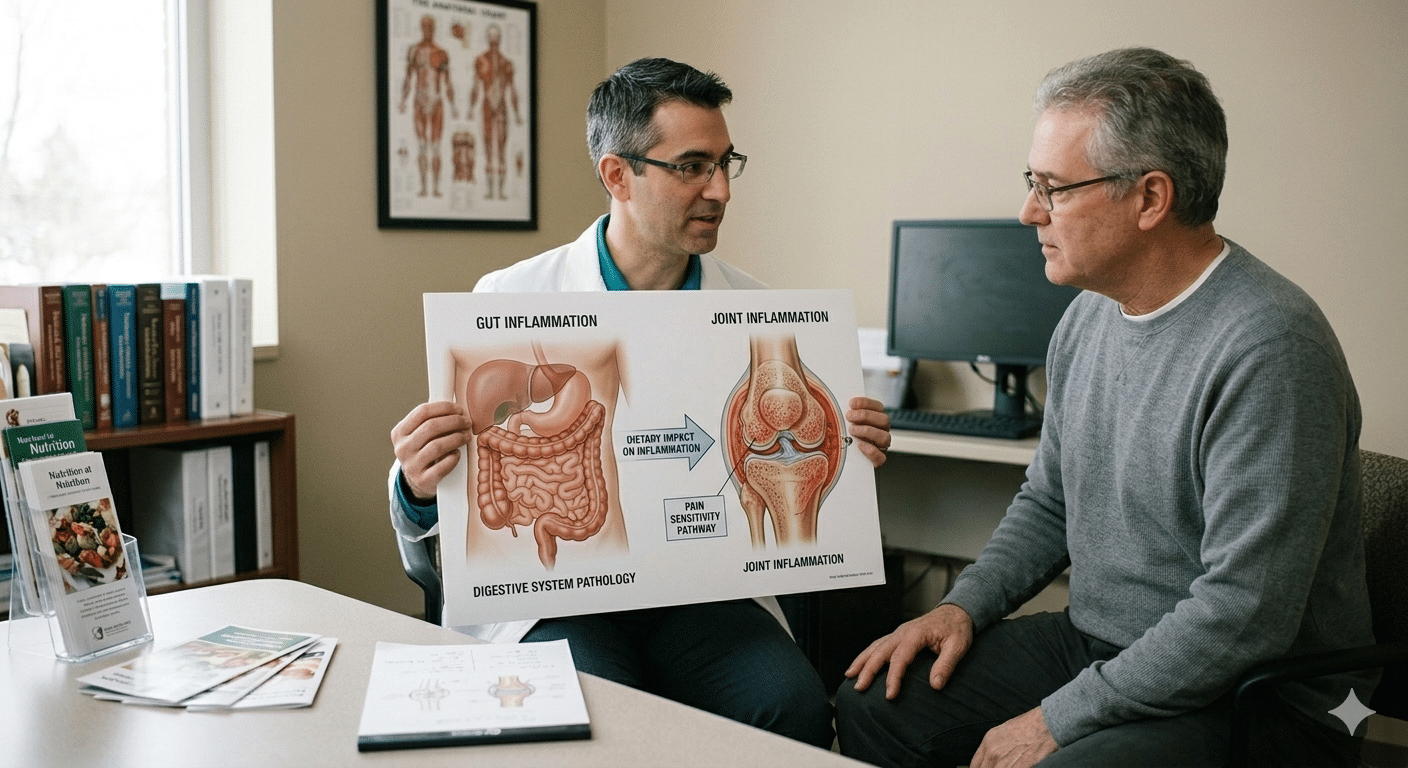
Every system constantly exchanges information. The nervous system influences immunity. Inflammation alters metabolism. Sleep affects hormone regulation. Stress changes pain perception. Energy production determines tissue recovery.
When communication between these systems becomes inefficient, compensation develops long before disease is recognized.
Symptoms are often the visible consequence of hidden regulatory strain.
Integrative medicine investigates these relationships rather than viewing each symptom independently.

🟦 The "Pain Detective" Approach Applied To Integrative Medicine
The investigative discipline used throughout STAR Health also guides integrative medicine.
Rather than asking only where symptoms exist, the evaluation asks:
- Which physiologic system is under excessive load?
- Which adaptations remain helpful?
- Which have become maladaptive?
- Which signals represent causes versus compensation?
The clinical methodology remains consistent:
Observe → Develop hypotheses → Verify with appropriate testing → Intervene conservatively → Reassess response
Scientific rigor does not change simply because the system under investigation changes.
🟦 From Structural Failure To Regulatory Failure
In interventional pain medicine, investigation often focuses on:
- mechanical loading
- nerve behavior
- tissue pathology
- imaging interpretation
- diagnostic procedures
In integrative medicine, evaluation focuses on:
- autonomic regulation
- inflammatory balance
- metabolic efficiency
- endocrine coordination
- recovery capacity
- sleep physiology
Although the scale differs, the diagnostic philosophy remains identical.
The goal is always to identify the primary driver rather than reacting to the loudest symptom.

🟦 Conditions Commonly Evaluated
Integrative medicine evaluations commonly include patients experiencing:
- Chronic fatigue
- Persistent inflammation
- Pain amplification syndromes
- Sleep disruption
- Brain fog
- Stress-related symptom escalation
- Recovery difficulties
- Metabolic inefficiency
- Persistent musculoskeletal pain
- Reduced resilience after illness or injury
These represent clinical signals, not necessarily final diagnoses.
🟦 Why Regulation Matters
Healthy systems continually adapt.
When adaptive capacity declines, seemingly unrelated symptoms often appear together.
Examples include:
- fatigue despite adequate sleep
- chronic pain without progressive structural injury
- persistent inflammation
- slow exercise recovery
- recurrent illness
- stress intolerance
- impaired concentration
These patterns frequently reflect declining physiologic resilience rather than isolated organ dysfunction.
The objective is to understand why regulation has become inefficient before selecting interventions.
🟦 Clinical Expertise
Dr. Joseph Fortin, DO, combines board-certified expertise in Physical Medicine & Rehabilitation with subspecialty certification in Interventional Pain Management and extensive experience in regenerative medicine, sports medicine, and integrative medicine.
This multidisciplinary perspective allows structural pathology, biomechanics, imaging, tissue biology, and physiologic regulation to be interpreted together—helping reduce unnecessary treatment while improving diagnostic precision.
🟦 Precision Diagnostic Evaluation
Verification always precedes intervention.
Evaluation may include:
- comprehensive medical history
- medication review
- laboratory interpretation within physiologic context
- inflammatory assessment
- metabolic evaluation
- hormonal review when clinically appropriate
- sleep and recovery assessment
- nutrition review
- movement and lifestyle analysis
Testing is selected to answer clinical questions—not simply to generate additional data.
🟦 Advanced Diagnostics / Precision Evaluation
Verification precedes intervention.
Integrative medicine diagnostics may include:
- Comprehensive medical and functional history
- Review of prior labs and imaging in systems context
- Selective metabolic, hormonal, or inflammatory testing
- Sleep, stress, and recovery pattern analysis
- Correlation of symptoms with load and life demands
Testing is used to clarify mechanism, not to chase abnormalities.
🟦 Integrated Healing Options
Strategy
Lifestyle & Recovery Optimization
Targeted Nutritional Strategies
Stress & Nervous System Modulation
Sleep Optimization
Medical Integration
Why It Matters
Restores baseline regulatory capacity
Supports metabolic & inflammatory balance
Reduces amplification & improves adaptability
Repairs signaling, immunity, & recovery
Ensures alignment with diagnostics & treatment plans

🟦 Local Care, Global Science
Patients throughout Fort Wayne and Northeast Indiana increasingly seek answers for persistent symptoms that conventional testing alone may not fully explain.
STAR Health combines physician-led clinical evaluation with principles from systems biology, rehabilitation medicine, pain science, and integrative medicine to investigate why symptoms persist—and how physiologic regulation can be better supported.
🟦 Historical Perspective
Modern integrative medicine has evolved from decades of research demonstrating that chronic disease often reflects interactions among multiple biologic systems rather than isolated organ dysfunction. Contemporary systems biology continues to reinforce the importance of evaluating regulation, resilience, and adaptation alongside traditional medical diagnosis.
🟦 Did You Know?
Did you know?
Research shows that chronic stress and sleep disruption can amplify pain perception and inflammation—independent of structural injury.
🟦 Frequently Asked Questions
Is integrative medicine the same as functional medicine?
Not necessarily. At STAR Health, integrative medicine is physician-led, evidence-informed, and integrated with conventional medical care.
Will supplements be recommended?
Only when clinically appropriate. Supplements are never assumed to be the starting point.
Can integrative medicine replace my primary physician?
No. Care is designed to complement existing medical management.
Is this only for chronic illness?
No. It may also benefit individuals experiencing impaired recovery, persistent inflammation, or declining resilience.
Is your approach evidence-based?
Yes. Clinical recommendations are selected conservatively and interpreted within the context of established medical evaluation.
🟦 Ready to find out more?
Persistent symptoms deserve thoughtful investigation—not assumptions.
If fatigue, inflammation, chronic pain, poor recovery, or other unexplained symptoms continue to interfere with your health, a physician-led systems evaluation may help identify why regulation has become strained.
STAR Health – Fort Wayne, Indiana
Time-rich diagnostic evaluations focused on understanding the entire system before recommending treatment.