
Laser Therapy in Fort Wayne: Photobiomodulation for Pain and Recovery When the Tissue Looks Stable—but the Pain Has Not Left
The scan may look stable. The injury may no longer appear acute. Yet the same tendon, joint, or muscle still hurts when movement resumes.
That gap creates the real clinical question: Is the remaining problem structural, biological, mechanical—or a combination of all three?
At STAR Health, laser therapy in Fort Wayne is delivered as physician-directed photobiomodulation, or PBM. It may support pain reduction, inflammatory balance, and tissue recovery when altered cellular behavior or pain signaling appears to be limiting progress.
Persistent pain makes the next step look simple: treat the painful spot. But the painful spot may be the messenger, not the whole problem. Laser therapy becomes useful only after the team understands what the tissue is signaling and why.
Laser therapy is not a diagnosis, a repair procedure, or a promise of healing. It is one possible part of a larger care plan designed around what is driving the patient’s symptoms.
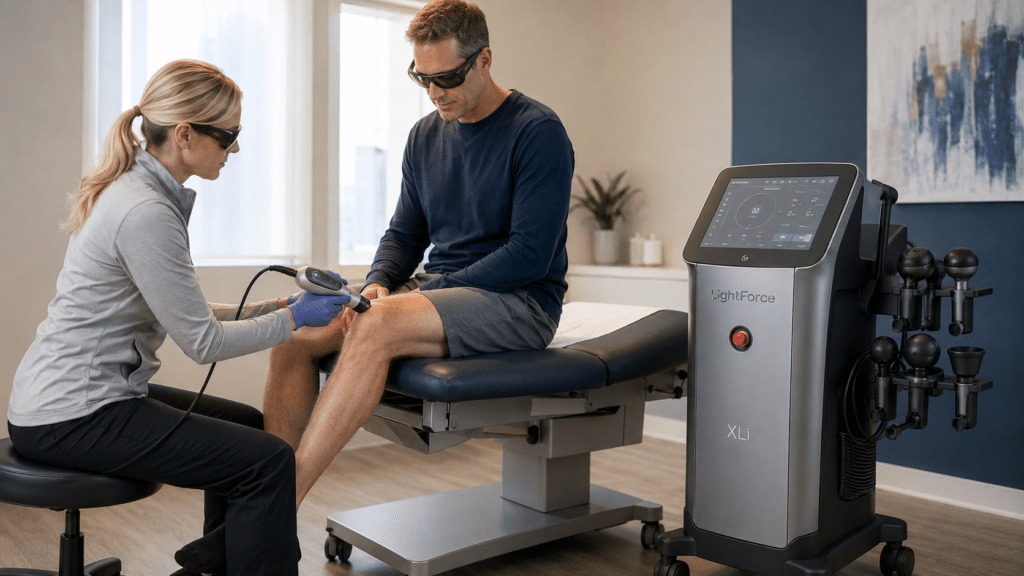
🟦 How Laser Therapy Fits the Three Systems Behind Persistent Pain
Pain often persists because three systems are interacting:
- Structure: the condition of a tendon, ligament, muscle, joint, nerve, or bone
- Signaling: cellular communication, inflammatory activity, and the nervous system’s sensitivity to threat
- Load: the amount, direction, frequency, and timing of force placed on the region
These systems rarely operate alone. A tendon may be structurally intact but biologically irritable. Guarding may reduce movement, which lowers capacity until ordinary load feels excessive. Laser therapy can address part of the signaling environment, but not the entire chain.
Photobiomodulation primarily enters this story through signaling. Specific wavelengths reach exposed skin over a selected target and may influence mitochondrial activity, local circulation, and inflammatory or neural pathways. The FDA describes photobiomodulation as nonheating light intended to alter biological activity and notes that effects depend on parameters such as wavelength, irradiance, fluence, pulsing, and spot size in its draft guidance for photobiomodulation devices.
That is why two patients with the same diagnosis may receive different photobiomodulation settings—or a different recommendation. Tissue depth, sensitivity, chronicity, and the surrounding plan shape the intended dose.
That dose dependence matters. The right treatment cannot be separated from the right target. Laser does not realign a joint, remove a mechanical obstruction, repair a complete tear, or make excessive training load disappear.
🟦 When Laser Therapy Fits the Clinical Decision
Imagine a runner with Achilles pain. Ultrasound shows tendon continuity, but examination reveals thickening, tenderness, reduced calf capacity, and a recent spike in hill training. The structure is present. Signaling is irritable. Load has exceeded capacity.
Rest may reduce symptoms without rebuilding tolerance. Aggressive exercise may keep provoking the area. Laser therapy may support the biological environment while rehabilitation restores strength and load capacity.
The response is then tested against function. Is morning stiffness changing? Can the runner tolerate progressive loading? Is calf capacity improving? Laser therapy remains only if it contributes to measurable progress.
Now change the diagnosis to a significant tear, nerve entrapment, or referred pain. The device has not changed—but its clinical role has. Diagnosis changes the plan.
🟦 Clinical Insight: What Laser Therapy Can—and Cannot—Change
A quieter pain signal may make movement, sleep, or therapy more comfortable. It does not automatically mean tissue capacity has returned.
Laser therapy can support recovery conditions; it does not complete recovery by itself. The plan may still need to address strength, mobility, work demands, training errors, metabolic health, or structural pathology.
This guards against using symptom relief as permission to resume the same load that triggered the problem. Laser therapy may widen the rehabilitation window, but capacity must still be rebuilt in stages.
Photobiomodulation may support selected tendon, muscle, ligament, joint, nerve-related, swelling, or post-procedure pain patterns. Suitability depends on the diagnosis—not the symptom name alone.
Care may also include pain management or regenerative medicine. Each option should answer a specific evaluation finding.
🟦 How STAR Health Evaluates Laser Therapy
STAR Health does not begin with a preset laser package. A physician-directed assessment may include:
- symptom mapping and treatment history
- musculoskeletal and orthopedic examination
- mechanical testing and movement analysis
- review of prior imaging
- diagnostic ultrasound when it can clarify tissue integrity or structural context
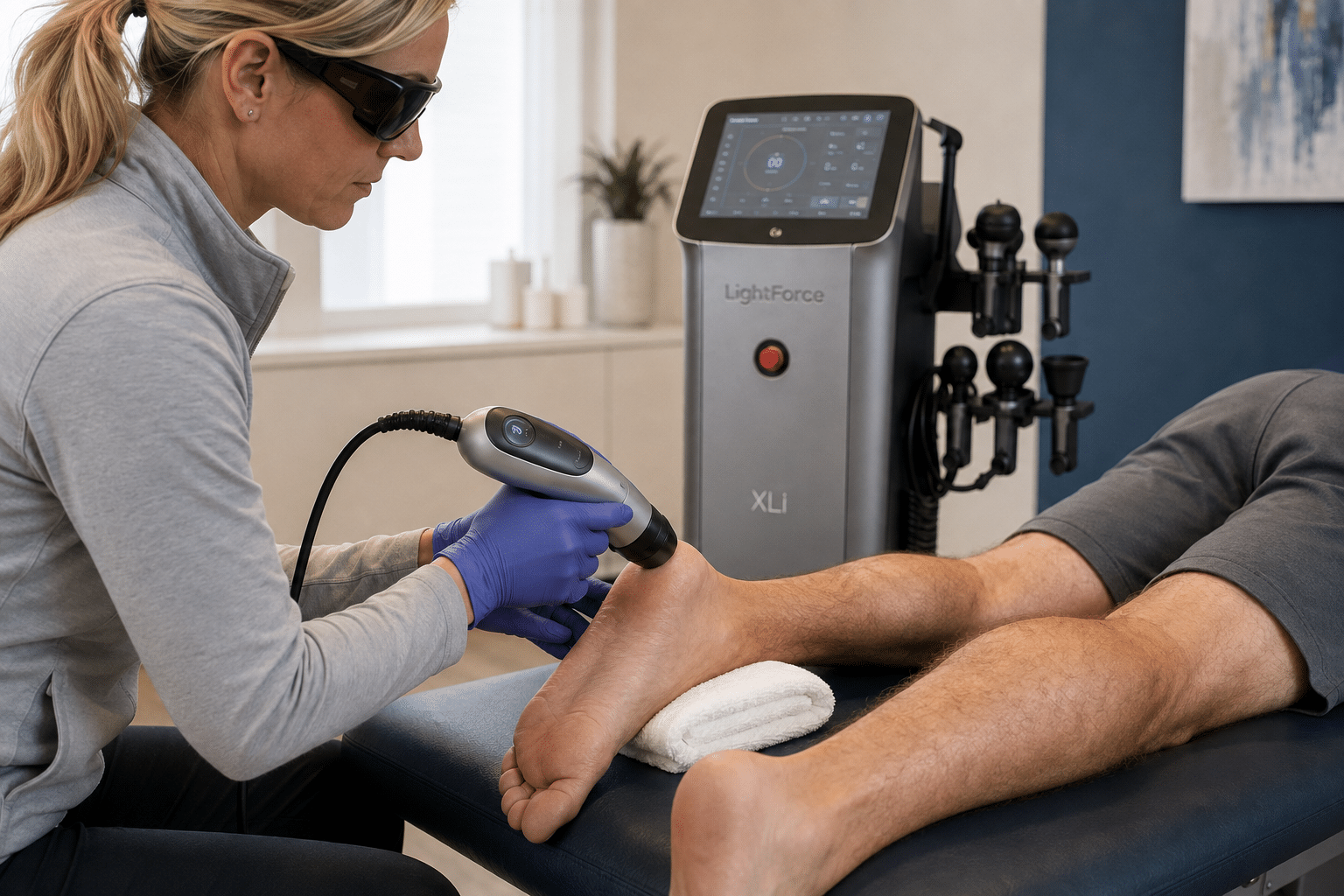
Findings determine whether laser belongs in the plan, where it should be applied, and what else is necessary. STAR Health uses the FDA-cleared LightForce XLi Deep Tissue Therapy Laser in physician-directed care; clearance applies to the device and labeled use, not to a guaranteed result.
Reassessment continues after treatment begins. Changes in pain, motion, tenderness, strength, and activity tolerance help determine whether laser therapy should continue, be adjusted, or leave the plan.
Evidence varies by condition and protocol. A 2024 systematic review and meta-analysis of injured athletes found a positive pain effect across six randomized trials, while limited evidence did not show faster return to play. Pain response matters; function and safe load tolerance remain essential.
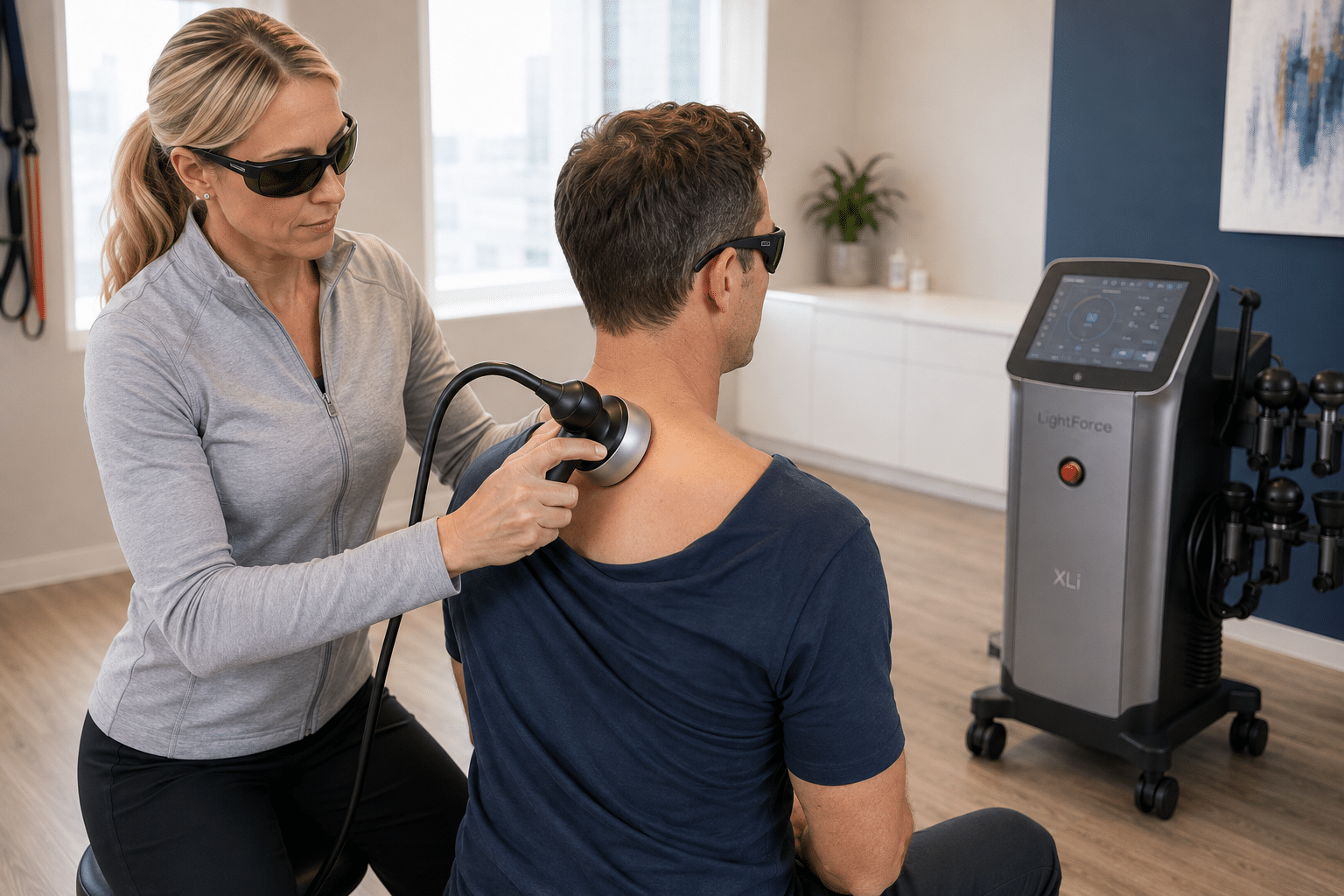
🟦 What a Laser Therapy Session Involves
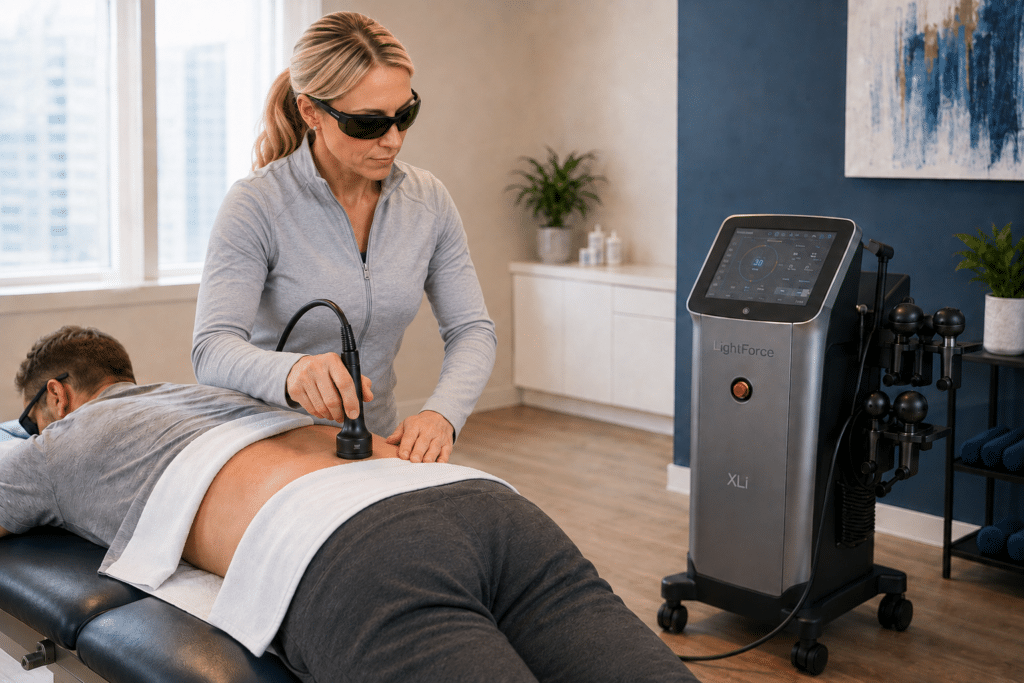
The treatment area is exposed because clothing can interfere with light delivery. Protective eyewear is used. Patients may notice gentle warmth or little sensation.
Sessions commonly last 15 minutes, depending on the region, depth, diagnosis, and dose. There are no needles, injected medications, or procedural downtime.
Frequency follows diagnosis and response—not a preset package. Change may appear after several visits, develop gradually, or not occur meaningfully. Chronic conditions may require repeated sessions with rehabilitation and activity modification. No timeline or outcome is guaranteed.
🟦 Author and Medical Review
Joseph Fortin, DO
Medical Director, STAR Health
Dr. Fortin is an interventional pain management specialist whose fields include physical medicine and rehabilitation, musculoskeletal medicine, sports medicine, diagnostic imaging, and regenerative medicine. This page reflects STAR Health’s diagnostic-first model: identify the pain generator, define the interacting factors, then select treatment.
🟦 Did You Know?
- More light is not automatically better. Photobiomodulation responses depend on wavelength, power, dose, timing, target, and tissue characteristics.
- “Cold laser” and “therapeutic laser” are broad labels. What matters is whether the device parameters and delivery match the diagnosis.
- A change in pain can be meaningful without proving that a structure has healed. Function must be reassessed.
🟦 From Early Laser Therapy to Modern Photobiomodulation
Modern photobiomodulation traces its roots to the late 1960s, when Hungarian physician Endre Mester, MD, reported unexpected biological effects from low-level laser exposure. His observations opened a field focused on how controlled light might influence cellular behavior.
Research followed across Europe, Asia, and North America as investigators examined wavelength, dose, pulsing, tissue penetration, and indication. History explains the curiosity; modern dosing and diagnosis determine the relevance.
🟦 Laser Therapy in Fort Wayne: Local Care, Global Science
Research can identify patterns across populations. A clinical evaluation must decide whether those patterns apply to one person, one tissue, and one moment in recovery.
STAR Health brings that global evidence into a local, physician-directed setting. For patients considering laser therapy in Fort Wayne, the objective is not to chase a technology. It is to determine whether photobiomodulation fits the structure, signaling state, and load demands revealed by the examination.
Global research informs the options; local examination determines whether laser therapy earns a role.
Technology is most useful when clinical reasoning gives it a precise job.
🟦 Frequently Asked Questions
What is laser therapy used for in pain care?
Photobiomodulation may support selected tendon, muscle, ligament, joint, nerve-related, or post-injury pain patterns. Diagnosis and contributing systems—not location alone—determine candidacy.
Does laser therapy reduce inflammation?
Photobiomodulation may influence inflammatory signaling in some tissues. It does not eliminate every source of inflammation, correct unstable anatomy, or replace care for infection or major trauma.
What is the difference between cold laser and higher-intensity laser therapy?
Those terms often describe output, not the complete treatment. Wavelength, power, energy density, pulsing, target depth, and time shape the dose. Parameters must match the device’s intended use and clinical plan.
How many laser therapy sessions will I need?
There is no universal count. Frequency depends on diagnosis, chronicity, target tissue, response, and integration with rehabilitation. Progress is reassessed rather than assumed.
Is medical laser therapy safe?
Photobiomodulation is non-invasive, but safe use requires screening, correct dosing, eye protection, and attention to device precautions. Medical history, skin sensation, treatment location, and pregnancy status should be reviewed.
Is laser therapy an alternative to injections or surgery?
Not automatically. Laser, injections, rehabilitation, regenerative care, and surgery address different problems. Photobiomodulation does not override a need for surgical evaluation. The comparison begins with diagnosis.
🟦 Find Out Whether Laser Therapy Fits Your Care Plan
Persistent pain deserves more than a preset protocol. Schedule a physician-directed evaluation at STAR Health to determine whether laser therapy is appropriate for your diagnosis, tissue status, and recovery goals.