
Sports Medicine in Fort Wayne Engineering Durable Human Performance — Not Just Treating Injuries
Athletic injuries are often described as accidents.
A misstep. A collision. An unfortunate moment during competition.
Yet when injuries are examined closely, a different story frequently emerges.
Pain develops where stress accumulates, but the origin of that stress often begins elsewhere.
At STAR Health, sports medicine is practiced as a diagnostic and scientific discipline rooted in biomechanics, movement science, neuromuscular control, tissue adaptation, and systems-based medicine. Rather than focusing solely on the injured structure, evaluation begins by understanding the mechanisms that allowed stress to concentrate in the first place.
Athletic injuries are rarely accidents. They are signals.
Whether the issue involves recurring tendon pain, chronic instability, persistent tightness, overuse symptoms, or difficulty returning to sport after surgery, physician-led evaluation is designed to uncover the deeper contributors that influence performance, recovery, and long-term durability.
Consistent with STAR Health’s mission to end pain and human suffering through compassionate, research-driven, innovative care, sports medicine is approached as an investigation into why breakdown occurred—so it is less likely to happen again.
🟦 Why Sports Medicine at STAR Health is Different
Most sports medicine begins with a simple question:
While important, that question often addresses the location of symptoms rather than the source of stress.
STAR Health begins with a different question:
“Why did stress accumulate here?”
Athletic injuries commonly emerge from system-level contributors, including:
• Repetitive load mismanagement
• Subtle biomechanical inefficiencies
• Neuromuscular timing errors
• Asymmetric force transfer
• Inadequate recovery relative to training demands
• Compensatory movement patterns
When these contributors remain unaddressed, symptoms may improve temporarily while underlying stress patterns persist.
A physician-led evaluation allows reconstruction of injury mechanisms, training history, recovery cycles, movement habits, and tissue behavior to understand the complete picture.
The objective is not simply to reduce symptoms.
The objective is to understand the system producing them.
🟦 The Systems-Based “Pain Detective” Approach
Athletes are often told to push through discomfort.
Yet pain itself is rarely the most important finding.
Pain is information.
In a systems-based model, discomfort may reflect interactions between:
• Movement mechanics
• Load distribution
• Tissue capacity
• Neuromuscular coordination
• Recovery physiology
• Training volume
• Energy transfer efficiency
Modern imaging can reveal where tissue stress has accumulated. However, imaging alone rarely explains why that stress developed.
A tendon may appear irritated.
A disc may appear abnormal.
A joint may show degeneration.
None of those findings automatically identify the true driver.
At STAR Health, imaging findings are integrated with movement analysis, functional testing, orthopedic examination, and clinical history to identify the underlying contributors influencing performance and recovery.
This investigative process closely resembles engineering failure analysis.
Systems rarely fail where the problem begins—they fail where stress concentrates.
Understanding that distinction often changes the direction of care.
🟦 Conditions Commonly Evaluated in Sports Medicine
Sports medicine at STAR Health commonly evaluates:
• Achilles tendon injuries
• Patellar tendon disorders
• Rotator cuff conditions
• Muscle strains and chronic tightness
• Ligament sprains
• Joint instability
• Overuse injuries
• Repetitive stress syndromes
• Stress reactions
• Load-related pain conditions
• Disc herniations
• Sports-related spinal conditions
• Stingers and burners
• Peripheral nerve irritation
• Post-surgical return-to-play challenges
• Performance-limiting movement dysfunction
If movement is part of your life, it deserves precision evaluation.
🟦 Sports Injuries Are System Failures—Not Isolated Accidents
Sports medicine at STAR Health addresses injury, performance limitation, and recovery across every region of the body.
From youth athletes developing movement patterns to aging competitors seeking longevity, evaluation focuses on the interaction between biomechanics, tissue capacity, and performance demands.
Regions Commonly Involved
Head & Neck
• Concussion sequelae
• Cervical load transfer dysfunction
• Neuromuscular control challenges
Shoulder & Elbow
• Throwing injuries
• Instability
• Force transfer inefficiencies
Spine
• Rotational overload
• Extension intolerance
• Repetitive stress accumulation
Hip & Pelvis
• Femoroacetabular impingement
• Gait asymmetry
• Load transfer dysfunction
Knee
• Ligament injury
• Patellofemoral pain
• Movement coordination deficits
Ankle & Foot
• Tendon disorders
• Propulsion inefficiency
• Recurrent instability
Evaluation focuses on biomechanics, load storage, and energy transfer efficiency throughout the kinetic chain.
🟦 Advanced Diagnostics and Precision Evaluation
Effective treatment begins with verification.
Verification precedes intervention.
Sports medicine diagnostics may include:
• Detailed orthopedic examination
• Neurologic evaluation
• Video-based gait analysis
• Movement assessment
• Force-transfer analysis
• Sport-specific demand modeling
• MRI interpretation within biomechanical context
• CT evaluation when appropriate
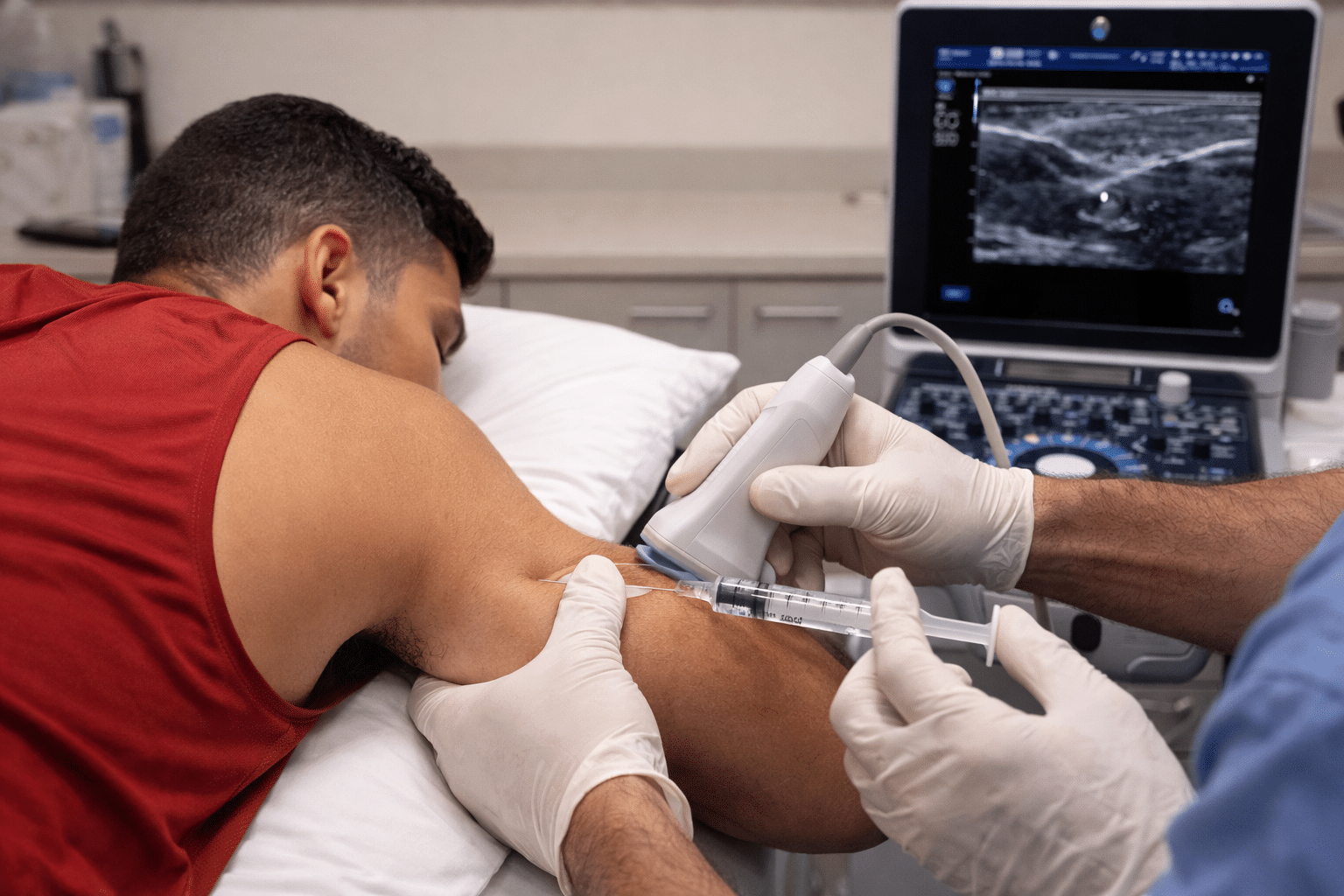
• Navigation-controlled diagnostic injections
Imaging findings are never used as standalone decision-makers.
Instead, imaging is interpreted alongside movement behavior, tissue response, performance demands, and clinical findings.
This approach reduces the risk of treating images instead of treating athletes.
🟦 Integrated Healing Options
Treatment selection is diagnosis-driven rather than protocol-driven.
Care may integrate multiple strategies depending on the specific mechanisms contributing to injury and performance limitation.
Potential Treatment Approaches
Targeted Physical Rehabilitation
Restores timing, coordination, stability, and load sharing.
Biomechanics-Based Movement Retraining
Addresses inefficient force transfer and compensatory movement patterns.
Improves procedural precision when diagnostic or therapeutic injections are appropriate.
Orthobiologic and Regenerative Support
May support tissue signaling and healing environments when clinically appropriate and compliant with current standards.
May be considered for selected tendon and chronic tissue conditions.
May serve as an adjunctive biological support strategy.
Each intervention is selected because of its role within the system—not simply because it exists.
🟦 Clinical Insight
One of the most common misconceptions in sports medicine is that pain always identifies the source of the problem.
In reality, the area that hurts may simply be the region absorbing excessive stress.
A runner experiencing knee pain may have a force-transfer issue originating at the hip.
A pitcher with shoulder symptoms may demonstrate altered trunk mechanics.
An athlete with recurring Achilles pain may exhibit asymmetrical loading patterns during gait.
The body functions as an integrated system.
When one component underperforms, another component often compensates.
Sports medicine becomes most effective when evaluation extends beyond symptoms to examine the entire movement system.
🟦 Experience, Expertise, Authority & Trust
Dr. Joseph Fortin (DO) integrates board-certified Physical Medicine & Rehabilitation (PM&R) expertise with subspecialty certification in Interventional Pain Management, alongside recognized experience in regenerative medicine, sports medicine, and integrative medicine—supporting system-level interpretation of imaging, movement, tissue biology, and pain mechanisms to reduce misdirected care.
National and international speaker on biomechanics, human movement, MRI & CT imaging physics, interventional pain management, and regenerative medicine.
This integrated expertise helps reduce diagnostic blind spots commonly encountered in siloed sports injury care.
🟦 Did You Know?
Many overuse injuries do not develop because an athlete suddenly trains too much.
Instead, subtle movement asymmetries can gradually increase stress across tissues over months or years.
Pain often appears only after the body has exhausted its ability to compensate.
By the time symptoms emerge, the underlying movement pattern may have been present for a long time.
🟦 Frequently Asked Questions
Is this only for elite athletes?
No. Sports medicine services are designed for athletes of all levels, from recreational participants and active adults to competitive and elite performers.
Do you replace physical therapy?
No. Sports medicine evaluation often works alongside rehabilitation by integrating medical diagnostics, biomechanics, and movement analysis with therapy-based recovery strategies.
Can this help prevent future injuries?
Identifying inefficient movement patterns, load-management challenges, and force-transfer issues may help reduce factors associated with recurrent injury.
Is imaging always required?
No. Imaging is used selectively and interpreted within the context of clinical findings, movement assessment, and performance demands.
Do you focus on surgery avoidance?
The goal is accurate diagnosis and appropriate care sequencing. Surgical intervention is neither assumed nor automatically excluded.
What makes physician-led sports medicine different?
Physician-led evaluation allows integration of imaging, biomechanics, neurologic assessment, tissue behavior, and performance demands into a comprehensive diagnostic framework.
🟦 Historical Perspective
Sports medicine has evolved dramatically over the past several decades.
Earlier models focused primarily on diagnosing injured structures and restoring participation as quickly as possible.
Modern sports medicine increasingly recognizes the importance of biomechanics, neuromuscular coordination, tissue adaptation, recovery physiology, and workload management.
As research in movement science continues to expand, injury prevention and performance durability have become central goals rather than secondary considerations.
The future of sports medicine is not simply treating injuries.
It is understanding the systems that create them.
🟦 What Athletes Can Expect
Athletes can expect:
• Extended, unrushed evaluations
• Physician-led diagnostic assessment
• Clear explanation of injury mechanisms
• Honest return-to-play guidance
• Integration of performance and recovery goals
• Continuity of care with the same physician
Recovery is evaluated through more than symptom reduction.
Measures of progress may include movement quality, confidence, functional capacity, load tolerance, and long-term durability.
🟦 Local Care, Global Science
Athletes throughout Fort Wayne and Northeast Indiana frequently search for:
• Sports injury specialist
• Return to sport without surgery
• Movement analysis doctor
• Biomechanics evaluation
• Sports medicine Fort Wayne
• Why injuries keep coming back
STAR Health applies global research in biomechanics, sports science, regenerative medicine, and systems-based care to local athlete evaluation and treatment.
The focus is not on shortcuts.
The focus is on durability.
🟦 Ready to find out more?
Athletic care should protect performance — not just manage injuries.
STAR Health —Fort Wayne, Indiana
Time-rich, physician-led evaluation
Schedule a comprehensive sports medicine assessment
Train smarter.
Recover stronger.
Move with confidence.