
Did you ever wonder why “stem cell therapy” meant one thing in 2021 and something very different today?
The shift didn’t happen overnight. It wasn’t driven by marketing trends or patient demand—it was driven by science catching up to language, and regulation catching up to both.
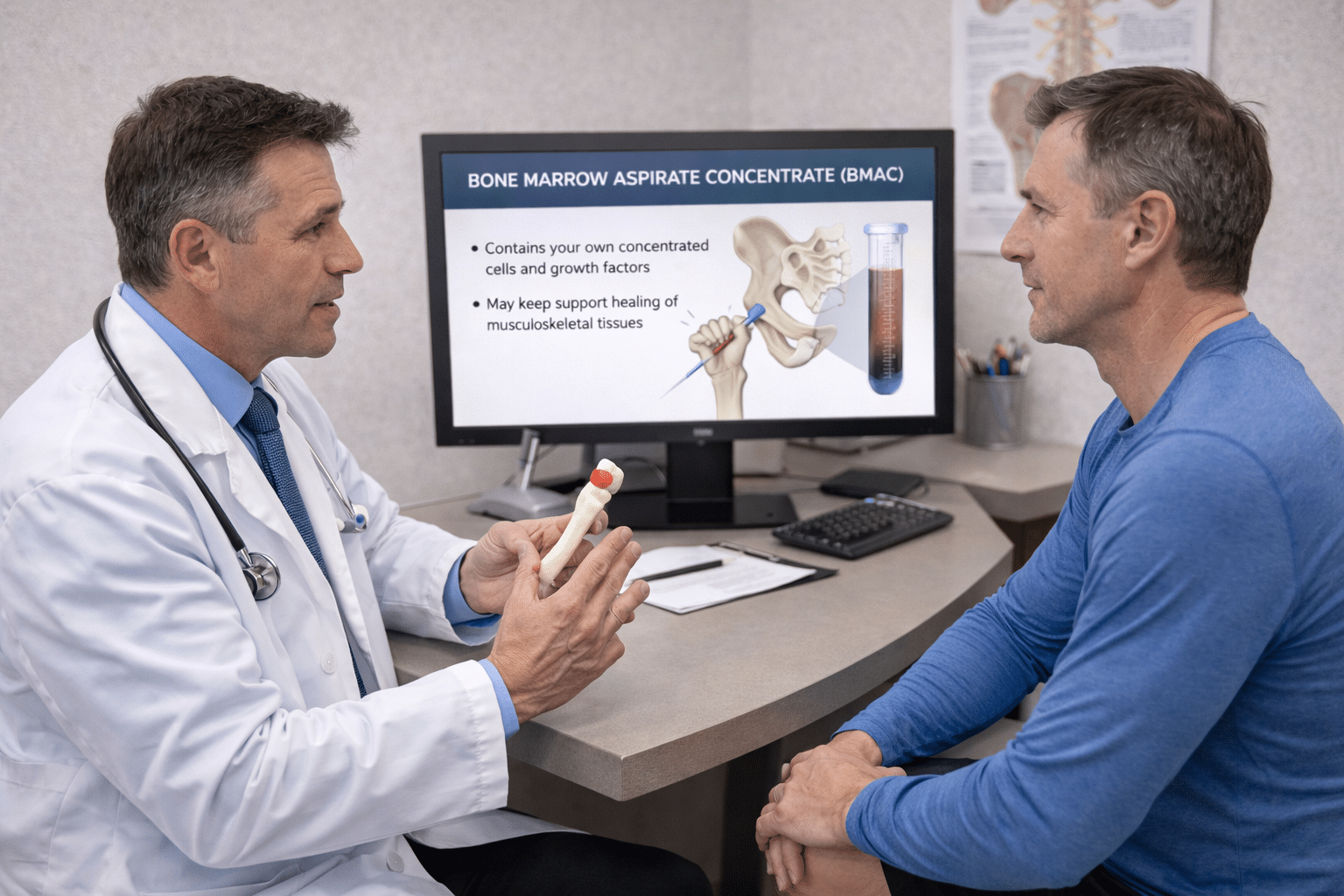
What was once loosely labeled “stem cell therapy” now lives under a more precise, clinically grounded framework: orthobiologics.
This change matters. Not because the treatments disappeared—but because the way we understand them changed, and with that, how patients should evaluate them.
There’s a quiet tension in modern regenerative medicine.
Understanding the Future of Regenerative Medicine
On one side, the promise: healing without surgery, recovery through your body’s own biology.
On the other, the reality: outcomes that vary, systems that resist shortcuts, and a growing body of evidence forcing medicine to redefine what these treatments actually do.
Between 2021 and 2026, regenerative medicine didn’t collapse—it matured.
And maturity, in medicine, often means letting go of what sounded powerful… and replacing it with what’s actually true.
FDA / CFR- Aligned Framing
Modern regenerative care operates under tighter clarity than ever before.
Today’s clinical standard:
• uses autologous biologics (your own blood or bone marrow)
• involves minimal manipulation of those tissues
• does not include FDA-approved stem cell drugs for orthopedic conditions
• avoids claims of cure, reversal, or guaranteed outcomes
This is not a limitation—it’s a correction.
The earlier era of regenerative marketing blurred lines between experimental science and clinical reality. In response, regulatory frameworks reinforced a key boundary:
If it behaves like a drug, it must be regulated like one.
Orthobiologics, as used today, remain within a different category—procedures that support biological processes, not replace them.
Systems-Based Explanation
. To understand what changed, you have to understand what these therapies actually do.
Orthobiologics do not “build new tissue” in the way many patients once believed. Instead, they influence systems already in motion.
They may affect:
• Inflammatory signaling — how the body initiates and resolves irritation
• Cellular communication — how cells coordinate repair responses
• Tissue tolerance to load — how structures handle stress over time
But they do not override:
• biomechanical dysfunction
• poor movement patterns
• nervous system sensitivity
• inadequate rehabilitation
This distinction is where expectations either align—or fail.
Because healing is not a single process. It is a system behavior, and orthobiologics are only one variable inside it.
Clinical Visualization
Imagine two patients with the same diagnosis—chronic knee pain.
Both receive a biologic injection.
One improves.
The other does not.
Why?
The difference often isn’t the injection itself. It’s the system surrounding it:
• joint alignment under load
• muscle coordination
• central pain processing
• adherence to rehabilitation
The biologic didn’t fail. It simply entered a system that either could respond—or couldn’t.
That’s the shift in 2026: clinicians no longer ask, “Does this treatment work?”
They ask, “Does this system allow it to work?”
Historical / Scientific Grounding
The turning point came quietly, through a reframing that changed everything.
In the 2010s, Arnold Caplan, PhD—widely considered a pioneer in stem cell research—introduced a critical clarification:
Mesenchymal stem cells were not primarily “builders” of new tissue.
They were signaling cells.
This insight reshaped expectations across the field.
Instead of acting as replacement parts, these cells function more like biological messengers—modulating inflammation, influencing repair, and coordinating responses.
By 2026, this concept is no longer theoretical.
It is foundational.
Before regulatory clarification, the term “stem cell therapy” was used broadly across clinics—often without distinction between experimental treatments and standard-of-care procedures.
By the mid-2020s, enforcement and education reshaped that landscape, pushing the field toward precision in both science and language.
🧠 Clinical Insight
Biologics support environments.
Recovery outcomes are determined by system behavior.
This is where many treatment plans succeed—or break down.
When biologics are used in isolation, they often underperform.
When they are integrated into a system—diagnostics, movement correction, load management, and rehabilitation—they become part of a coordinated response.
Not a solution.
A signal.
What Changed Since 2021
The evolution from 2021 to 2026 is not about new injections—it’s about better understanding.
Key changes include:
• Clearer regulatory boundaries
Clinics now operate within stricter definitions of what is permissible and how it can be described.
• Improved diagnostic precision
Imaging, movement analysis, and clinical evaluation have become more integrated—reducing guesswork.
• Stronger rehabilitation integration
Biologics are no longer positioned as standalone treatments, but as part of a broader recovery system.
• More realistic expectation setting
Patients are better informed about variability, timelines, and limitations.
This last point may be the most important.
Because expectation is not just psychological—it shapes compliance, engagement, and ultimately outcomes.
E-E-A-T (Experience, Expertise, Authority, Trust)
Modern regenerative medicine requires more than access to biologics.
It requires:
• clinical judgment in patient selection
• system-level thinking in treatment planning
• transparency in communication
• restraint in claims
Clinicians who understand these therapies recognize a simple truth:
The more precise the science becomes, the more careful the language must be.
Trust is no longer built on promise—it is built on alignment between biology and explanation.
Did You Know?
Most procedures once marketed as “stem cell therapy” in orthopedic care do not involve true stem cell expansion or laboratory manipulation.
Instead, they rely on concentrated biological components derived from the patient at the point of care.
Local Care, Global Science
Common Northeast Indiana searches:
- “regenerative medicine explained”
- “PRP vs stem cell therapy”
- “orthobiologics Fort Wayne”
FAQ
The term is used less frequently in clinical settings. Most treatments now fall under orthobiologics, using minimally manipulated tissues like PRP or bone marrow concentrate.
These procedures are generally regulated as part of medical practice when using a patient’s own tissue with minimal manipulation—not as FDA-approved drugs.
They may support the body’s repair processes, but they do not directly rebuild tissue in isolation. Outcomes depend on the broader biological system.
Candidates are typically those with conditions where inflammation, tissue stress, and mechanical factors can be meaningfully influenced—but this requires individualized evaluation.
Differences in biomechanics, nervous system response, tissue condition, and rehabilitation adherence all influence outcomes.