
It rarely begins with an injury.
No fall.
No twist.
No clear moment you can point to.
And yet, the joint aches.
Maybe it’s your knee after a week of poor sleep.
Your shoulder during a stressful stretch at work.
Your back when you’re fighting off an illness.
The pattern feels inconsistent—almost unpredictable.
But what if the joint isn’t the problem… just the place where stress becomes visible?
Because pain doesn’t always signal damage.
Sometimes, it signals accumulation.
Systems Explanation
Joint pain is often framed as a structural issue—cartilage wearing down, joints “degenerating,” tissues breaking apart. Understanding these underlying factors can help in managing joint pain more effectively.
But structure is only one layer.
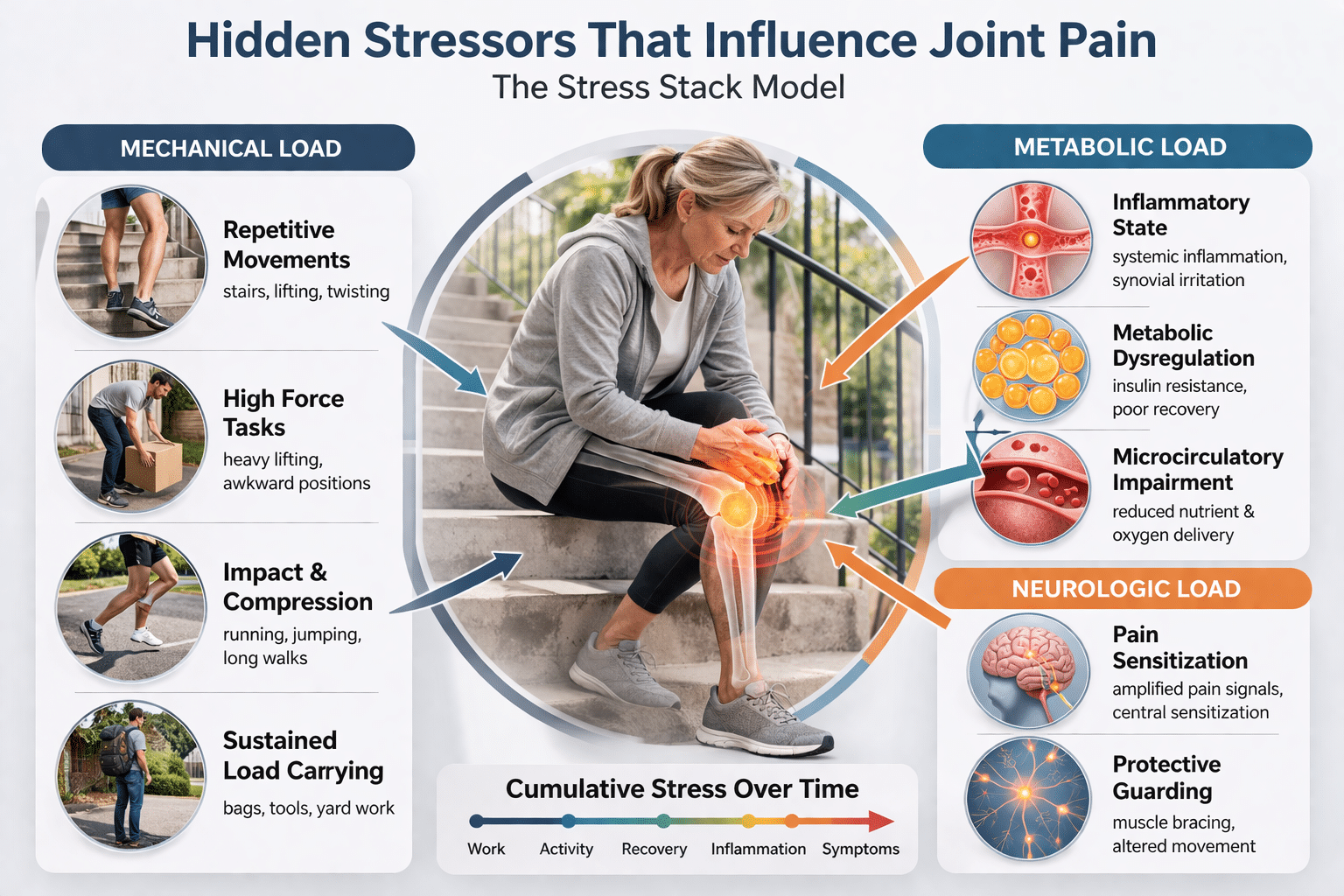
Beneath it sits a system managing multiple forms of stress:
• Mechanical overload
• Nervous system amplification
• Metabolic stress
• Inflammatory signaling
Each of these operates independently—until they don’t.
When they begin to stack, the system shifts.
Pain emerges when total stress load exceeds the body’s ability to adapt.
Not because something suddenly broke.
But because something gradually accumulated.
Clinical Visualization
Joint pain is often framed as a structural issue—cartilage wearing down, joints “degenerating,” tissues breaking apart.
But structure is only one layer.
Beneath it sits a system managing multiple forms of stress:
• Mechanical overload
• Nervous system amplification
• Metabolic stress
• Inflammatory signaling
Each of these operates independently—until they don’t.
When they begin to stack, the system shifts.
Pain emerges when total stress load exceeds the body’s ability to adapt.
Not because something suddenly broke.
But because something gradually accumulated.
Clinical Insight🧠
Joint pain often reflects total system stress—not isolated structural damage.
This is why imaging and symptoms don’t always match.
A joint can look “worn” but feel fine.
Or look normal—but feel unstable, irritated, or reactive.
Because pain is not a direct readout of structure.
It’s a response to load—across systems.
Evidence-Respecting Education
Joints tolerate stress best when three conditions align:
• Movement is efficient
• Recovery capacity is intact
• Nervous system tone is regulated
When these are present:
• Load distributes evenly
• Signals remain proportionate
• Recovery keeps pace with demand
When they are not:
• Load concentrates
• Sensitivity increases
• Adaptation falls behind
Even normal activity can begin to feel excessive.
This is not failure.
It’s a mismatch between input and capacity.
Historical / Scientific Grounding
n 1936, Hans Selye, MD, introduced the concept of the generalized stress response.
His work revealed that the body does not differentiate between types of stress:
• Physical
• Emotional
• Environmental
All contribute to a shared physiological load.
Over time, cumulative stress alters:
• Hormonal balance
• Immune activity
• Tissue resilience
A principle that directly applies to modern joint pain.
The joint is not isolated from stress.
It is influenced by it.
For decades, joint pain was explained primarily through “wear and tear.”
But emerging models shifted that view.
Pain is no longer seen as a simple reflection of damage.
It is understood as a protective response shaped by multiple systems.
And those systems extend far beyond the joint itself.
Practical Reframing
When joint pain is viewed through a systems lens, the focus changes.
Instead of asking:
“What is damaged?”
The question becomes:
“What is overloaded?”
Effective care begins with identifying and addressing:
• Sources of mechanical overload
• Patterns of inefficient movement
• Gaps in recovery (sleep, nutrition, stress regulation)
Because reducing total stress load often changes symptoms—
without altering structure.
This reframing helps prevent unnecessary escalation into invasive care.
E-E-A-T (Experience, Expertise, Authority, Trust)
Understanding joint pain requires integration across disciplines:
• Biomechanics
• Neurology
• Physiology
• Behavioral health
A structural-only approach captures part of the picture.
A systems-based approach captures more of it.
Trust is built when explanations match lived experience—especially when pain appears without clear injury.
Did You Know?
-Poor sleep can increase pain sensitivity even without tissue change
-Stress hormones influence how the nervous system interprets load
-Low-grade inflammation can alter joint tolerance without visible injury
Local Care, Global Science
In Fort Wayne and surrounding areas, common searches include:
• “joint pain without arthritis”
• “stress and joint pain”
• “why joints hurt sometimes”
These questions point to a growing awareness:
That pain doesn’t always follow injury—and that explanation requires more than structure alone.
FAQ
Stress can increase nervous system sensitivity and inflammatory signaling, which may amplify pain even without structural damage.
Sleep supports recovery and regulates pain processing. Poor sleep can lower tolerance to normal mechanical stress.
No. Many forms of joint pain occur without structural degeneration and are influenced by load, movement, and systemic stress.
Fluctuations in stress, activity, and recovery can change how the body processes load, leading to variable symptoms.
Not always. The goal is often to adjust load and improve movement efficiency rather than eliminate activity entirely.
Schedule a systems-based evaluation to identify what’s stressing your joints.