
A Systems-Based, Diagnostic-First Guide for Patients Seeking Clarity Over Guesswork
Did you ever notice how some pain treatments feel immediate—but incomplete—while others take longer yet finally make sense?
That difference is rarely about technology or access. It is about clinical reasoning.
Most patients searching for a “pain doctor” are not looking for more options. They are looking for an explanation that holds together—one that explains why the pain exists and what sequence of care actually fits their condition.
When searching for a qualified pain management physician, patients should consider various factors to ensure they receive the best care.
Finding the right pain management physician can be a significant step in managing your condition effectively.
It is crucial to choose a pain management physician who understands your specific needs and conditions.
Your pain management physician should provide a comprehensive approach that addresses all facets of pain.
Consider discussing with your pain management physician about their treatment philosophies and experiences.
Choosing a Pain Management Physician: Key Considerations
Pain medicine is not one field. It is a spectrum of models. Some prioritize intervention. Others prioritize diagnosis.
The difference matters. Because the wrong sequence—even with the right tools—can lead to prolonged suffering instead of resolution.
🟦 SYSTEMS EXPLANATION
Pain is not a location. It is an output.
And that output is shaped by overlapping systems that rarely operate in isolation:
- Tissue & structure: discs, joints, tendons, nerves
- Biomechanics: movement efficiency, load distribution, compensation
- Nervous system signaling: peripheral irritation, central amplification
- Inflammatory load: local irritation and systemic contributors
- Recovery capacity: sleep, stress physiology, conditioning
A skilled pain physician does not chase symptoms.
They identify:
- which system is dominant
- which systems are secondary
- which interventions match that hierarchy
Because treating the wrong layer—even accurately—fails if it is not the primary driver.
🟦 WHAT “BEST” REALLY MEANS
When patients say they want the “best” pain management physician, they are rarely asking for more procedures.
They are asking for:
- clear explanation of symptoms
- accurate diagnosis—not vague labeling
- a plan that restores function, not just reduces pain temporarily
- guidance that avoids unnecessary escalation
- confidence that each step has a reason
In practice, “best” does not mean most aggressive.
It means most precise.
🟦 PROCEDURE-FIRST VS DIAGNOSIS-FIRST
Two models dominate modern pain care.
They are not equal—and not interchangeable.
Procedure-first care works when:
- diagnosis is already established
- conservative care has been completed appropriately
- intervention has strong evidence for that condition
Diagnosis-first care is essential when:
- imaging does not match symptoms
- pain is persistent, shifting, or multi-regional
- prior treatments provided only short-term relief
- symptoms overlap across regions (neck + headache, back + leg, jaw + ear)
A diagnosis-first physician does not avoid procedures.
They use them only when the system is ready and the hypothesis is clear.
A trusted pain management physician will help guide you through your treatment options.
🟦 CLINICAL VISUALIZATION
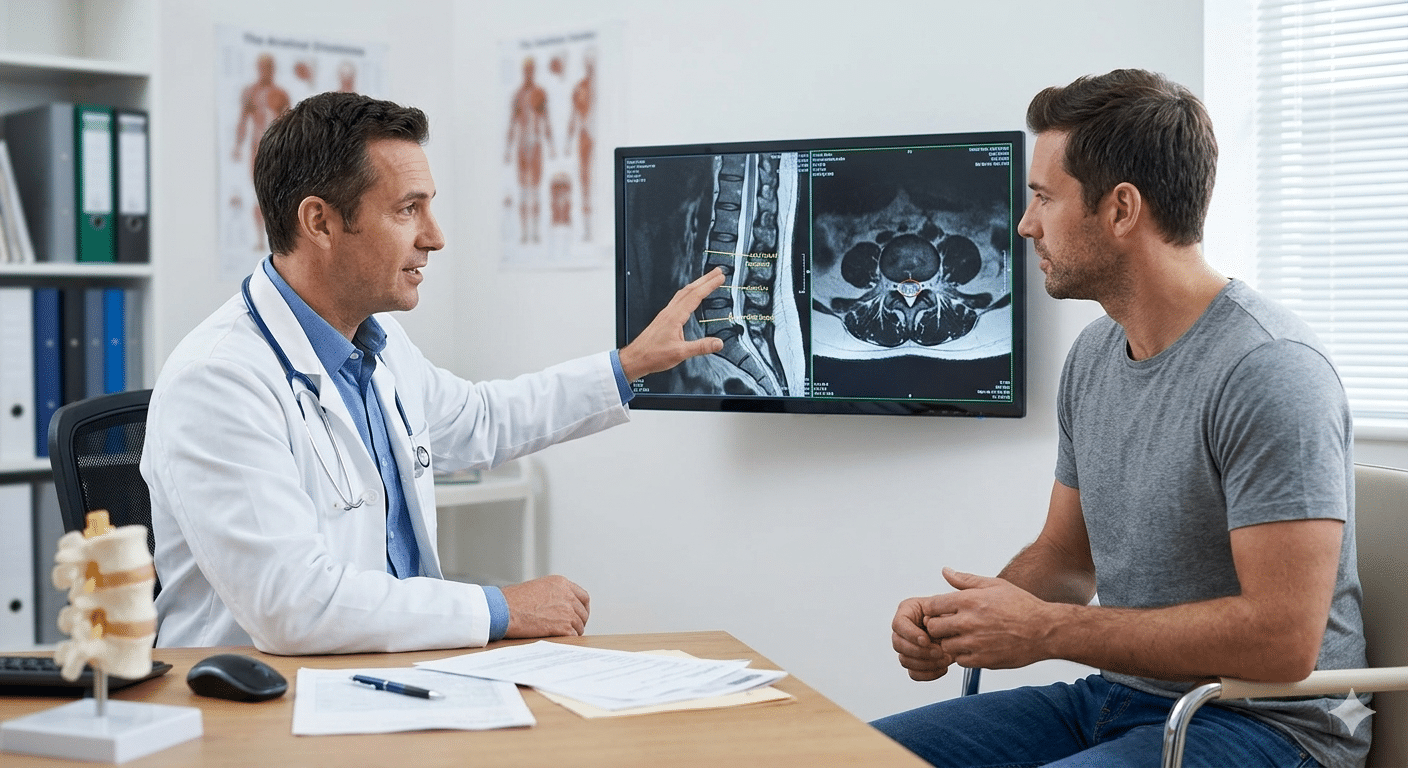
Imagine two patients with identical MRI findings.
- Same disc bulge
- Same degenerative changes
Yet:
- one has severe pain
- one has none
Why?
Your pain management physician should strive to build a partnership that empowers you in your care.
Because imaging shows structure—not behavior.
A strong physician interprets imaging alongside:
- movement patterns
- symptom triggers
- nervous system sensitivity
- functional limitations
The MRI is a piece of evidence—not a conclusion.
For deeper understanding of how imaging relates to symptoms, see our internal guide on pain diagnostics and imaging interpretation.
🟦 CLINICAL INSIGHT
Choosing a compassionate pain management physician can greatly enhance your treatment experience.
The most effective pain care begins with accurate pattern recognition—not intervention selection.
When diagnosis is unclear, escalation increases risk without improving outcomes.
Discussing your preferences with your pain management physician can lead to better outcomes.
When diagnosis is precise, even simple interventions can be effective.
🟦 E-E-A-T (EXPERIENCE / EXPERTISE / AUTHORITY / TRUST)
High-quality pain care consistently demonstrates:
- Training aligned with condition complexity
- Structured evaluation with sufficient time
- Imaging interpreted in clinical context
- Willingness to decline unnecessary treatment
- Sequenced care planning with measurable checkpoints
According to the National Institutes of Health (NIH), chronic pain is a multifactorial condition requiring integrated evaluation across biological and functional systems.
Additionally, research published in The Lancet highlights that over-reliance on structural findings alone often leads to misaligned treatment strategies in chronic pain populations.
These findings reinforce a central truth:
precision in diagnosis determines effectiveness of care.
🟦 DID YOU KNOW
Up to 30–40% of imaging findings in the spine are present in people without pain.
This means structure alone cannot explain symptoms—and should never be the sole basis of treatment decisions.
🟦 HISTORICAL CONTEXT
In 1953, John J. Bonica, MD helped establish modern pain medicine as a multidisciplinary field.
His central insight remains foundational:
Ultimately, the effectiveness of treatment often hinges on the relationship with your pain management physician.
A good pain management physician will understand the multidimensional nature of pain.
Pain is not just tissue injury—it is a complex system experience shaped by multiple inputs.
Today’s best practices continue to follow this model.
🟦 LOCAL CARE, GLOBAL SCIENCE
In Fort Wayne and Northeast Indiana, common searches include:
- pain doctor near me
- chronic pain without surgery
- interventional pain specialist
- MRI doesn’t match pain
These patterns reflect a consistent need:
patients are not just seeking relief—they are seeking explanation.
For patients exploring structured care pathways, our overview of comprehensive pain management services provides additional context on treatment sequencing.
🟦 FAQ
What type of doctor is best for chronic pain?
A physician trained in pain medicine who prioritizes diagnosis, understands multi-system contributors, and can coordinate both conservative and interventional care when appropriate.
Should I choose a doctor who offers more procedures?
Not necessarily. More options do not equal better care. The key is whether each option is used with a clear rationale and proper sequencing.
Why didn’t my previous treatment work long-term?
Often because the primary driver of pain was not fully identified, or multiple contributing systems were not addressed together.
Does imaging always explain pain?
No. Imaging shows structure, but pain depends on how systems behave—not just what they look like.
When are injections or procedures appropriate?
When diagnosis is clear, conservative care has been attempted, and there is strong evidence the intervention targets the correct pain generator.
🟦 CTA
Schedule a diagnostic-first consultation focused on identifying the true driver of your pain and building a structured, evidence-aligned path forward.
Choosing a knowledgeable pain management physician is vital for achieving lasting pain relief.
Ultimately, your relationship with your pain management physician will impact your treatment journey.
Finding a pain management physician who listens and understands your concerns is essential.
It is important to feel comfortable with your pain management physician and their treatment strategies.
The right pain management physician will offer personalized care tailored to your situation.
Trust your instincts when selecting a pain management physician.
Consider the communication style of your pain management physician as it influences your care experience.
They should also be open to discussing various treatment modalities with you.
Establishing a collaborative relationship with your pain management physician is key to successful outcomes.
Contact us to schedule a consultation today!