
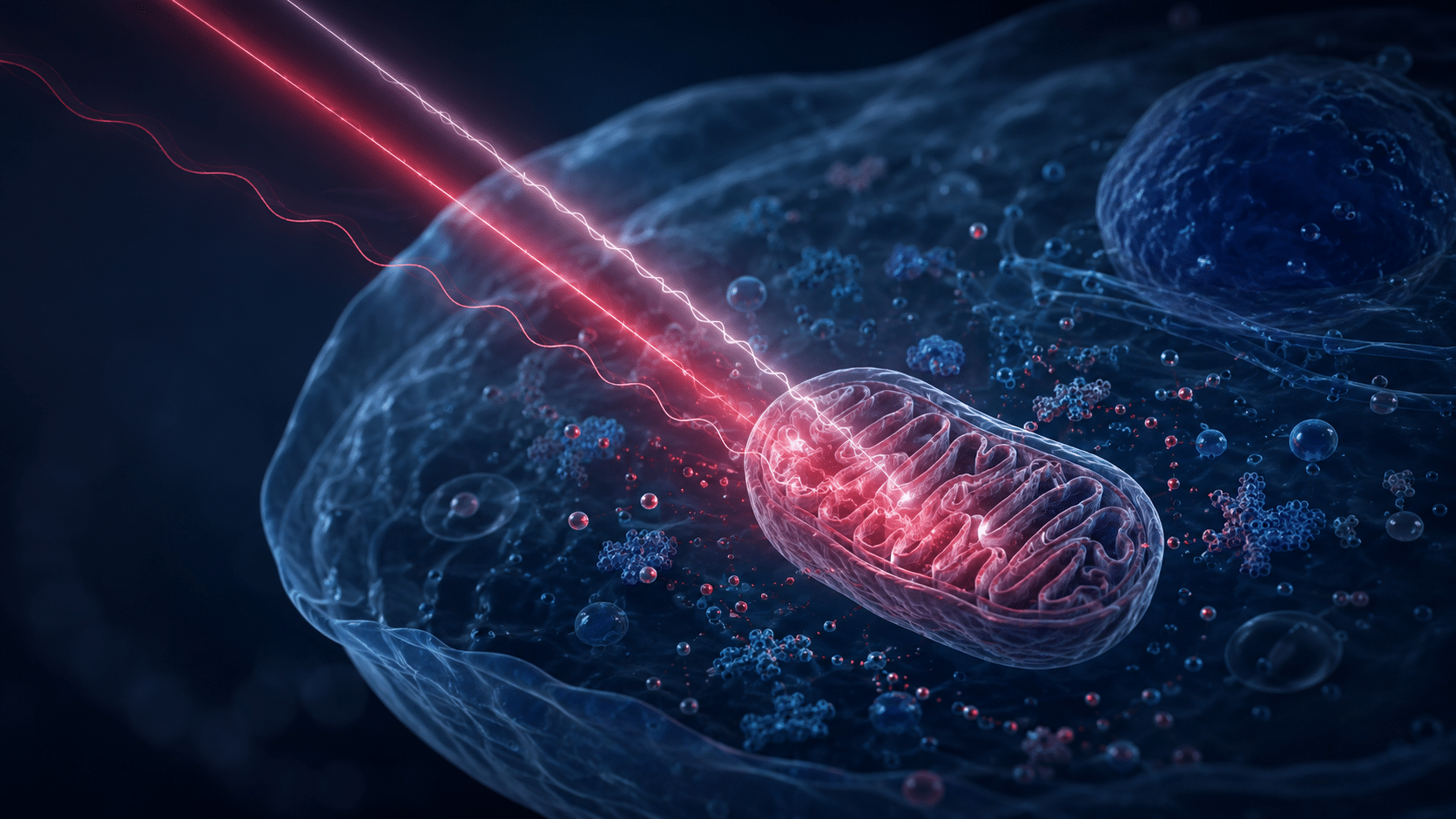
Light reaches the skin. There is no incision, injection, or anesthetic effect. Often, there is little to feel beyond mild warmth. Yet photons may be interacting with molecules that help a cell manage energy and stress.
That is the central mystery behind photobiomodulation cellular effects: light does not patch damaged tissue or pour energy into a cell like fuel into a tank. It acts as an input. If the wavelength reaches a receptive molecule, and if the dose fits the tissue and clinical context, that input may alter downstream signaling.
The distinction matters because pain is not a cellular diagnosis. Before laser therapy is considered, the more important question is what is limiting recovery:
- Structure — Is tissue torn, unstable, compressed, or progressively damaged?
- Signaling — Are inflammatory, metabolic, or neural responses unusually active or under-responsive?
- Load — Is movement exceeding the tissue’s present capacity?
Photobiomodulation may influence signaling. It does not erase structural failure or replace appropriate loading.
FROM PHOTON TO CELLULAR RESPONSE
Light Is an Instruction, Not a Repair Material
A cell contains chromophores—molecules capable of absorbing particular wavelengths. In red and near-infrared photobiomodulation, one leading proposed photoacceptor is cytochrome c oxidase, or Complex IV, in the mitochondrial electron transport chain. Light-sensitive ion channels and interactions involving water may also contribute; no single mechanism explains every tissue or wavelength.
Absorption can change the receiving molecule’s state. The first event is small, but cells can amplify it through interconnected pathways.
The Mitochondrion Changes the Message
Mitochondria make ATP, but they also participate in redox balance, calcium handling, stress responses, and communication with the nucleus.
Laboratory work supports a relationship between photobiomodulation and mitochondrial activity. One study found increased cytochrome c oxidase activity in stressed fibroblasts after 660-nanometer irradiation; this cell model does not prove that every painful human condition responds similarly. Read the specific study indexed by PubMed.
Depending on the cell’s starting state and the applied parameters, photobiomodulation may influence:
- electron transport and ATP dynamics
- nitric oxide availability
- brief, regulated changes in reactive oxygen species
- calcium-dependent signaling
- transcription pathways involved in inflammation, survival, and repair
These are regulatory effects, not evidence that a laser directly rebuilds collagen, closes a tendon tear, or permanently switches off pain.
Why Dosage Changes the Answer
Photobiomodulation can demonstrate a biphasic response: too little exposure may produce no meaningful signal, while excessive exposure may reduce the desired response. Wavelength, power, irradiance, area, time, tissue depth, pigmentation, blood flow, and tissue condition influence dose.
That is why “high intensity” and “cold laser” are incomplete descriptions. Device power affects how quickly energy can be delivered; it does not, by itself, establish biological effectiveness. The relevant question is whether an appropriate dose reaches the intended tissue without unwanted heating or exposure.
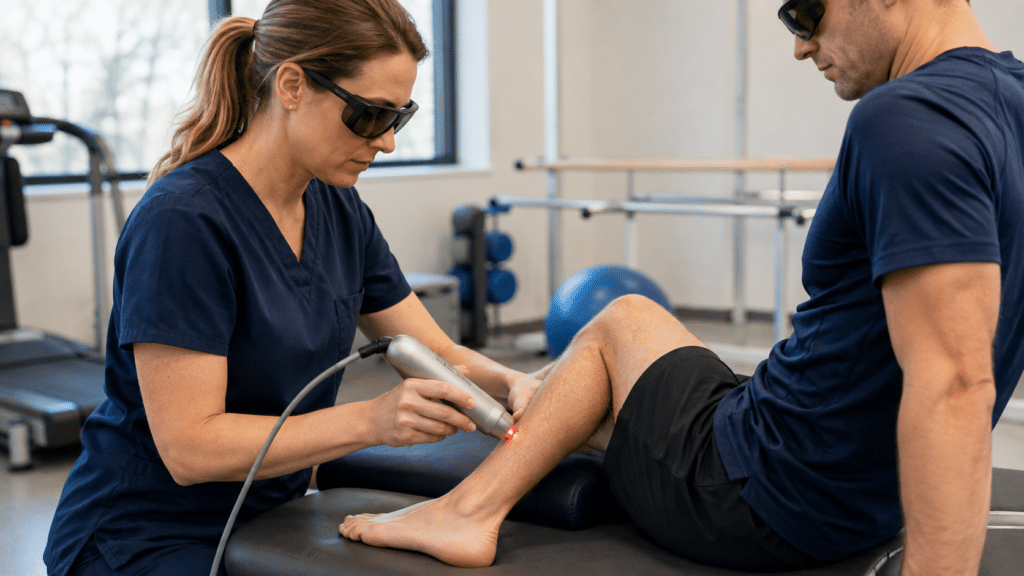
Therapeutic photobiomodulation is non-ablative: its intended effect does not depend on cutting, protein denaturation, or thermal injury. Higher-power systems can create warmth, so technique, settings, skin response, and eye protection matter. The FDA regulates photobiomodulation devices by intended use and supporting evidence. See the FDA’s photobiomodulation device guidance.
CLINICAL VISUALIZATION — WHEN THE CELL IS NOT THE WHOLE STORY
Imagine a runner with an irritable Achilles tendon. Imaging shows no rupture, but each step loads tissue that has not regained capacity. Pain shortens the stride. The calf contributes less. Protection increases, and the tendon receives too much load at the wrong time—or too little progressive load to adapt.
Photobiomodulation may be used to influence local signaling and make activity more tolerable. But the treatment has not corrected the runner’s load progression, ankle mechanics, strength deficit, sleep, or recovery schedule.
Here the systems model prevents a seductive mistake: less pain may create a rehabilitation window, but it does not prove restored capacity. Care may pair laser or photobiomodulation therapy with individualized movement work such as STAR Health’s Locomotion Class, when appropriate.
CLINICAL INSIGHT
Photobiomodulation does not tell a cell to “heal.” It changes part of the information environment in which the cell responds.
The clinical task is to determine whether altered signaling is actually limiting recovery—and whether improving that environment will help the patient tolerate the movement, loading, or rehabilitation needed for broader change.
E-E-A-T — WHAT THE EVIDENCE CAN AND CANNOT SAY
Experience
Clinical response is interpreted alongside examination findings, function, tissue irritability, and change over time—not from pain score alone.
Expertise
Photobiomodulation planning requires knowledge of anatomy, diagnosis, wavelength, dose, precautions, and the difference between symptom modulation and restored capacity.
Authoritativeness
Mechanistic studies explain plausible pathways; regulatory guidance and condition-specific clinical research define reasonable claims.
Trustworthiness
Evidence varies by diagnosis and protocol. Cell and animal findings do not guarantee human outcomes, and lack of response should prompt reassessment rather than automatic dose escalation.
AUTHOR BLOCK
STAR Health Clinical Education Team
Clinical perspective informed by Joseph Fortin, DO, Medical Director of STAR Health in Fort Wayne, Indiana. Dr. Fortin’s practice focuses on physical medicine and rehabilitation, interventional pain management, musculoskeletal diagnosis, sports medicine, and individualized non-surgical care.
DID YOU KNOW?
Visible red and invisible near-infrared light are not interchangeable. Wavelength affects absorption and penetration; tissue depth and optical properties affect how much reaches the target. A device’s wavelength is only the beginning of dose calculation.
HISTORICAL — AN ACCIDENT THAT CHANGED THE QUESTION
In the late 1960s, Hungarian physician Endre Mester investigated low-power laser exposure and observed biological changes that could not be explained by burning or tissue destruction. The unexpected findings redirected attention from what lasers could remove to what low-intensity light might regulate.
The field later adopted photobiomodulation for this non-thermal interaction. The name captures the central idea: photons may modulate activity, but the response depends on the living system receiving them.
LOCAL CARE, GLOBAL SCIENCE
At STAR Health in Fort Wayne, photobiomodulation is considered within a diagnostic sequence—not as a universal answer for back pain, arthritis, tendon pain, or sports injuries.
The evaluation asks whether the dominant barrier is structural, signaling-related, load-related, or mixed. Photobiomodulation may be considered when irritability restricts rehabilitation, but it may be inappropriate when the diagnosis requires different care, a progressive neurological or structural problem is suspected, or precautions are present.
Global research informs the parameters; local examination determines whether the modality belongs in the plan. Response is judged by function—such as walking tolerance, range of motion, or rehabilitation participation—not warmth or device power class.
FREQUENTLY ASKED QUESTIONS
Does Photobiomodulation Give Cells More Energy?
It may alter mitochondrial activity and ATP dynamics under some conditions, but “more energy” is an oversimplification. Cells use ATP within wider signaling networks. A measured metabolic change does not automatically translate into tissue repair or pain relief.
Is Photobiomodulation the Same as Heat Therapy?
No. Therapeutic photobiomodulation is intended to produce photochemical signaling rather than thermal tissue damage. Mild warmth can occur, particularly with higher-power delivery, but heating is not the defining mechanism of photobiomodulation.
Can Laser Therapy Reduce Inflammation?
Photobiomodulation may influence inflammatory signaling, but the effect depends on the condition, tissue, dose, and timing. Inflammation also has protective and reparative roles, so evaluation should determine why it is present rather than assuming it should always be suppressed.
How Many Laser Therapy Sessions Are Needed?
There is no responsible universal session count. The diagnosis, chronicity, treatment parameters, response, and rehabilitation plan all matter. Progress should be reassessed; continued treatment without meaningful functional change deserves reconsideration.
Does Pain Relief Mean the Tissue Has Healed?
Not necessarily. Pain can change before strength, load tolerance, or structure changes. Reduced symptoms may make movement easier, but rehabilitation and gradual loading may still be needed to build capacity.
FIND THE LIMITING SYSTEM FIRST
Schedule a diagnostic evaluation at STAR Health to determine what is limiting your recovery—and whether photobiomodulation belongs within a broader, individualized care plan.
Contact us to schedule a consultation today!