

When Chronic Pain Is Real – but the Diagnosis Is Missing
How STAR Health Builds a Chronic Pain Diagnosis in Fort Wayne, Indiana
Did you ever wonder how someone can see several specialists, complete multiple scans, try medications or therapy—and still be unable to answer one basic question: “Why do I hurt?”
For many patients, the most unsettling part is the missing explanation. A report may describe arthritis or a disc bulge, yet those words may not match what happens during movement or sleep.
The pain is real. The missing piece may be a chronic pain diagnosis that connects the evidence.
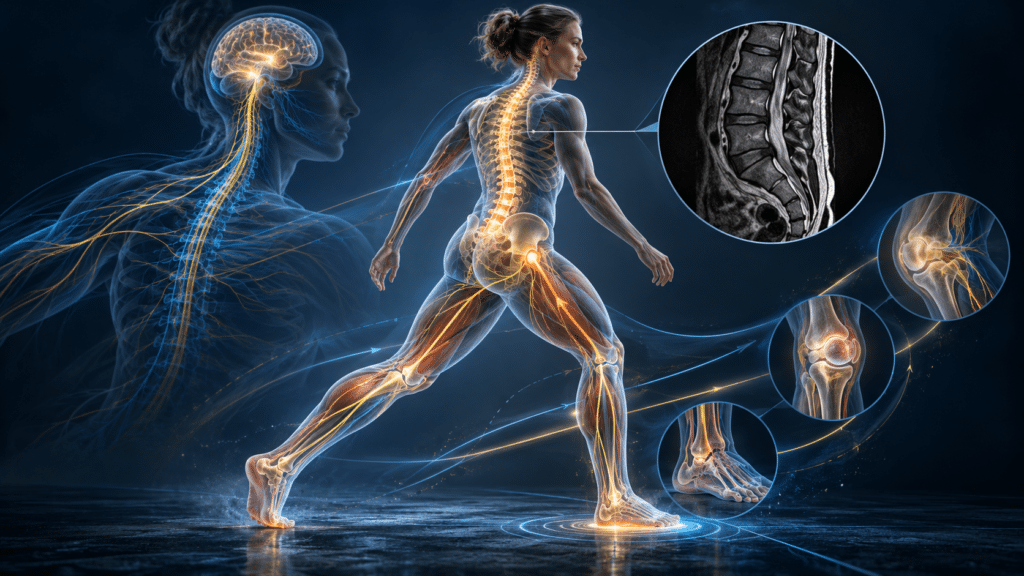
STAR Health approaches an unclear case as an investigation: how do structure, signaling, and load interact, and what may be sustaining the pain?
Why a Traditional Chronic Pain Diagnosis Can Miss the Connection
Pain workups can become fragmented. One clinician studies the joint, another evaluates the nerve, and a third focuses on the scan. Each view may be valid, but separate observations do not automatically create a complete diagnosis.
Pain can emerge from several interacting domains:
- Structure: joints, discs, tendons, muscles, and bone
- Signaling: nerves, inflammation, and pain-processing responses
- Load: posture, gait, force transfer, and compensation
A finding in one domain can alter the others. A painful joint may change walking mechanics, overload another tissue, and increase neural sensitivity. The place that hurts most may not be where the process began.
A chronic pain diagnosis should explain what provokes the pain, where it travels, how it changes with load, and whether the suspected structure behaves as predicted during examination.
A Scan Shows Structure—Not the Entire Pain System
MRI, CT, X-ray, and ultrasound can reveal fractures, narrowing, degeneration, inflammation, tears, and conditions requiring specialized care.
But an image is a snapshot, while pain is produced by a living system. Degenerative spine findings also appear in people without symptoms, so a scan abnormality must be correlated with the history and examination rather than assumed to be the pain generator. A systematic review documents how common several degenerative findings are in asymptomatic people.
Imaging alone cannot reliably determine:
- Which visible structure is actively generating symptoms
- Whether a finding is incidental or clinically meaningful
- How load or altered nerve signaling changes the response
STAR Health interprets imaging alongside the history, physical and neurological examination, load-response testing, movement observation, and—when appropriate—targeted diagnostics.
Clinical Visualization: The Clue That Appears Only Under Load
Imagine a lumbar MRI showing changes at several levels without revealing which matters most. Standing is tolerable. Walking increases leg symptoms. A different stride reduces them; a spinal position reproduces them.
Now the case is no longer a static picture. It is a sequence of clues.
Comparing timing, neurological findings, movement, and load response turns a vague complaint into a testable chronic pain diagnosis—without assuming that one test holds the answer.
Diagnostic Blocks: Testing a Hypothesis in Real Time
When examination and imaging point toward a joint, nerve, or spinal structure, an image-guided diagnostic injection may be considered. It asks: Does temporarily changing input from this suspected structure alter the familiar pain predictably?
Meaningful change may support the hypothesis; little change may redirect the investigation. Diagnostic blocks are not infallible, but they can keep a structural finding from being mistaken for confirmed causation.
This diagnostic-first logic guides STAR Health’s approach to image-guided injections and broader pain management: define the question before choosing the intervention.
When the Chronic Pain Diagnosis Is Hidden in Movement
Some pain becomes visible only when the system is challenged. Changes in gait, trunk rotation, shoulder rhythm, or hip control may repeatedly load vulnerable tissues.
STAR Health may evaluate:
- Walking or running mechanics
- Cervical and lumbar movement sequencing
- Load transfer through the hips, pelvis, and shoulders
- Balance, coordination, asymmetry, and post-injury protection
Movement analysis tests whether a repeated pattern fits the history and reproduces the problem, helping direct rehabilitation toward a relevant deficit.
Clinical Insight
A scan can identify a candidate. A chronic pain diagnosis requires correlation. The suspected source becomes more credible when anatomy, examination, movement behavior, neurological findings, and response to a targeted test converge on the same explanation.
Pain is also more than a direct readout of tissue damage. The International Association for the Study of Pain describes it as a sensory and emotional experience influenced by biological, psychological, and social factors, and distinguishes pain from nociception. That does not make pain imaginary; it helps explain why one structural finding may not account for the entire experience.
Experience, Expertise, Authority, and Trust
A complex chronic pain diagnosis requires a clinician who can decide which findings matter and what should be tested next.
STAR Health uses a physician-led model under Joseph Fortin, DO, Medical Director and interventional pain management specialist. His training in Physical Medicine & Rehabilitation and advanced interventional spine and imaging supports an approach connecting anatomy, function, signaling, and diagnostics.
Author and Clinical Oversight
Written under the clinical direction of Joseph Fortin, DO
Medical Director, STAR Health
Board-certified in Physical Medicine & Rehabilitation
Subspecialty-certified in Interventional Pain Management
Fort Wayne, Indiana
Did You Know?
An abnormal MRI finding and a pain generator are not automatically the same thing. A chronic pain diagnosis asks whether the finding matches symptoms, examination, movement, and targeted testing.
Historical Perspective: René Laënnec and the Value of Context
In Paris in 1816, physician René Laënnec developed the stethoscope. It did not replace clinical judgment; it added evidence that physicians could compare with symptoms and anatomical findings.
Modern imaging follows the same principle. A scan, ultrasound image, or diagnostic procedure is evidence—not the conclusion.
Local Care, Global Science
People across Fort Wayne and Northeast Indiana may search for “pain that does not show on MRI,” “nerve pain versus muscle pain,” or “why pain spreads.” Each expresses the same concern: the symptoms are real, but the explanation feels incomplete.
STAR Health translates pain physiology, imaging, biomechanics, and rehabilitation research into local care. The aim is to identify the relationships that best explain the pain and use that chronic pain diagnosis to guide proportionate, individualized care.
Frequently Asked Questions
Can pain be real if my MRI is normal?
Yes. MRI shows structure, but not every pain mechanism. Nerve irritation, sensitization, movement-related overload, and soft-tissue problems may require additional evaluation.
Does an abnormal MRI prove what is causing my pain?
Not by itself. The finding should match the symptoms, examination, and functional behavior. Some abnormalities are incidental; others matter when several lines of evidence agree.
What is included in a comprehensive chronic pain evaluation?
It may include a history, examination, imaging review, movement or load-response assessment, and selective testing based on symptoms and risk factors.
Are diagnostic injections treatments or tests?
They may serve either role. Diagnostically, they test whether changing input from a suspected structure changes familiar symptoms. Results require context and do not guarantee an outcome.
What if more than one system is contributing to my pain?
Care may need to address structural stress, movement, nerve involvement, inflammation, conditioning, sleep, or pain processing rather than one target.
Begin With the Right Question
Pain rarely comes from one isolated clue—and neither should your evaluation.
Schedule a comprehensive pain evaluation at STAR Health in Fort Wayne, Indiana. The first objective is not to rush toward a procedure. It is to build a clearer chronic pain diagnosis and determine which next step, if any, is supported by the evidence.
Contact us to schedule a consultation today!