
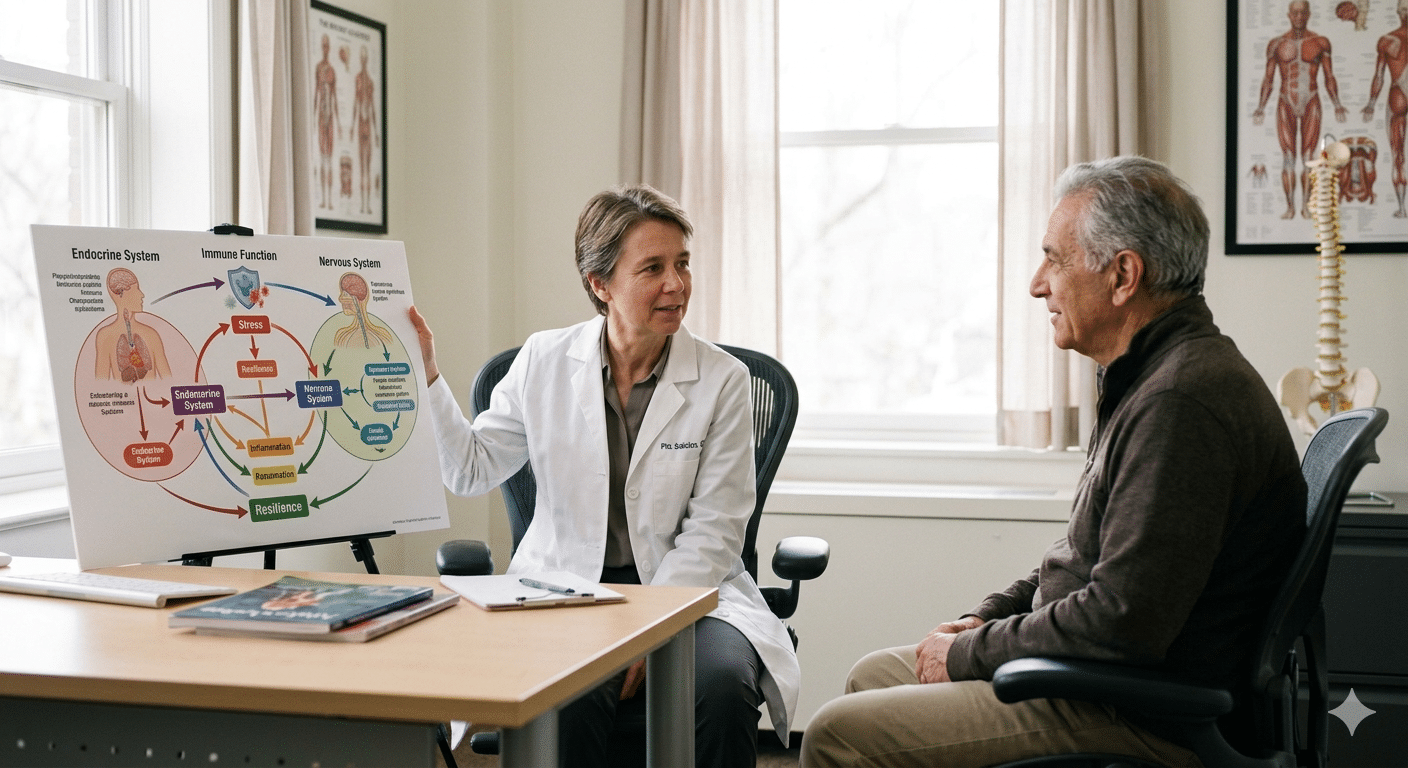
Did you ever notice how two people can follow the same treatment plan—and still end up in completely different places?
One improves steadily. The other plateaus, regresses, or develops new limitations.
The diagnosis may be identical. The imaging may match. The protocol may be followed precisely.
Yet the outcomes split.
Integrative medicine exists to explain that divergence.
Not by replacing diagnosis. Not by rejecting evidence-based care.
But by asking a deeper question: what determines how the body responds to treatment in the first place?
At STAR Health in Fort Wayne, integrative medicine is not positioned as an alternative.
It is a systems-based medical framework—used to understand variability, persistence, and recovery across time.
🟦 SYSTEMS EXPLANATION
Traditional medicine is highly effective at identifying structural or pathological issues:
- disc herniation
- ligament injury
- nerve compression
- inflammatory disease
These are essential findings. They guide critical decisions.
But they do not always explain why symptoms persist, fluctuate, or resist treatment.
Integrative medicine expands the lens.
Instead of isolating a single structure, it evaluates how multiple systems interact under load:
- Movement mechanics and load tolerance
- Nervous system signaling and sensitivity
- Inflammatory and immune regulation
- Sleep and circadian biology
- Metabolic and nutritional status
- Stress physiology and recovery capacity
Symptoms rarely originate from one system in isolation.
They emerge when systems lose coordination.
Integrative medicine does not compete with diagnosis—it contextualizes it.
🟦 CLINICAL VISUALIZATION
Imagine two patients with the same lumbar disc injury.
Both receive appropriate care. Both complete rehabilitation.
But:
- One sleeps poorly
- One has elevated stress physiology
- One has reduced load tolerance from deconditioning
- One has persistent inflammatory signaling
Over time, the second patient experiences:
- delayed recovery
- recurring pain
- reduced adaptability to activity
The structure healed.
The system did not.
This is where integrative medicine operates—between diagnosis and outcome.
🟦 CLINICAL INSIGHT
When recovery stalls, the limiting factor is often system coordination—not treatment intensity.
Adding more intervention rarely solves the problem.
Refining system interaction often does.
🟦 WHAT INTEGRATIVE MEDICINE IS — AND IS NOT
What It Is
- A diagnosis-respecting medical approach grounded in physiology
- A framework for coordinating care across systems
- A method for explaining inconsistent or incomplete outcomes
What It Is Not
- It is not a rejection of conventional medicine
- It is not a replacement for necessary procedures or medications
- It is not a collection of trends, supplements, or generic protocols
At STAR Health, no integrative strategy replaces safety-based care.
It is applied only when it improves system-level function.
🟦 EVIDENCE-RESPECTING EDUCATION
Integrative medicine uses targeted, mechanism-driven strategies—not broad additions.
These may include:
- Nutrition approaches that influence metabolic and inflammatory pathways
- Sleep regulation that affects nervous system recovery
- Stress modulation impacting pain amplification
- Movement reconditioning to restore load tolerance
- Selective adjunct therapies when clinically justified
Each intervention is evaluated based on:
- mechanism
- safety
- relevance
More care is not better care. Better coordination is.
For general guidance on evidence-based health frameworks, see the .
For deeper clinical grounding, peer-reviewed discussions from sources like provide additional context.
🟦 WHY REDUCTIONISM FAILS IN CHRONIC CONDITIONS
Reductionist models assume that correcting a single issue restores function.
In acute injury, this is often true.
In chronic conditions, it frequently is not.
Patterns that challenge reductionism include:
- pain persisting after tissue healing
- fatigue disproportionate to objective findings
- symptoms fluctuating with stress or sleep
- repeated interventions with diminishing benefit
These patterns suggest that the issue is no longer purely structural.
It is regulatory.
Integrative medicine addresses this by evaluating how systems behave over time—not just what they look like at one moment.
🟦 E-E-A-T (Experience, Expertise, Authority, Trust)
At STAR Health:
- Care is grounded in clinical diagnostics and systems physiology
- Interventions are selected based on mechanism and patient-specific response patterns
- Treatment sequencing is prioritized over treatment volume
- Decisions are aligned with evidence-based medical standards
Trust is built not through complexity—but through clarity in reasoning.
🟦 AUTHOR BLOCK
STAR Health Clinical Team
Fort Wayne, Indiana
A multidisciplinary team specializing in systems-based musculoskeletal care, integrating diagnostics, rehabilitation, and performance-focused medicine.
🟦 DID YOU KNOW
Two patients with identical imaging findings can have dramatically different pain experiences—because pain is influenced as much by nervous system processing and systemic load as by structural damage.
🟦 HISTORICAL
In 1977, George Engel introduced the biopsychosocial model, challenging purely biomedical thinking.
He proposed that health outcomes arise from the interaction of:
- biological processes
- psychological state
- environmental context
While often simplified in modern discussions, this model laid the groundwork for systems-based medicine.
Integrative medicine extends this concept using modern insights from:
- neuroscience
- biomechanics
- metabolic physiology
🟦 LOCAL CARE, GLOBAL SCIENCE
In Fort Wayne and across Northeast Indiana, patients often search for answers like:
- “Why does my pain keep coming back?”
- “Why didn’t treatment fully work?”
- “What is systems-based care?”
These are not questions about alternatives.
They are questions about unexplained variability.
Integrative medicine provides a framework for understanding that variability—by connecting local symptoms to global system behavior.
🟦 FAQ
Is integrative medicine the same as functional medicine?
They overlap in systems thinking, but integrative medicine is typically more closely aligned with conventional diagnostics and clinical coordination.
Does integrative medicine replace traditional care?
No. It works alongside it, helping determine sequencing, timing, and system readiness.
Why do symptoms persist after treatment?
Often due to system-level factors like nervous system sensitivity, inflammation, or recovery capacity—not unresolved structural damage.
Is integrative medicine evidence-based?
When practiced appropriately, it is grounded in physiology and supported by evolving clinical research.
Who benefits most from an integrative approach?
Patients with persistent, fluctuating, or complex conditions where a single diagnosis does not fully explain symptoms.
Schedule a time-rich evaluation to determine whether a systems-based approach is appropriate for your condition.
Contact us for an appointment today!