
Why does the skin sometimes respond better to subtle stimulation than to aggressive intervention?
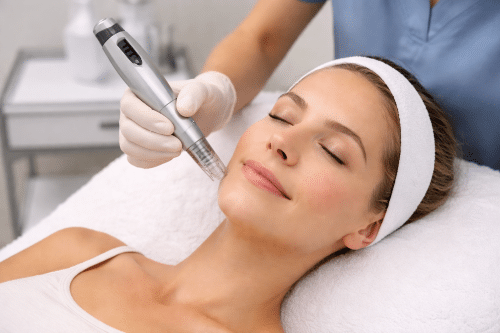
The instinct in modern aesthetics often leans toward adding—serums, biologics, resurfacing agents—yet skin is not passive. It is a signal-driven system, constantly interpreting mechanical, chemical, and neurological inputs to decide how to repair, reorganize, or defend.
Microchanneling sits in a different category.
It does not attempt to override biology. It introduces controlled mechanical signals—precise, repeatable, and measured—allowing the skin to respond using its own repair logic.
At STAR Health, this distinction matters. The focus is not on forcing change, but on guiding tissue response through biomechanical clarity. A biomechanically informed, tissue-respecting procedure, not a cosmetic shortcut.
Systems Explanation
Skin is not a surface—it is a layered communication network.
Each layer contributes to how the tissue responds to stress, stimulation, and recovery:
- Epidermal barrier function regulates protection and permeability
- Dermal collagen architecture provides structure and resilience
- Microvascular circulation supports nutrient delivery and waste removal
- Inflammatory signaling determines repair vs. irritation pathways
- Nervous system input modulates sensitivity and response thresholds
Microchanneling interacts with all of these systems simultaneously.
Rather than overwhelming the tissue, it delivers uniform, controlled micro-stimulation—small enough to avoid disruption, but specific enough to trigger recognition.
The result is not damage. It is organized signaling.
Clinical Visualization
What Microchanneling Actually Does
Microchanneling uses fine, precision-guided needles to create evenly spaced micro-channels across the skin.
These channels are not random. They are:
- Depth-controlled
- Uniformly distributed
- Mechanically consistent
This consistency allows the skin to interpret the input clearly.
In response:
- Local signaling pathways activate
- Fibroblasts receive mechanical cues
- Collagen and elastin organization is encouraged
- Circulation increases subtly in the treated region
Unlike aggressive resurfacing:
- The epidermis remains largely intact
- Barrier disruption is minimal
- Recovery pathways stay within physiologic limits
This distinction is critical.
The goal is not to provoke the skin—it is to communicate with it.
| Skin Condition | Recommended Treatments |
| Aging Skin | 3 to 6 sessions, spaced 4-6 weeks apart |
| Acne Scars | 4 to 8 sessions, spaced 4 weeks apart |
| Stretch Marks | 4 to 6 sessions, spaced 4-6 weeks apart |
| Even Skin Tone | 3 to 5 sessions, spaced 4 weeks apart |
🧠 Clinical Insight
Skin responds best to signals it can interpret.
Precision—not intensity—determines the quality of renewal.
Historical
In 1861, Austrian anatomist Karl Langer, MD, mapped what are now known as Langer’s lines—patterns in the skin that reflect underlying mechanical tension.
His work revealed something foundational:
- Skin is not isotropic (uniform in all directions)
- Mechanical forces influence healing outcomes
- Direction and distribution of stress matter
Modern microchanneling operates within this same principle.
By respecting the mechanical language of tissue, it aligns intervention with biology rather than working against it.
Regulatory- Safe Positioning
Microchanneling is often misunderstood in a landscape filled with exaggerated claims.
At its core, it is important to clarify what it does not do:
- It does not implant biologics
- It does not alter cellular genetics
- It is not a regenerative cure
Instead, it supports:
- Physiologic repair pathways
- Natural collagen organization processes
- Mechanical signaling within normal tissue behavior
This positioning is not a limitation—it is a strength.
It keeps the intervention grounded in predictable, biology-aligned outcomes.
E-E-A-T
Microchanneling at STAR Health is guided by clinical reasoning, not cosmetic trends.
Every application considers:
- Tissue tolerance
- Signaling thresholds
- Patient-specific variability
- Integration with broader care strategies
The emphasis is on measured intervention, not aggressive correction.
Because skin health is not achieved through force—it is achieved through coherent signaling over time.
Did You Know
Even minor variations in mechanical input—such as angle, spacing, or pressure—can significantly change how skin cells respond.
Consistency is not just a technique detail.
It is a biological requirement for organized repair.
Local Care, Global Science
In Fort Wayne, interest in non-invasive skin support continues to grow.
Common search patterns include:
- microchanneling skin treatment
- non-laser skin rejuvenation
- skin renewal without downtime
This reflects a broader shift toward approaches that respect tissue behavior rather than override it.
Microchanneling fits within this evolution—where global scientific understanding meets local, individualized care.
FAQ
While often used interchangeably, microchanneling emphasizes controlled, uniform mechanical input with consistent depth and spacing, focusing on signaling precision rather than variability.
The procedure introduces controlled micro-stimulation, not destructive injury. The epidermis remains largely intact, allowing repair pathways to stay within physiologic limits.
This depends on tissue response and individual goals. The focus is not on a fixed number, but on how the skin adapts over time.
Yes, when clinically appropriate. It is often integrated into broader care strategies that consider circulation, inflammation, and tissue health.
Downtime is typically minimal due to the non-ablative nature of the procedure, though individual responses can vary.
Candidates are best determined through evaluation of skin condition, tolerance, and overall health context, rather than a one-size-fits-all approach.
Schedule a consultation to determine whether microchanneling aligns with your skin health strategy and tissue response profile.