
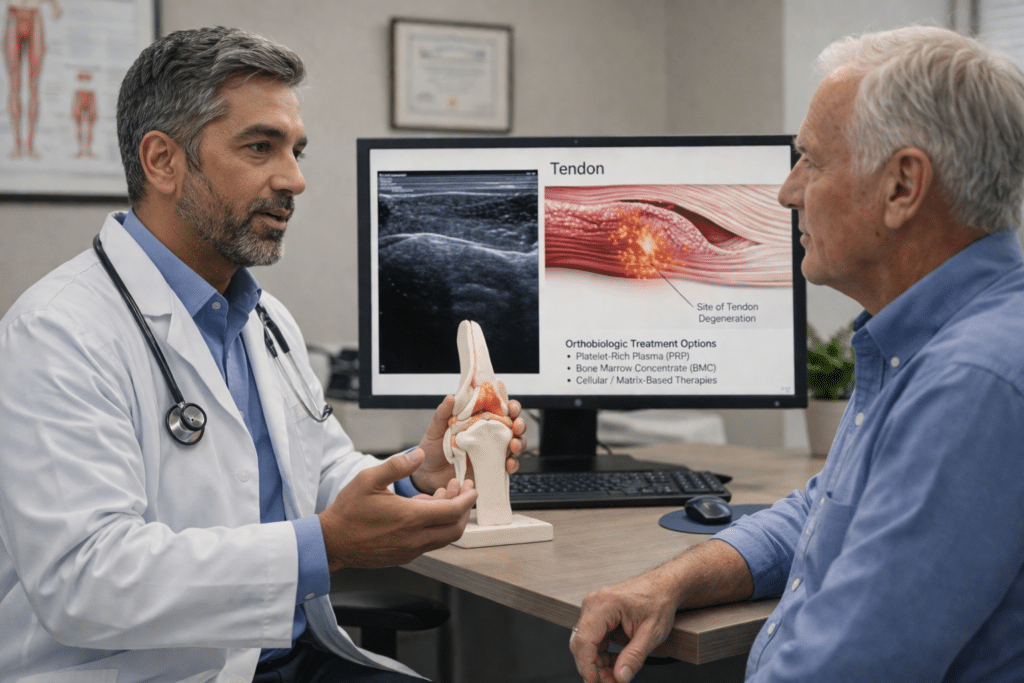
Why Healing Is a Coordinated Process—Not a Procedure
Why can the very same regenerative treatment help one individual regain meaningful function while another experiences only modest—or temporary—improvement?
That question sits at the center of modern regenerative medicine.
This question sits at the center of modern regenerative medicine.
It also explains why regenerative medicine sometimes falls short when it is approached as a procedure instead of a systems-based medical intervention.
At STAR Health, regenerative medicine is not viewed as simple cellular replacement.
It is practiced as systems engineering applied to human biology—an approach that evaluates not only what is being delivered, but whether the biologic, mechanical, neurologic, and structural environment is prepared to respond.
Healing does not emerge from a syringe.
Regeneration Is a Systems Problem—Not Simply a Tissue Problem
Every engineered system depends upon coordination.
Aircraft remain stable because countless components communicate continuously.
Bridges withstand stress because forces are distributed across an integrated structure.
Power grids remain reliable because feedback systems constantly adapt to changing demand.
Human healing follows the same principle.
Tissue repair depends upon the coordinated interaction of multiple biologic systems rather than a single therapeutic event.
These include:
- Biologic signaling through cytokines, growth factors, and cellular communication
- Mechanical loading involving force magnitude, timing, and direction
- Structural integrity of collagen architecture and extracellular matrix
- Neurologic regulation including motor control and protective inhibition
- Vascular supply delivering oxygen and nutrients
- Inflammatory resolution that transitions healing from repair toward remodeling
Optimizing only one variable—such as delivering an orthobiologic injection—while neglecting the remaining systems resembles reinforcing a single beam in a failing bridge.
Temporary improvement may occur, but long-term resilience rarely does.
Temporary improvement may occur.
Long-term resilience rarely does.
Feedback Loops Govern Healing
Healing occurs inside continuous feedback loops.
Mechanical forces influence cellular behavior and cells modify tissue architecture.
Mechanical forces influence cellular behavior.
Cells modify tissue architecture.
Changes in tissue stiffness alter how future forces are transmitted.
These relationships constantly evolve.
When loading exceeds tissue capacity, inflammation persists.
When loading is insufficient, tissues lose strength.
When loading is appropriately progressed, remodeling becomes increasingly organized.
This systems perspective explains why patients sometimes experience:
- High-quality biologics
- Accurate image-guided placement
- Appropriate preparation techniques
But experience only temporary improvement.
The biologic may have functioned exactly as intended.
The surrounding system remained unable to sustain repair.
Historical Perspective: Healing Has Always Been Systemic
Modern regenerative medicine did not invent systems biology.
It expanded upon principles observed more than a century ago.
In 1864, French physiologist Paul Bert described experiments that later became known as parabiosis, demonstrating that circulating biologic factors could influence tissue behavior across connected organisms.
Although molecular signaling pathways were unknown at the time, one observation became increasingly important:
Healing could not be explained by local tissue alone.
During and following World War II, physicians treating radiation injuries reached a similar conclusion.
Many patients succumbed not because of isolated organ injury but because bone marrow function had failed.
Restoring hematopoietic tissue restored survival.
These discoveries fundamentally reshaped medical thinking.
Healing depends upon the condition of the entire biological system—not merely the injured structure.
Modern regenerative medicine continues to refine this principle through advances in biomechanics, molecular biology, rehabilitation science, and systems physiology.
Imaging Reveals Structure—Not Readiness
MRI and CT imaging transformed modern diagnosis.
However, structural imaging alone cannot determine whether tissue is prepared to heal.
Imaging demonstrates:
- Structural disruption
- Degenerative change
- Tissue morphology
It does not directly measure:
- Load tolerance
- Neuromuscular coordination
- Cellular responsiveness
- Adaptive capacity
- Biomechanical efficiency
This explains why two patients with similar MRI findings often function very differently.
Some remain highly active despite significant structural degeneration.
Others experience substantial pain despite relatively modest imaging abnormalities.
At STAR Health, imaging is interpreted within a broader diagnostic framework that integrates physical examination, movement analysis, biomechanics, neurologic assessment, and functional testing.
Structure is interpreted within context—not isolation.
These relationships constantly evolve.
Diagnostics Before Delivery
Effective regenerative medicine begins long before a biologic is introduced.
The diagnostic process seeks answers to questions such as:
- Is pain primarily mechanical, inflammatory, neurologic, or mixed?
- Is instability preventing efficient force transfer?
- Is the biologic environment capable of responding?
- Are dysfunctional movement patterns perpetuating overload?
- Is neural inhibition limiting coordinated movement?
Without understanding these variables, even expertly prepared biologics may produce inconsistent outcomes.
The limitation is often not the regenerative therapy itself.
It is the system receiving it.
Clinical Insight
The most common reason regenerative medicine underperforms is not inadequate biologic preparation.
It is persistent systems misalignment involving biomechanics, structural loading, neurologic control, or rehabilitation progression.
Structure Enables Signal Fidelity
Cells never function independently of their environment.
They interpret biochemical signals through the physical architecture surrounding them.
When extracellular matrix organization deteriorates:
- Mechanical information becomes distorted.
- Cellular communication becomes less efficient.
- Collagen alignment loses organization.
- Remodeling becomes increasingly chaotic.
This explains why bioscaffolding and extracellular matrix preservation continue to receive growing scientific attention.
Structure itself does not regenerate tissue.
Structure provides the framework through which biologic signals become meaningful.
Movement Completes the Healing System
Healing does not conclude when an injection is complete.
Recovery continues through movement.
Progressive loading determines whether new tissue becomes:
- Organized
- Functional
- Durable
Thoughtfully prescribed rehabilitation influences collagen alignment, neuromuscular coordination, force distribution, and long-term tissue adaptation.
Regenerative medicine that ignores movement science risks recreating the very mechanical conditions responsible for tissue failure.
For this reason, regenerative care at STAR Health integrates rehabilitation, biomechanics, and progressive loading into physician-directed treatment planning.
Engineering Predictability Into Biology
Engineering disciplines reduce uncertainty by controlling variables.
Regenerative medicine increasingly follows the same philosophy.
Treatment planning seeks to:
- Reduce unnecessary variability
- Control biologic and mechanical inputs
- Monitor clinical response
- Adjust loading as healing progresses
Rather than depending upon biologic chance alone, regenerative strategies attempt to optimize the conditions under which healing naturally occurs.
This transforms regenerative medicine from a procedure-centered model into a strategy-driven systems approach.
Did You Know?
Experimental studies consistently demonstrate that identical biologic cells can produce markedly different responses depending upon mechanical loading, oxygen availability, extracellular matrix organization, and inflammatory environment.
The same biologic signal may promote organized healing in one environment while producing limited benefit in another.
Local Care, Global Science
Patients throughout Fort Wayne and Northeast Indiana frequently search for:
- systems-based regenerative medicine
- why PRP doesn’t work for everyone
- regenerative medicine biomechanics
- non-surgical regenerative therapy
- regenerative medicine Fort Wayne
STAR Health integrates contemporary evidence from systems biology, biomechanics, rehabilitation science, and orthobiologic medicine into physician-led care designed around each patient’s diagnostic findings rather than a standardized procedure.
Related Services
- Regenerative Medicine
- Orthobiologic Therapy
- Bioscaffolding
- Physical Rehabilitation
Frequently Asked Questions
Why doesn’t regenerative medicine work the same for everyone?
Healing depends upon the interaction of biology, biomechanics, neurologic regulation, inflammation, vascular supply, and rehabilitation. Individual differences across these systems influence recovery.
Is regenerative medicine a replacement for surgery?
Not necessarily. Regenerative medicine may be appropriate for selected conditions, but treatment recommendations depend on diagnosis, structural integrity, severity of disease, and individual goals.
Why is rehabilitation important after regenerative therapy?
Appropriate rehabilitation helps guide collagen organization, restore efficient movement patterns, and progressively increase tissue load tolerance during healing.
Can MRI determine whether regenerative medicine will work?
MRI provides valuable structural information but cannot independently determine biologic responsiveness, neuromuscular function, or load tolerance.
Why is diagnosis emphasized before treatment?
Understanding the mechanical, neurologic, inflammatory, and structural contributors to symptoms helps determine whether regenerative medicine is appropriate and how it should be integrated into an overall treatment strategy.
E-E-A-T | Physician Perspective
Regenerative medicine should never be reduced to a single product or procedure.
Physician-led evaluation, diagnostic precision, biomechanics, rehabilitation, and evidence-informed decision making remain central to determining whether biologic therapies are appropriate.
Incorporating these elements into a comprehensive treatment plan ensures optimal outcomes.
STAR Health integrates contemporary evidence from systems biology, biomechanics, rehabilitation science, and orthobiologic medicine into physician-led care designed around each patient’s diagnostic findings.