

Headache Medicine at STAR Heal
When Headaches Don’t Behave, They’re Telling a Story
The scan is reassuring. The medication helps—until it does not. Then the headache returns after driving, computer work, poor sleep, or jaw tension.
Headaches are not a diagnosis. They are a signal.
For patients seeking headache treatment in Fort Wayne, STAR Health investigates head pain as a neurologic, biomechanical, and biologic message. The objective is to understand the system producing it.
Care is led by Dr. Joseph Fortin, board-certified in Physical Medicine & Rehabilitation and subspecialty-certified in Interventional Pain Management.
“To end pain and human suffering through compassionate, research-driven, innovative care.”
🟦 HEADACHE TREATMENT: WHY STAR HEALTH IS DIFFERENT
We Treat the “Why,” Not Just the Pain
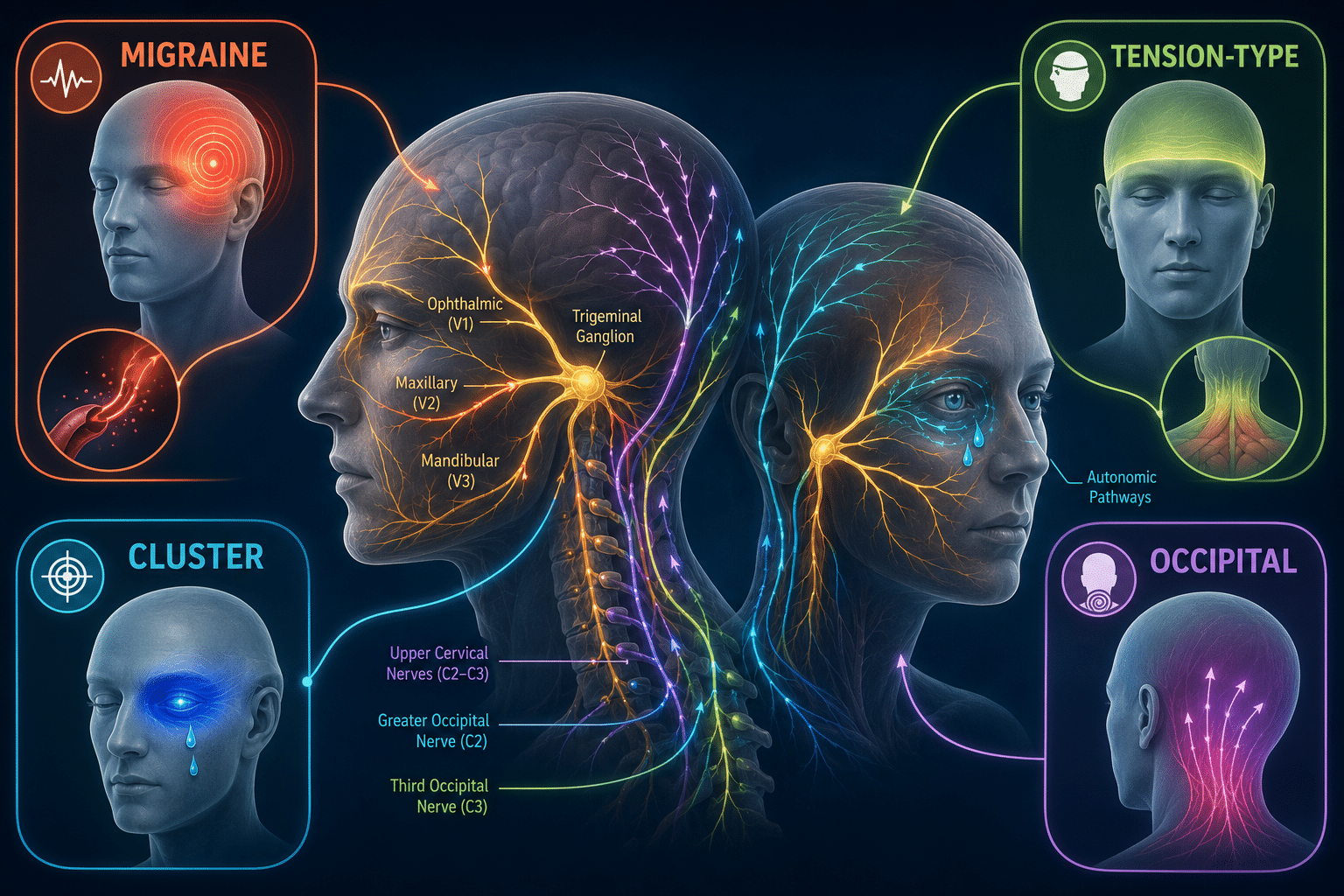
Head pain may begin in one place and be sustained somewhere else. Nerve sensitivity can interact with restricted cervical motion. Jaw guarding changes muscular load. Poor sleep or stress can lower tolerance.
That is why STAR Health examines three connected domains:
That is why STAR Health examines three connected domains:
- Structure: cervical joints, discs, muscles, connective tissues, and jaw mechanics
- Signaling: trigeminal and upper-cervical pathways, sensory sensitivity, and pain modulation
- Load: posture, gait, work demands, sleep, stress, and repeated movement
No MRI finding, posture measurement, or label tells the entire story. Data are correlated before conclusions are made.
Most new evaluations last one to two hours, allowing time to reconstruct the pattern.
DID YOU EVER WONDER?
Why can a headache be severe when a brain MRI is “normal,” the neck feels only mildly stiff, or the pain migrates from one pattern to another?
The mismatch may be the clue. Static imaging shows anatomy, but may not reveal abnormal load, irritated signaling, impaired coordination, or changing tolerance. Normal imaging does not make the pain imaginary.
🟦 HEADACHE PATTERNS WE EVALUATE
STAR Health evaluates patterns including:

🟦 HOW HEADACHE CARE WORKS
Precision Over Guesswork
Evaluation begins with the pattern: timing, location, sensory features, triggers, injuries, sleep, medication response, and function. Examination may assess neurologic behavior, cervical movement, muscle coordination, jaw contribution, posture, gait, and load tolerance.
The process may include:
- MRI, CT, or X-ray review in clinical context
- Dynamic ultrasound when indicated
- Video-based posture or movement analysis
- Electrodiagnostic assessment when indicated
- Selective diagnostic injection or nerve block
- Coordination with Pain Management or Physical Rehabilitation
The sequence matters: map the pattern → test the hypothesis → confirm when necessary → coordinate care.
The National Institute of Neurological Disorders and Stroke provides general migraine education.
🟦 IMAGING: INTELLIGENCE, NOT A VERDICT
Imaging provides structural information. It does not automatically establish causation.
An abnormality may be real yet unrelated. A normal study may reduce concern for certain problems without excluding joint dysfunction, nerve sensitivity, or load-dependent pain.
The International Classification of Headache Disorders notes that evidence for a cervical source can include provocation with reduced motion or abolition after diagnostic blockade—not imaging alone. See the ICHD-3 cervicogenic headache criteria.
Headaches demand correlation, not conclusions formed in an imaging vacuum.
CLINICAL INSIGHT
Clinical Insight: When headache intensity changes with neck position, jaw activity, fatigue, sensory demand, or stress load, confirming the driver may be more valuable than escalating treatment based on the symptom alone.
🟦 WHY STAR HEALTH USES A WIDE LENS
Headaches may involve neurologic signaling, cervical mechanics, skeletal tolerance, recovery biology, and daily demands.
Dr. Fortin’s clinical background spans:
This breadth expands the questions asked without predetermining treatment.
Imaging informs structure. Nerve testing examines signal behavior. Movement analysis reveals load transfer. The wide lens is useful only when findings are integrated.
WHAT PATIENTS CAN EXPECT
Patients can expect:
- An unhurried, physician-led evaluation
- Clear explanations of knowns and uncertainties
- A diagnostic roadmap rather than a template
- Continuity and reassessment based on response
- Treatment recommendations matched to the evidence
STAR Health does not practice volume headache medicine.
🟦 EXPECTATIONS AND COMPLIANCE CLARITY
What This Service May Help Clarify
Care may identify contributors involving biomechanics, nerve signaling, sensitization, movement, sleep, autonomic tone, or inflammatory load. Better understanding supports treatment selection.
What This Service Cannot Promise
Headache disorders are complex. STAR Health does not promise a cure, instant fix, or guaranteed outcome. Care remains individualized, evidence-framed, and medically appropriate.
DID YOU KNOW?
Did You Know? Severe symptoms can involve joint motion, muscle coordination, nerve sensitivity, or sensory integration—even when brain imaging is reassuring. MRI and CT may identify important structural conditions, but neither independently explains every headache.

HISTORICAL PERSPECTIVE
Head pain was described in ancient Egyptian and Greek medicine long before modern imaging. Those theories do not map onto current knowledge, but reveal an enduring challenge: head pain may have influences beyond the head.
🟦 LOCAL CARE, GLOBAL SCIENCE
Patients across Fort Wayne and Northeast Indiana may seek care because migraines changed, neck-related pain returns, or imaging has not explained the symptoms.
STAR Health integrates neurologic classification, biomechanics, imaging, and movement science. Headache treatment in Fort Wayne should begin with diagnosis—not a reflexive procedure.
FREQUENTLY ASKED QUESTIONS
Yes. Migraine is evaluated as a neurologic disorder with individual triggers and modifiers. Cervical or movement-related findings are assessed without assuming causation.
Not necessarily. A diagnostic injection may test a specific pain-generator hypothesis. It is not the default and does not guarantee a therapeutic procedure.
Reassuring imaging is valuable, but does not exclude every functional, neurologic, joint, muscle, or movement contributor. Symptoms and examination still require correlation.
The physician reviews the history, records, and imaging; performs a neurologic and musculoskeletal examination; and explains next steps. Most new evaluations are scheduled for one to two hours.
Seek urgent care for a sudden severe or unfamiliar headache, especially after trauma or with weakness, confusion, fainting, seizure, fever, stiff neck, vision loss, or difficulty speaking. Do not delay emergency assessment.
When Headaches Don’t Behave Predictably, Investigation Matters
If the pattern keeps changing, it may be time to examine the system producing the signal.
Schedule a comprehensive headache evaluation
STAR Health — Fort Wayne, Indiana
Time-rich. Physician-led. Systems-based.