
Instrument-Assisted Therapeutic Massage at STAR Health Precision Mechanical Therapy—Integrated With Medical and Rehabilitation Care
Why can pressure feel helpful one day—and aggravating the next?
Pain, guarding, and stiffness change with tissue sensitivity, movement demands, recovery, and the nervous system’s interpretation of threat. The same instrument can create a different response when its force, frequency, amplitude, location, or timing changes.
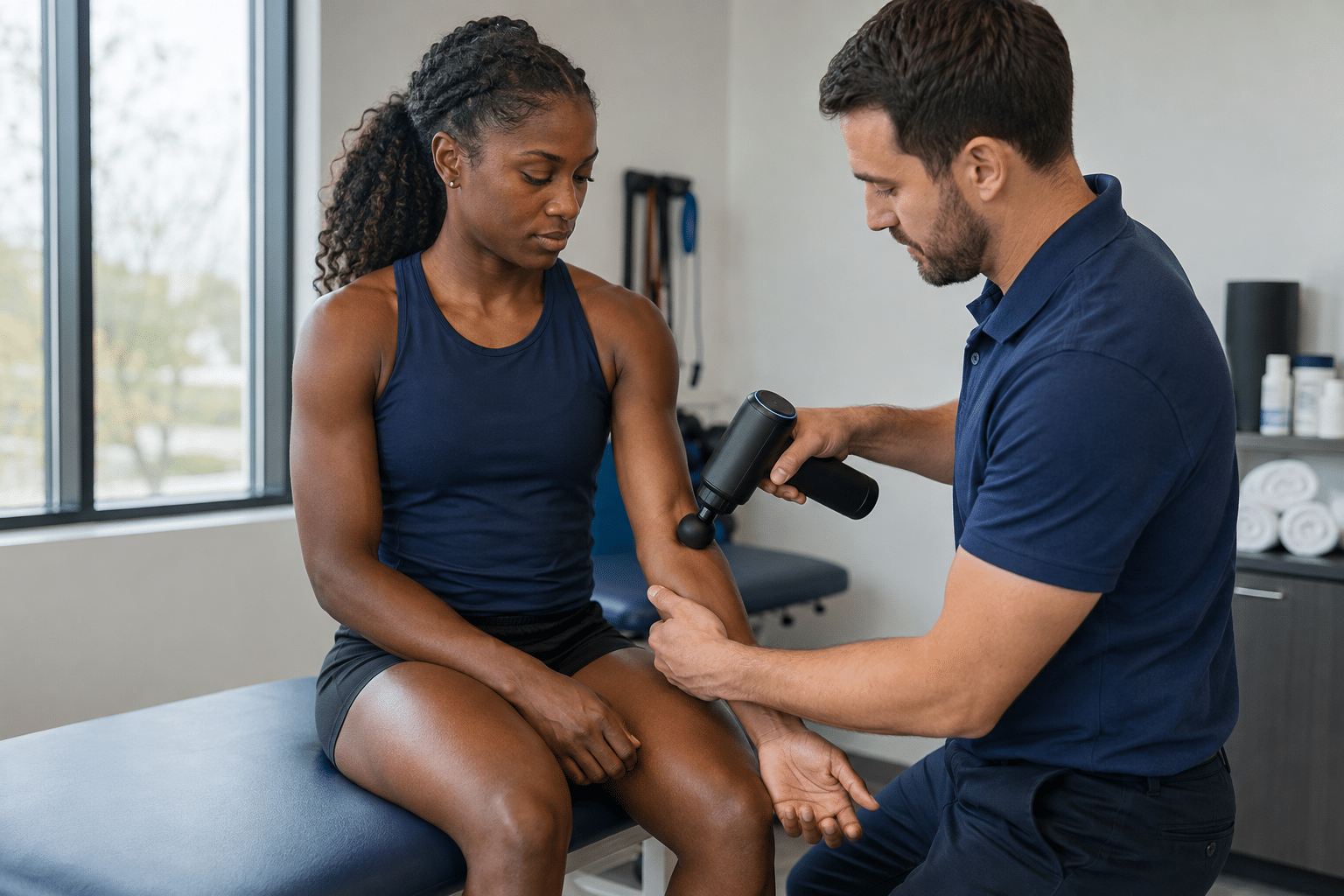
At STAR Health, instrument-assisted therapeutic massage is a diagnosis-informed adjunct. Controlled percussion or vibration may be used to support comfort, short-term mobility, and participation in rehabilitation. It is not presented as a cure, a way to “break up” tissue, or a substitute for medical evaluation.
- Clinically selected mechanical input
- Integrated with rehabilitation and medical care
- Adjusted to tissue sensitivity and recovery stage
- Delivered with patient feedback and appropriate screening
🟦Why STAR Health Is Different
At STAR Health, massage begins with a clinical question: What is driving the sensitivity—and what response should care create?
It may be appropriate when it helps a patient move more comfortably or creates a temporary window for exercise. It may be inappropriate with suspected fracture, infection, blood-clot risk, open wounds, altered sensation, or another condition requiring different care.
That distinction matters. The instrument is not the treatment plan. Diagnosis, sequencing, and response determine its role.
🟦 The Systems-Based “Pain Detective” Framework
Imagine a runner with Achilles pain. Ultrasound shows tendon continuity, but examination reveals thickening, tenderness, reduced calf capacity, and a recent spike in hill training. The structure is present. Signaling is irritable. Load has exceeded capacity.
Rest may reduce symptoms without rebuilding tolerance. Aggressive exercise may keep provoking the area. Laser therapy may support the biological environment while rehabilitation restores strength and load capacity.
The response is then tested against function. Is morning stiffness changing? Can the runner tolerate progressive loading? Is calf capacity improving? Laser therapy remains only if it contributes to measurable progress.
Now change the diagnosis to a significant tear, nerve entrapment, or referred pain. The device has not changed—but its clinical role has. Diagnosis changes the plan.
Image: Physician-directed photobiomodulation applied to an exposed musculoskeletal treatment area at STAR Health
ALT: laser therapy in Fort Wayne physician-directed photobiomodulation treatment at STAR Health

🟦Clinical Visualization: The Moment the Dose Matters
Two patients report persistent thigh tightness. One is recovering after hard training. The other has new warmth, swelling, and unexplained pain. The first may tolerate selected percussion before movement retraining. The second needs medical assessment—not stronger massage.
The device looks identical. The symptom sounds similar. The examination changes everything. Intensity is not chosen by pressure preference alone, although comfort, consent, and feedback remain essential.
🟦 Clinical Insight: What the Instruments Can—and Cannot—Do
Instrument-assisted therapeutic massage applies repeatable percussion or vibration to selected soft tissue. “Dose” combines pressure, frequency, amplitude, treatment area, duration, and patient response; it is not a universal prescription.
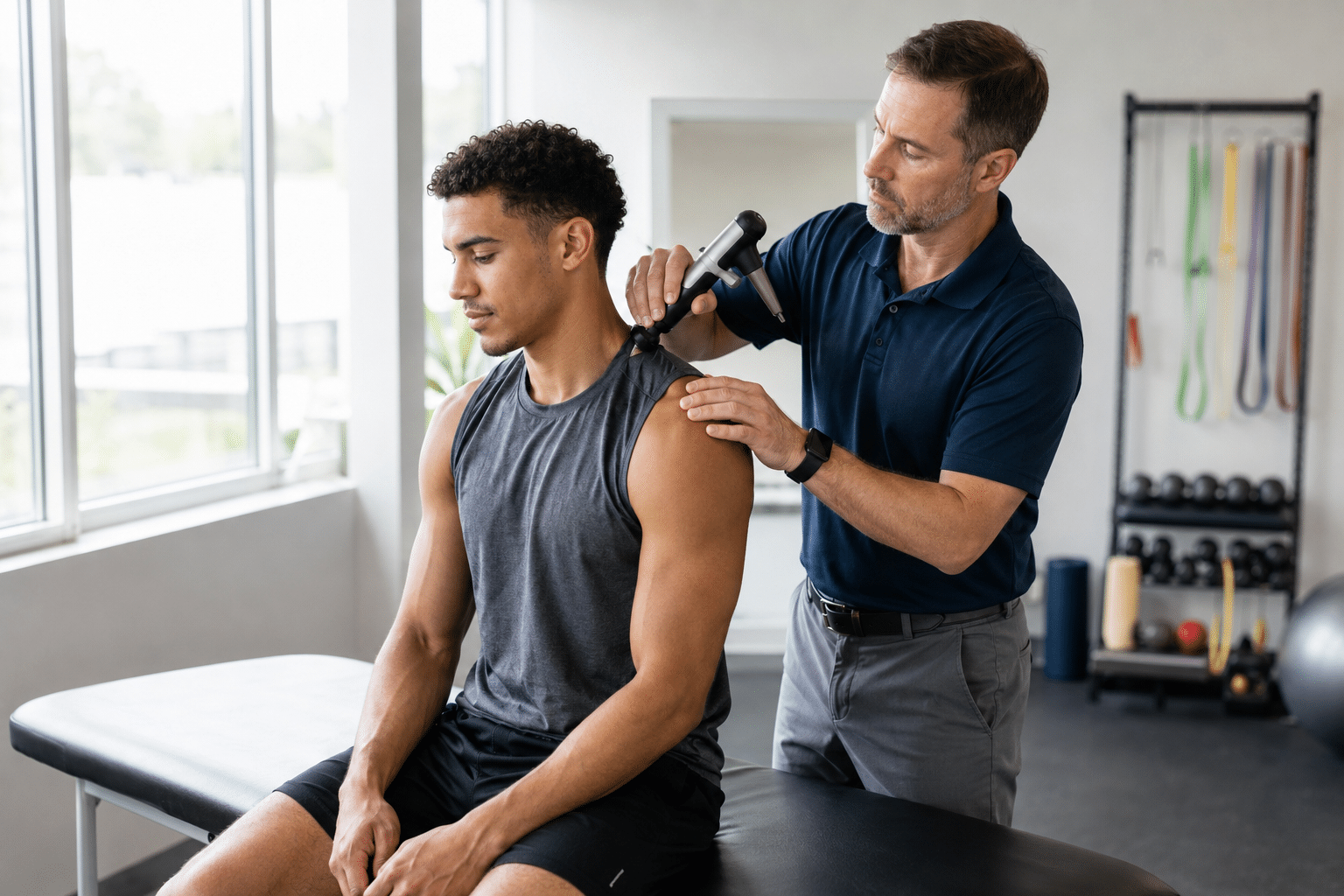
Percussive therapy delivers rapid impulses. A focal, uniaxial application may target a small muscle region; a broader or biaxial application may distribute input across the back, hip, or thigh. It may be used for exercise-related soreness, guarding, or preparation for movement.
Low-amplitude vibrational therapy provides gentler oscillatory input when deeper percussion is poorly tolerated. Yet recent surgery, swelling, bruising, impaired sensation, anticoagulant use, vascular concerns, and fragile tissue can change or eliminate its role.
Selection is based on:
- Examination findings and working diagnosis
- Tissue irritability and symptom behavior
- Recovery or postoperative stage
- Relevant precautions and medical history
- The movement task planned after treatment
- The patient’s real-time response
The goal is not to erase every tender point, but to improve tolerance for gait training, shoulder motion, strength work, or daily activity. When indicated, massage can be coordinated with Sports Medicine Services(opens in new tab) or Musculoskeletal & Orthopedic Medicine(opens in new tab).
It may be considered for muscle tension, sports-related fatigue, overuse symptoms, neck or back discomfort, and stiffness during rehabilitation. Benefits vary, are often temporary, and should be reassessed.
🟦 Experience, Expertise, Authority, and Trust
Dr. Joseph Fortin (DO) integrates board-certified Physical Medicine & Rehabilitation (PM&R) expertise with subspecialty certification in Interventional Pain Management, alongside recognized experience in regenerative medicine, sports medicine, and integrative medicine—supporting system-level interpretation of imaging, movement, tissue biology, and pain mechanisms to reduce misdirected care.
National and international speaker on biomechanics, human movement, MRI & CT imaging physics, interventional pain management, and regenerative medicine.
This integrated perspective helps determine when mechanical therapy belongs in care—and when the symptom requires a different investigation.
🟦Did You Know?
More pressure is not automatically more therapeutic. A brief, tolerable mechanical input may create a temporary change in comfort or range of motion that can be used immediately for purposeful movement. If the input increases guarding, numbness, bruising, or lingering pain, the dose—or the treatment itself—should be reconsidered.
🟦Historical Perspective and Evidence Boundaries
Massage has long been used for pain and wellbeing; handheld percussion devices are comparatively new and allow mechanical parameters to be varied more consistently.
The science remains narrower than the marketing. The National Center for Complementary and Integrative Health(opens in new tab) notes that massage research varies by condition and often supports only short-term or low-certainty benefits. It also reports that serious harms are uncommon but have occurred, particularly with vigorous techniques or vulnerable patients.
A 2023 systematic review of massage-gun percussive therapy(opens in new tab) reported possible improvements in flexibility, selected performance measures, and musculoskeletal pain; however, all 13 included studies had methodological or reporting limitations. The appropriate conclusion is measured: percussive therapy may be a useful adjunct, but it is not a diagnosis or a stand-alone recovery system.
🟦 Local Care, Global Science
Patients seeking clinical massage therapy in Fort Wayne may need help returning to exercise, tolerating rehabilitation, or understanding persistent guarding.
STAR Health brings biomechanics, neuroscience, and rehabilitation principles into local, physician-directed care for Fort Wayne and Northeast Indiana.
Patients can expect:
- A clinical, non-spa environment
- Screening for relevant risks and precautions
- Explanation of the selected instrument and treatment goal
- Communication across medical and rehabilitation teams
- Dose adjustments based on response
- Reassessment of function—not pressure for its own sake
Frequently Asked Questions
No. Instrument-assisted therapeutic massage at STAR Health is used in a medical and rehabilitation setting for a defined clinical objective. Relaxation may occur, but it is not the sole basis for selecting treatment.
Your comfort, consent, and feedback matter. Intensity is adjusted to tissue response and the functional goal—not an assumption that deeper pressure is better.
Sometimes. Surgical precautions, wound status, sensation, swelling, medications, and surgeon guidance matter. Treatment should not be applied over an unhealed incision or used without appropriate clearance.
No. It may support comfort or movement, but it does not replace diagnosis, progressive exercise, load management, or treatment of an underlying condition.
There is no universal schedule. Frequency depends on the diagnosis, response, recovery stage, and whether each session produces a useful functional change. Care should be continued only when its role and benefit remain clear.
🟦 Find Out Whether Massage Therapy Fits Your Care Plan
Persistent pain deserves more than a preset protocol. Schedule a physician-directed evaluation at STAR Health to determine whether laser therapy is appropriate for your diagnosis, tissue status, and recovery goals.