
Kyphoplasty at STAR Health Precision Vertebral Augmentation at STAR Health
A minor fall, cough, or ordinary bend is followed by pain that does not behave like a typical strain. Standing becomes difficult. Turning in bed hurts.
The visible problem may be pain. The hidden problem may be a vertebra that can no longer carry load normally.
For patients considering kyphoplasty in Fort Wayne, the first question is not how quickly pain can be treated. It is whether an active vertebral compression fracture is responsible for the loss of function.
At STAR Health, the procedure is considered only after symptoms, imaging, bone health, and mechanical demands have been evaluated together.
🟦 A Compression Fracture Is More Than a Painful Bone
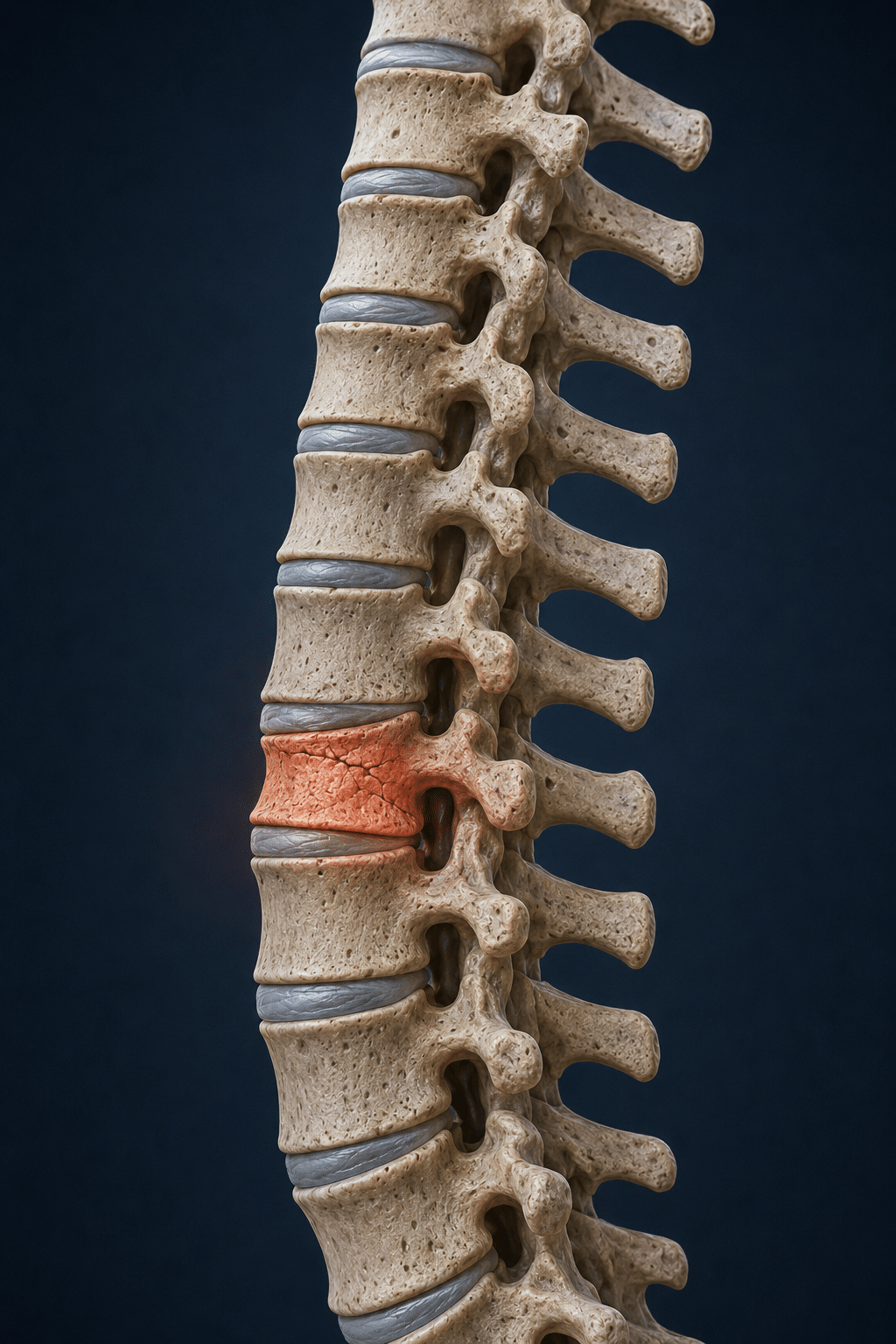
The spine transfers force between the head, rib cage, pelvis, and limbs. Each vertebral body contributes to alignment and load sharing.
When one vertebra compresses, three systems can change at once:
- Structure: the vertebral body may lose height or develop a wedge-shaped deformity.
- Signaling: the fracture and surrounding tissues may generate pain with standing, walking, rolling, or other loading movements.
- Load: force may be redistributed across discs, muscles, joints, and neighboring vertebrae.
That redistribution can create a quiet cascade. Pain reduces movement; reduced movement contributes to deconditioning. A flexed posture can change balance and breathing mechanics, while osteoporosis leaves other bones vulnerable.
The fracture, the person, and the bone disease must be assessed as one system. The National Library of Medicine’s overview of vertebral augmentation reviews patient selection, imaging, contraindications, and rehabilitation.
🟦 What Kyphoplasty Does Inside the Vertebra
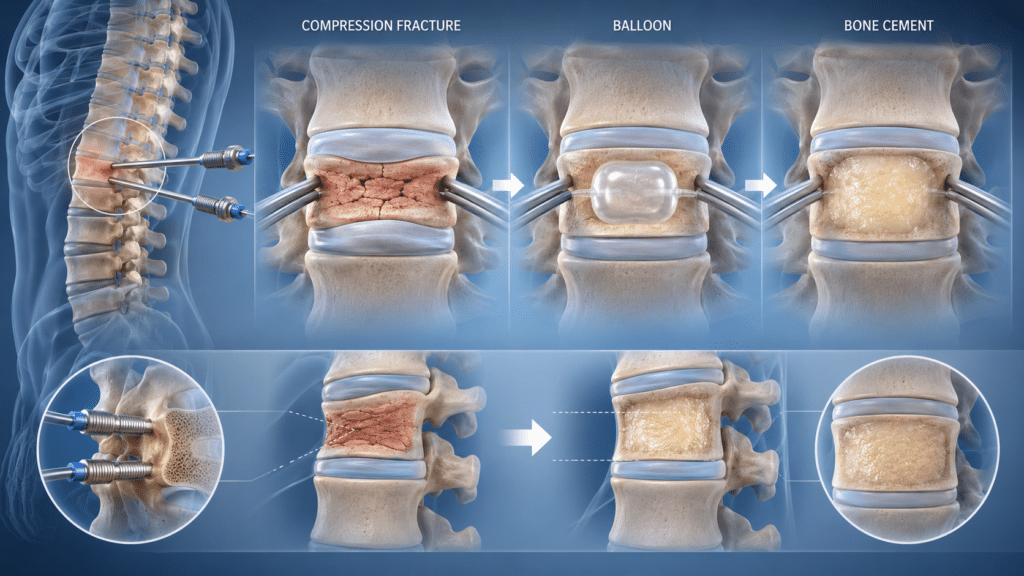
During balloon kyphoplasty, the patient is positioned carefully and the fractured level is identified with real-time fluoroscopic imaging.
Through a small percutaneous path, an instrument enters the vertebral body. A balloon creates a controlled cavity and may recover some height when the fracture remains mobile. The balloon is removed, and bone cement is delivered under imaging guidance.
The objective is not to make the spine “new,” and height restoration is not always possible. The objective is to reduce painful micromotion and reinforce the fractured structure while controlling cement placement.
Unlike vertebroplasty, kyphoplasty uses a balloon-created cavity before cement delivery. Both are forms of vertebral augmentation, but they are not identical.
🟦 Who May Be a Candidate—and Who May Not Be
Not every compression fracture needs kyphoplasty. Some improve with activity modification, medication, bracing, and rehabilitation. Others continue to produce function-limiting pain or progressive collapse despite appropriate conservative care.
A diagnostic evaluation may include:
- The timing and mechanism of symptom onset
- Focal tenderness and weight-bearing pain
- Neurologic and functional examination
- X-rays to assess height loss and alignment
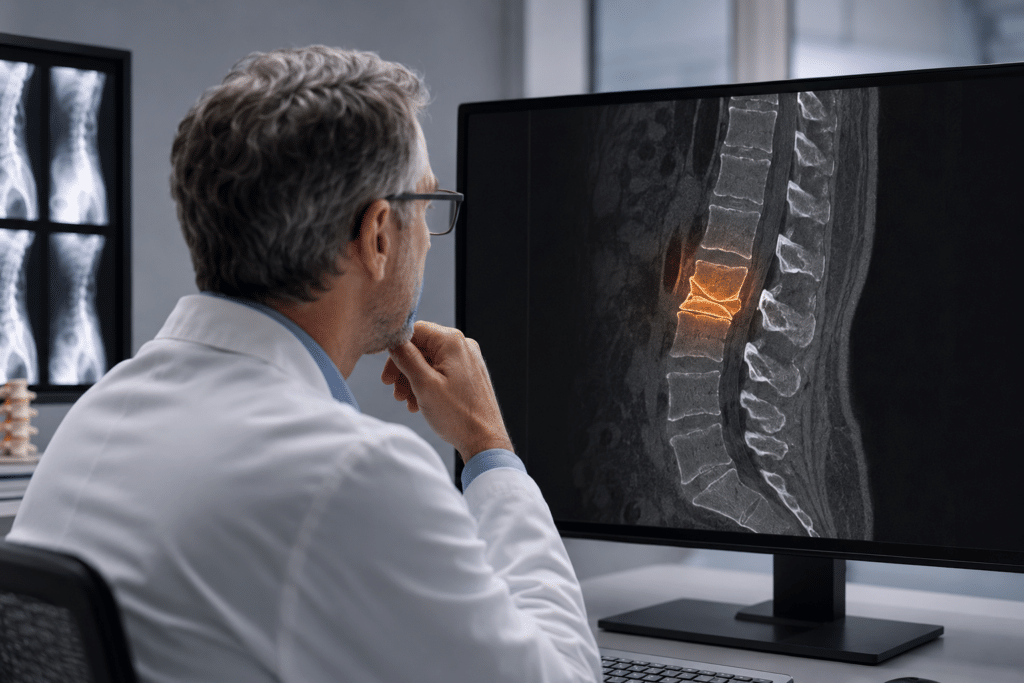
- MRI to look for marrow edema and identify an active fracture
- CT when fracture morphology needs closer definition
- Bone-density testing when appropriate
Kyphoplasty may be considered when imaging confirms a painful acute or subacute fracture that corresponds with the clinical findings. Selected malignancy-related fractures require disease-specific planning.
It may be inappropriate when the fracture is inactive, infection is present, or fragments threaten the spinal canal. New weakness, bowel or bladder dysfunction, or fever requires prompt evaluation.
🟦 Clinical Insight One Access Path or Two?
Kyphoplasty can use a unipedicular path through one pedicle or a bipedicular path through both. Dr. Joseph Fortin often uses a unipedicular technique when anatomy permits safe access to the intended zone.
One path may reduce procedural time and radiation exposure, but “one” is not automatically better than “two.” Safe trajectory and adequate cement distribution matter more than the number of access points. Fracture shape or anatomy may favor bilateral access.
The approach should follow the fracture.
🟦 What Recovery May Look Like
Kyphoplasty uses small access sites without open spinal exposure or permanent rods and screws. Discharge timing depends on the patient and procedural setting.
Some patients notice early improvement; others recover gradually. Access-site soreness can occur. Timing depends on fracture age, baseline function, and bone quality.
Potential complications include bleeding, infection, cement leakage, nerve injury, anesthesia-related events, pulmonary cement embolism, and additional fractures. Kyphoplasty does not cure osteoporosis.
Long-term care may therefore include:
- Bone-health evaluation and treatment
- Safe return to weight-bearing movement
- Strength, balance, and gait rehabilitation
- Fall-risk reduction
- Nutrition, medication, and lifestyle review
STAR Health can coordinate these needs within a broader pain management and rehabilitation strategy when appropriate.
🟦 Kyphoplasty in Fort Wayne: Diagnostic Experience
Kyphoplasty sits at the intersection of anatomy, imaging, materials science, and rehabilitation. The clinician must determine whether the fracture is active, explains the symptoms, and makes augmentation reasonable relative to risk.
At STAR Health, care is directed by Joseph Fortin, DO, Medical Director and an interventional pain physician board-certified in Physical Medicine and Rehabilitation and Pain Medicine. He completed residency training at Baylor College of Medicine and fellowship training in interventional spine and imaging.
🟦 Author Block
Joseph D. Fortin, DO
Medical Director, STAR Health
Board-certified in Physical Medicine and Rehabilitation and Pain Medicine
Fort Wayne, Indiana
This educational content does not replace an individualized diagnosis or medical consultation.
🟦 Did You Know?
A vertebral compression fracture can occur without a dramatic accident. In weakened bone, ordinary loading—a cough, twist, lift, or short fall—may exceed the vertebra’s structural tolerance.
Pain intensity alone cannot establish the diagnosis. Clinical findings and imaging must tell the same story.
🟦 From Vertebroplasty to Balloon Kyphoplasty
Modern vertebral augmentation began in France in 1987, when Jacques Galibert and Hervé Deramond used vertebroplasty for a painful cervical vertebral hemangioma. The concept later expanded to osteoporotic fractures.
Balloon kyphoplasty emerged in the 1990s to create a cavity before cement placement and, in selected mobile fractures, recover some height. The field has since been shaped by better imaging, refined materials, and more careful patient selection.
🟦 Local Care, Global Science
The science is international; the decision is personal.
At STAR Health in Fort Wayne, global evidence returns to a local question: What is failing—structure, signaling, load, or some combination of all three?
If the fracture is not the pain generator, kyphoplasty is not the answer. If an active fracture disrupts mobility and mechanics, augmentation may become one part of a plan addressing bone strength, movement, and future risk.
🟦 Frequently Asked Questions
Is kyphoplasty considered surgery?
Kyphoplasty is a minimally invasive, percutaneous vertebral augmentation procedure. It uses small access sites and imaging guidance rather than an open incision with rods or screws.
Is kyphoplasty the same as vertebroplasty?
No. Both stabilize a vertebra with bone cement, but kyphoplasty first uses a balloon to create a cavity and may restore some height in selected fractures. Vertebroplasty injects cement without that balloon step.
Will kyphoplasty prevent another compression fracture?
It stabilizes the treated vertebra but cannot guarantee prevention of a new fracture elsewhere. Bone-health treatment, appropriate exercise, balance work, and fall prevention remain important.
How soon can I return to normal activity?
Timing varies. The treating clinician provides instructions based on the fracture, procedure, medical history, and baseline function. Some patients mobilize soon after treatment, but heavier activity may require a staged return.
What are the risks of kyphoplasty?
Risks include bleeding, infection, cement leakage, nerve injury, anesthesia-related events, embolism, and additional fractures. An individual consultation is needed to weigh these risks against the likely benefit.
🟦 Find Out What the Fracture Is Changing
Persistent pain after a fall, sudden height loss, or pain that sharply increases with standing may deserve more than symptom control.
Contact STAR Health in Fort Wayne to schedule a diagnostic evaluation and determine whether kyphoplasty—or another form of care—fits your condition.