
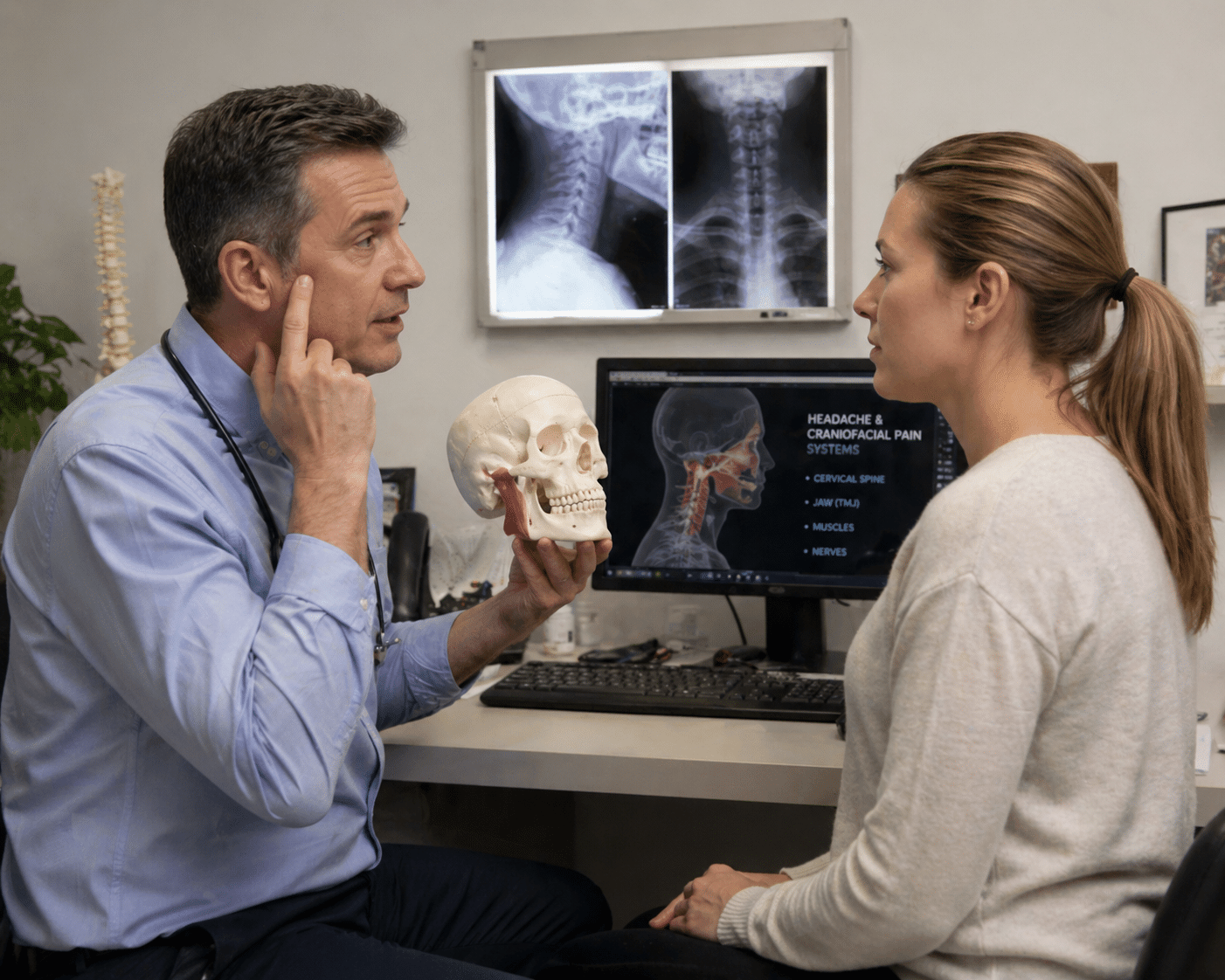
Did you ever notice how a headache rarely stays in one place?
It may begin behind the eyes, shift to the temples, settle at the base of the skull, and somehow pull into the jaw.
That movement is not random. It is signal behavior, not structural coincidence.
Headache and craniofacial pain are among the most misunderstood conditions in medicine—not because they are rare, but because they are interpreted too narrowly. A label is applied, symptoms are grouped, and the deeper question remains unanswered: what system is actually driving this?
At STAR Health, headaches are not treated as isolated events. They are evaluated as multi-system disruptions, where location is often misleading—and origin requires decoding.
🟦 SYSTEMS EXPLANATION
Craniofacial pain exists at the convergence of multiple systems that must remain synchronized to maintain stability.
When coordination falters, the nervous system begins to reinterpret normal signals as threat.
Key systems involved include:
• Neurologic signaling
Trigeminal nerve pathways integrate facial sensation with upper cervical input, forming a shared processing hub.
• Musculoskeletal mechanics
Jaw alignment, cervical spine mobility, and posture influence how forces are distributed across the head and neck.
• Vascular regulation
Autonomic tone controls blood vessel dilation and constriction, affecting pressure sensitivity.
• Sensory amplification
Light, sound, and smell sensitivity reflect altered signal filtering—not simply “triggers.”
• Inflammatory signaling
Local tissue irritation and systemic inflammation can amplify neural responsiveness.
Pain does not begin where it is felt. It emerges when these systems lose timing, balance, or load tolerance.
🟦 CLINICAL VISUALIZATION
A patient undergoes an MRI. The result comes back: unremarkable.
Relief is expected—but confusion follows.
If nothing is wrong, why does the pain persist, shift, or intensify?
Because many headache mechanisms are functional rather than structural. They involve how systems behave—not what they look like.
Common contributors include:
• nerve sensitization without visible compression
• muscular overload with referred pain patterns
• upper cervical joint dysfunction
• temporomandibular joint (TMJ) imbalance
• autonomic nervous system dysregulation
These processes operate at a level beyond standard imaging resolution.
According to the National Institute of Neurological Disorders and Stroke, headaches frequently involve complex neurovascular and sensory pathways rather than isolated structural abnormalities.
A normal scan rules out danger—but it does not explain dysfunction.
🟦 CLINICAL INSIGHT
Headache intensity often reflects nervous system sensitivity—not structural damage.
Sensitivity can increase through repeated overload, poor recovery, or prolonged signal amplification.
But unlike structural injury, sensitivity is dynamic. It can be reduced when systems are restored to coordinated function.
🟦 MECHANICAL CONTRIBUTIONS
Mechanical inputs quietly shape how headache patterns develop and persist.
Subtle restrictions or imbalances can shift neural signaling in ways that are not immediately obvious.
Examples include:
• restricted motion in the upper cervical spine altering trigeminal input
• jaw tension or asymmetry increasing muscular load
• forward head posture changing visual and vestibular orientation
• prolonged desk work creating sustained low-level strain
These influences explain why symptoms often:
• worsen with static positions
• intensify during stress or clenching
• improve with movement or repositioning
Research published in The Journal of Headache and Pain highlights the role of cervical and trigeminal convergence in headache generation, reinforcing the connection between neck mechanics and craniofacial symptoms.
🟦 E-E-A-T
At STAR Health, evaluation is grounded in clinical pattern recognition, neurologic examination, and biomechanical assessment.
This approach integrates:
• evidence-based medicine
• movement-based diagnostics
• image-guided precision when necessary
The goal is not to label the headache—but to identify which system has lost coordination and why.
🟦 AUTHOR BLOCK
STAR Health Clinical Team
Specializing in interventional pain, neurologic evaluation, and integrated musculoskeletal care, the STAR Health team focuses on system-level diagnosis to improve clarity in complex pain conditions.
🟦 DID YOU KNOW
The trigeminal nerve and upper cervical spine share overlapping pathways in the brainstem.
This is why neck dysfunction can produce facial pain—and why jaw tension can trigger headaches.
🟦 HISTORICAL
Harold Wolff, MD — New York — 1948
Wolff’s research transformed the understanding of headaches by demonstrating that vascular and neurologic regulation, not just muscle tension or sinus pressure, played a central role.
His work shifted headache science from structure-based thinking to system-based interpretation—a transition that continues to evolve today.
🟦 LOCAL CARE, GLOBAL SCIENCE
In Fort Wayne and across Northeast Indiana, patients frequently search for answers that imaging alone cannot provide.
Common concerns include:
• headaches with normal MRI findings
• jaw-related facial pain
• persistent migraines without clear triggers
These patterns reflect a broader reality: modern headache care requires integrating global research with local, individualized evaluation.
🟦 FAQ
Why do headaches move from one area to another?
Pain pathways overlap in the brain, especially between the trigeminal nerve and cervical spine. This allows signals to shift location even when the source remains the same.
Can jaw problems really cause headaches?
Yes. TMJ dysfunction can alter muscle tension and nerve signaling, contributing to craniofacial pain patterns.
If my MRI is normal, what explains the pain?
Functional issues such as nerve sensitization, joint mechanics, and autonomic imbalance often do not appear on imaging.
Why do headaches worsen with posture or desk work?
Sustained positions increase mechanical load on the neck and jaw, which can amplify neural sensitivity over time.
Are all headaches neurologic conditions?
Not exclusively. Most involve a combination of neurologic, mechanical, and vascular factors interacting simultaneously.
Schedule a comprehensive evaluation to identify which systems are driving your headaches.
Contact us to schedule an appointment today!