
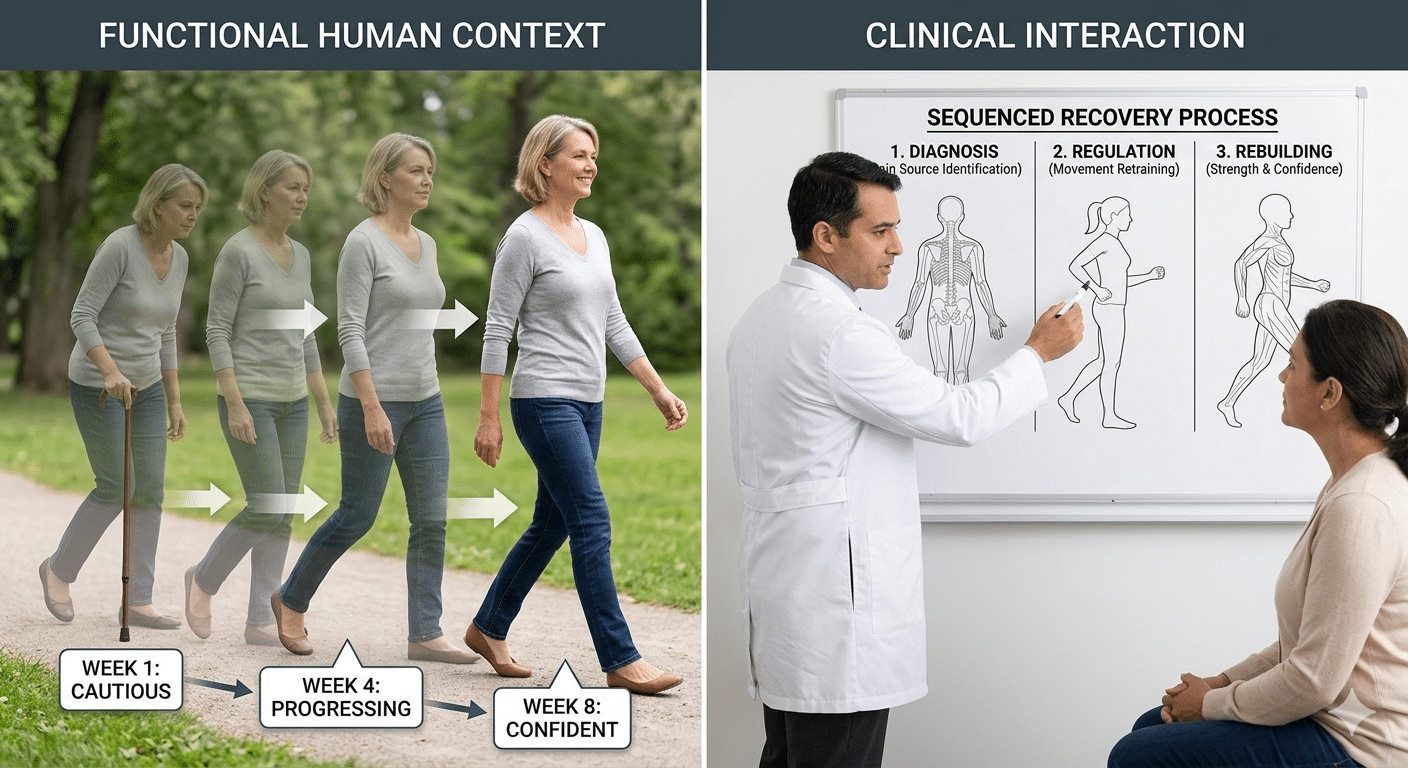
Our Comprehensive Approach to Pain Recovery
Why Sequence Matters More Than Intensity in Lasting Recovery
Our approach focuses on effective pain recovery, ensuring that every aspect of the healing process is addressed.
Our approach to pain recovery addresses the various dimensions of healing necessary for effective pain recovery.
Did you ever notice how pain seems to disappear just long enough to create hope—then return without warning?
For many, the cycle becomes familiar:
relief → activity → flare → regression
It creates the illusion that something is working—until it doesn’t.
This pattern is rarely random.
It is usually the result of mis-sequenced recovery, where effort is applied without alignment.
At STAR Health, pain recovery is a priority, emphasizing that pain recovery is not a mere checklist but a dedicated journey.
At STAR Health, pain recovery is not treated as a menu of options. It is treated as a system with order:
Understanding pain recovery allows for better strategies that ensure sustained pain recovery and overall wellness.
• Define the problem
• Regulate the system
• Rebuild capacity
Each step prepares the next.
Skip one—and the system compensates until it can’t.
🟦 SYSTEMS EXPLANATION
The body’s systems must be in sync to promote successful pain recovery and allow for healing to take root.
Successful pain recovery requires a holistic understanding of the interplay between various physical systems.
The three-step process streamlines your journey toward pain recovery, ensuring you are not just alleviating symptoms but achieving pain recovery.
Pain is not a single signal—it is an output shaped by layered systems interacting in real time.
These include:
• Tissue structures — joints, discs, tendons, nerves
• Biomechanics — how load is transferred and absorbed
• Nervous system tone — sensitivity, amplification, threat detection
• Inflammatory signaling — local irritation or systemic drivers
• Recovery biology — sleep quality, stress load, metabolic input
When care targets only one layer—often the loudest symptom—progress can occur temporarily.
But without system alignment, stability does not follow improvement.
The three-step process exists to synchronize these layers before demanding performance.
🟦 CLINICAL VISUALIZATION
Imagine rebuilding a structure:
You wouldn’t reinforce the roof
before stabilizing the foundation.
Yet in pain care, this inversion happens constantly:
• strengthening before diagnosis clarity
• returning to activity before sensitivity resolves
• escalating treatment before understanding the driver
Upon achieving clarity, we can align strategies that support pain recovery and help individuals maintain their progress in pain recovery.
For a time, the structure holds.
Then stress accumulates—and something gives.
Sequence is not about doing more.
It is about doing the right thing at the right time.
🟦 STEP 1 — DEFINE THE PROBLEM
Clarity Before Action
Labels like “back pain,” “arthritis,” or “disc bulge” often describe findings—not causes.
A true diagnostic step asks:
• What is the primary pain generator?
• What mechanism is driving it?
• What pattern does it follow?
• Does imaging match behavior?
• What systems are contributing?
This produces a testable clinical hypothesis, not just a label.
Why this step fails
Because it requires time, pattern recognition, and integration—not just imaging review.
Without it, everything that follows becomes trial-and-error disguised as care.
🟦 STEP 2 — REGULATE THE SYSTEM
Stability Before Stress
Once the driver is defined, the system must be brought into a state where it can adapt.
Regulating the system is essential for effective pain recovery, as it allows the body to regain its natural balance and promote pain recovery.
Regulation includes:
• reducing inflammatory signaling
• calming nervous system amplification
• modifying load to prevent repeated flares
• correcting key mechanical faults
• restoring recovery inputs (sleep, stress balance)
This is not passive.
It is active stabilization of a system that has become protective.
Building resilience is a crucial aspect of pain recovery, ensuring that individuals can withstand future challenges in their pain recovery journey.
Why regulation matters
A sensitive system interprets even appropriate input as threat.
Without regulation:
progress → flare → avoidance → regression
Regulation breaks this loop.
🟦 STEP 3 — REBUILD CAPACITY
Adaptation Through Controlled Stress
Once stability exists, rebuilding begins.
Ultimately, understanding the complexities of pain recovery leads to more effective strategies for long-term wellness and pain recovery.
This is where recovery becomes durable.
Rebuilding includes:
• progressive strength and endurance
• coordinated movement restoration
• tissue load tolerance development
• confidence in movement
• return-to-function conditioning
But the key principle is this:
Effective pain recovery requires recognizing that the journey involves learning and adapting to ensure pain recovery is lasting.
Load must match capacity—then expand it.
Too little → stagnation
Too much → relapse
Correct dosing creates adaptation.
🟦 CLINICAL INSIGHT
Pain resolves more reliably when systems are sequenced—not chased.
Through targeted efforts in pain recovery, individuals can experience a meaningful return to their daily activities.
🟦 WHY RELAPSE HAPPENS
Most recurrence is not failure—it is misalignment in process:
• the wrong driver was treated
• the system remained in a protective state
• load exceeded tolerance too early
• progress was measured only by pain, not function
• care lacked coordination between disciplines
Relapse is often predictable—because the sequence was incomplete.
🟦 E-E-A-T
At STAR Health, care is structured around diagnostic clarity, system regulation, and progressive rebuilding.
This model integrates:
In the context of pain recovery, we must acknowledge how stress impacts the body’s resilience and capacity for pain recovery.
• clinical examination and movement analysis
• image-guided diagnostics when appropriate
• coordinated rehabilitation strategies
• system-level recovery inputs
For broader clinical context on pain mechanisms and recovery, see the National Institute of Neurological Disorders and Stroke.
Research on stress physiology and recovery adaptation continues to support multi-system involvement in persistent pain.
🟦 AUTHOR BLOCK
Recognizing the importance of systemic factors is vital for ensuring successful pain recovery and preventing future setbacks.
STAR Health Clinical Team
Fort Wayne, Indiana
Focused on systems-based pain care, diagnostic precision, and long-term functional recovery.
🟦 DID YOU KNOW
Many imaging findings exist in people without pain.
This means:
• not all abnormalities require treatment
• not all treatments address the real driver
• context determines clinical relevance
🟦 HISTORICAL
Hans Selye, MD — 1950s
Selye’s work on stress physiology revealed that cumulative load alters the body’s ability to recover.
In modern pain care, this translates to:
• mechanical stress
• nervous system load
• sleep disruption
• metabolic strain
When these exceed adaptive capacity, symptoms persist.
Recovery improves when load is regulated before adaptation is demanded.
🟦 LOCAL CARE, GLOBAL SCIENCE
Across Fort Wayne and Northeast Indiana, patients often ask:
• why does pain keep coming back?
• why did treatment work temporarily?
• how do I rebuild without flaring?
These questions reflect a deeper need:
not just relief—but a structured path forward.
🟦 FAQ
Why does my pain return after treatment?
Because the underlying system may not have been fully aligned before load was reintroduced.
Is more treatment always better?
Not necessarily. Without correct sequencing, additional treatment can amplify the same cycle.
How do I know if my diagnosis is correct?
It should explain your symptom pattern and predict how changes affect function.
What if exercise makes my pain worse?
That often indicates the system is not yet regulated or the load exceeds current capacity.
Can chronic pain still improve?
Yes—when the correct driver is identified and systems are addressed in sequence.
Schedule a time-rich evaluation to define the driver of your pain, regulate the system, and build a durable recovery plan.
Contact us for an appointment today!