
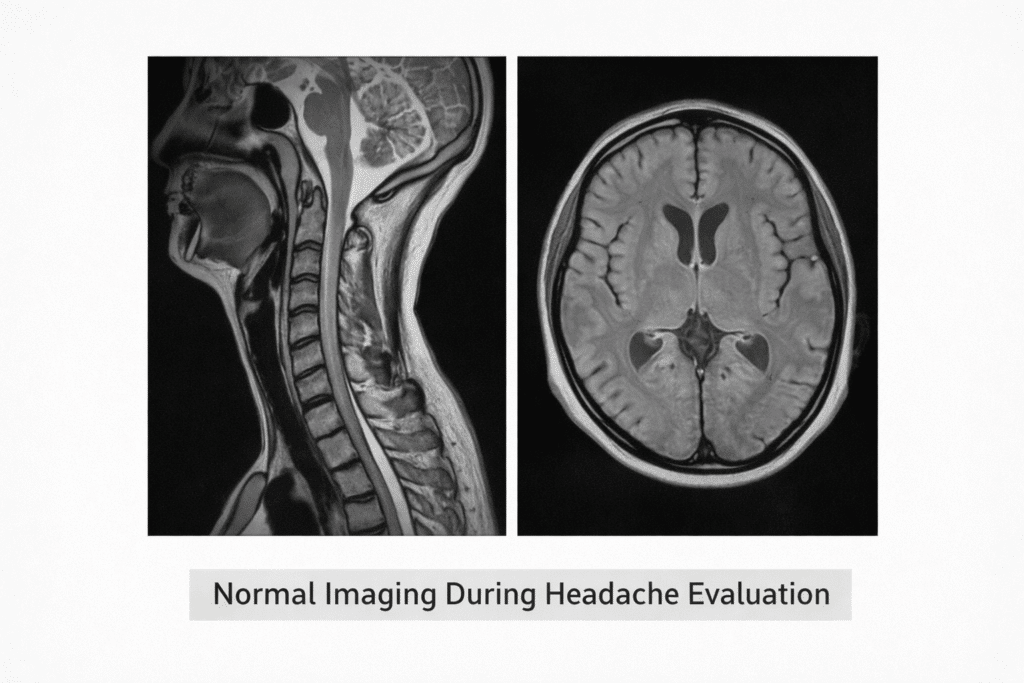
When the Scan Is Normal—but the Headache Is Not
The MRI report arrives with reassuring words: no mass, no bleeding, no obvious structural explanation.
For a moment, there is relief.
Then the headache returns.
It appears during computer work, after driving, while chewing, following a stressful day, or when the neck remains in one position too long. The test may be reassuring, but the pain is still real—and the unanswered question remains.
Why does the system keep producing a headache when the brain MRI appears normal?
At STAR Health, headaches with a normal MRI are investigated beyond the image. The evaluation considers how the neck, nerves, jaw, movement patterns, and recovery biology may interact under load.
The scan is evidence. It is not the entire story.
DID YOU EVER WONDER?

Did you ever wonder how a headache can become intense and repetitive when the “big tests” are normal—especially when the pain changes with posture, neck movement, jaw tension, fatigue, or stress?

That mismatch may be the clue.

The source may not be a visible abnormality inside the brain. It may involve how the head–neck–jaw system moves, transfers load, processes sensory input, and responds to repeated demands.
UNDERSTANDING HEADACHES BEYOND THE BRAIN
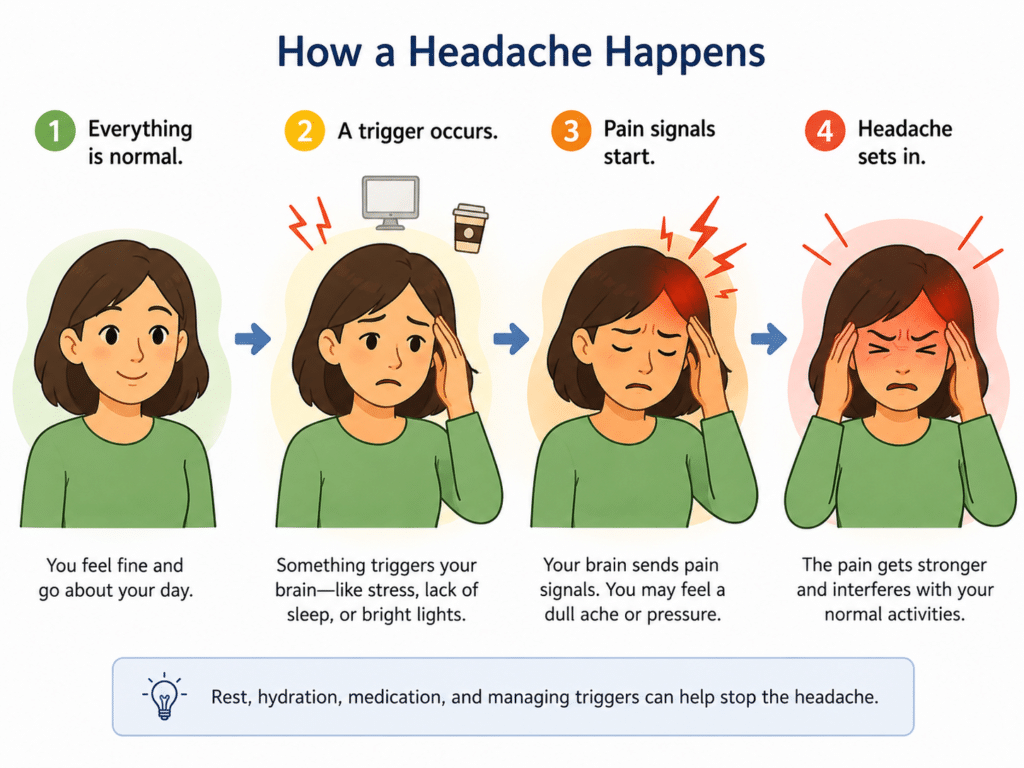
A headache is a symptom, not a single disease. Different headache disorders can overlap, imitate one another, or change over time.
A systems-based evaluation examines three connected domains:
- Structure: cervical joints, discs, muscles, connective tissues, jaw mechanics, and relevant cranial anatomy
- Signaling: trigeminal, occipital, and upper-cervical nerve pathways; sensory sensitivity; and pain modulation
- Load: posture, repetitive movement, work demands, sleep, stress, previous injury, and recovery capacity
One finding rarely explains everything.
A stiff neck does not automatically prove a cervicogenic headache. Jaw tenderness does not establish temporomandibular joint dysfunction as the primary generator. An abnormal cervical MRI may be incidental. Conversely, normal imaging does not exclude altered joint motion, muscle guarding, nerve sensitivity, or load-dependent dysfunction.
The diagnosis emerges from correlation—not assumption.
WHY THE NECK MAY BE THE MISSING LINK
Occipital, trigeminal, and upper-cervical pathways can become sensitive following trauma, repetitive strain, local compression, inflammation, or persistent protective guarding.
A patient may describe:
- Pain traveling from the base of the skull
- Scalp tenderness or sensitivity
- Burning, stabbing, electric, or shooting sensations
- Pain worsened by pressure or neck movement
- Symptoms that cross between the neck, jaw, temple, and face
These patterns require careful interpretation. Similar symptoms can arise from different generators, and more than one contributor may be present.
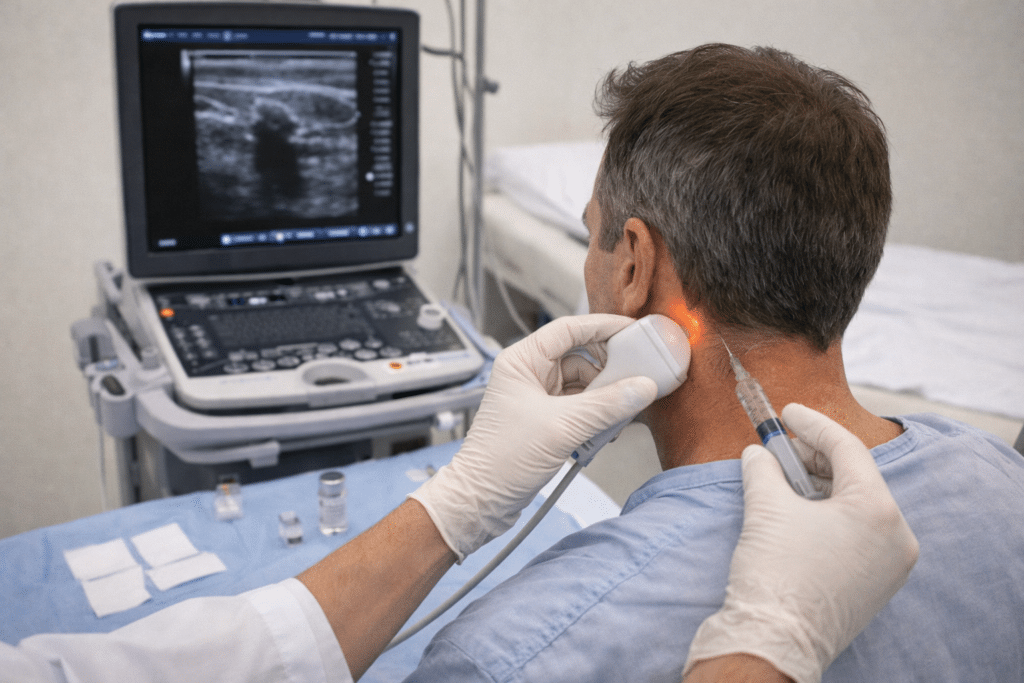
When appropriate, targeted examination, ultrasound assessment, electrodiagnostic testing, or a selective diagnostic block may help determine whether nerve irritation is clinically meaningful.
WHY THE JAW MATTERS
The jaw does not function independently from the neck.
Clenching, grinding, altered bite mechanics, guarded chewing, and temporomandibular joint irritation can change muscular demand across the face, skull, and upper cervical region. Neck dysfunction can also influence jaw behavior.
That creates a loop:
Jaw tension changes load → cervical muscles compensate → sensory signaling increases → pain encourages more guarding.
The goal is not to blame every headache on the TMJ. It is to determine whether jaw mechanics are contributing to the larger pattern.
THE STAR HEALTH DIAGNOSTIC DIFFERENCE
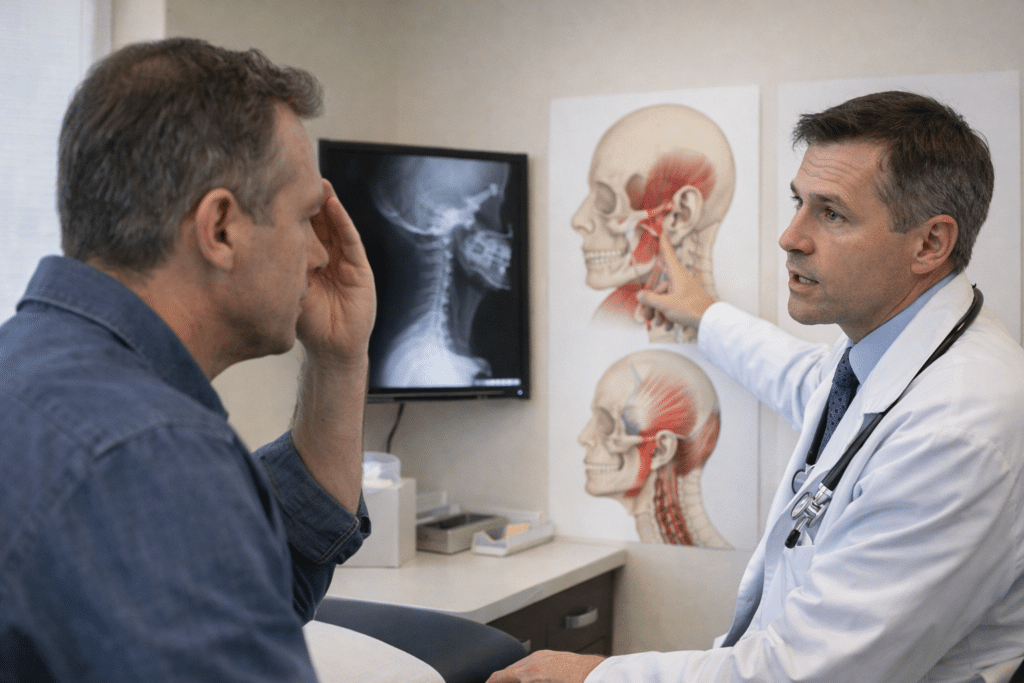
Most new evaluations are scheduled for one to two hours because complex headaches cannot always be reconstructed during a brief symptom-focused visit.
The evaluation may include:
- Detailed headache and injury history
- Neurologic and musculoskeletal examination
- Cervical and jaw movement assessment
- Review of previous MRI, CT, or X-ray studies
- Dynamic ultrasound when clinically indicated
- Video-based posture or movement analysis
- Evaluation of sleep, stress, medication response, and autonomic factors
- Selective diagnostic testing when a proposed generator requires confirmation
Patients may also be directed to STAR Health’s headache evaluation and treatment or coordinated physical rehabilitation services when those resources fit the diagnostic findings.
For general education about migraine as a neurologic disorder, the National Institute of Neurological Disorders and Stroke provides a patient-focused overview.
Treatment follows the investigation. It does not replace it.
CLINICAL VISUALIZATION
Imagine someone whose headache predictably intensifies after an hour of driving.
The brain MRI is reassuring, but the pain begins at the upper neck, spreads behind one eye, and worsens when the head turns. Jaw clenching appears as the symptoms build.
During evaluation, the clinician maps the pain pathway, tests cervical motion, examines jaw behavior, observes nerve sensitivity, and recreates the driving position. The familiar headache begins—not because the scan was wrong, but because the generator is revealed by movement and sustained load.
The investigation becomes visible:
Map the pattern → test the suspected input → confirm when necessary → build a coordinated plan.
CLINICAL INSIGHT
A normal brain MRI can be reassuring without being explanatory. When headaches change with neck position, jaw activity, posture, or repetitive load, the next step may be functional correlation—not another assumption.
TREATMENT IS NOT ONE-SIZE-FITS-ALL
Treatment depends on what the evaluation supports. Recommendations may include:
- Rehabilitation for cervical control and load tolerance
- Posture and movement retraining
- Jaw-focused care when clinically relevant
- Soft-tissue treatment
- Sleep, stress, or recovery strategies
- Medication coordination
- Selective image-guided injection or nerve block
An injection is not automatically required. Rehabilitation is not prescribed from a template. Integrative strategies do not replace appropriate neurologic investigation.
Each intervention should answer the diagnosis—not merely react to the pain.
STAR Health does not promise permanent relief, a cure, or a guaranteed reduction in headache frequency. The purpose of care is to improve diagnostic clarity and select medically appropriate treatment based on the individual findings.
DID YOU KNOW?
Did You Know? Many headache generators involve function rather than a visible brain lesion. Joint motion, muscle coordination, nerve sensitivity, and sensory integration can produce substantial symptoms while standard brain imaging remains reassuring.

Imaging may answer an important question—“Is there a visible structural concern?”—without answering another: “Why is this system producing pain today?”
EXPERIENCE, EXPERTISE, AUTHORITY, AND TRUST
Care is led by Dr. Joseph Fortin, whose clinical background includes:
- Board certification in Physical Medicine & Rehabilitation
- Subspecialty certification in Interventional Pain Management
- Board certification in Electrodiagnostic Medicine
- Certification in Clinical Densitometry
- Experience in biomechanics, movement science, and imaging interpretation
- Medical authorship, research, and professional teaching
This wide clinical lens allows headache patterns to be examined across neurologic, musculoskeletal, mechanical, and biologic systems without allowing one test or treatment to dominate the process.
HISTORICAL PERSPECTIVE
Physicians described headache patterns centuries before modern brain imaging existed. Their explanations were limited by the science of their time, but they recognized that head pain could be influenced by injury, posture, strain, and internal regulation.
Modern medicine adds neurologic classification, advanced imaging, precision examination, and diagnostic testing.
Yet the enduring mystery remains the same: the place where pain is felt may not be the place where the problem began.
LOCAL CARE, GLOBAL SCIENCE
Patients throughout Fort Wayne and Northeast Indiana often seek help for chronic headaches with a normal MRI, neck-related headaches, cervicogenic headache, or pain that changes with posture and jaw tension.
STAR Health applies neuroscience, biomechanics, imaging interpretation, and movement analysis through a local, physician-led model.
Global science informs the investigation. Local care makes it personal.
FREQUENTLY ASKED QUESTIONS
Can headaches be real when the MRI is normal?
Yes. A normal MRI does not mean the symptoms are imaginary. It may rule out or reduce concern for certain structural conditions without assessing every joint, nerve, muscle, movement, or sensory contributor.
Does a normal brain MRI rule out migraine?
No. Migraine is generally diagnosed through clinical history and established diagnostic criteria. Imaging may be used when the presentation or examination raises concern for another condition.
How do I know whether my headache is coming from my neck?
Clues may include reduced neck motion, pain provoked by position, symptoms beginning near the upper neck, or reproduction of familiar pain during examination. No single clue confirms the diagnosis.
Will I need an injection?
Not necessarily. Diagnostic injections or nerve blocks are used selectively when they can test a specific proposed generator. They are not the default treatment for every headache.
When does a headache require emergency care?
Seek urgent medical attention for a sudden severe or unfamiliar headache, particularly when accompanied by weakness, co
A Normal MRI Should Not End the Investigation
If headaches continue to disrupt work, sleep, movement, or daily life, the next step may be understanding how the neck, nerves, jaw, and nervous system are interacting.
Schedule a comprehensive headache evaluation
STAR Health — Fort Wayne, Indiana
Time-rich. Physician-led. Systems-based.