
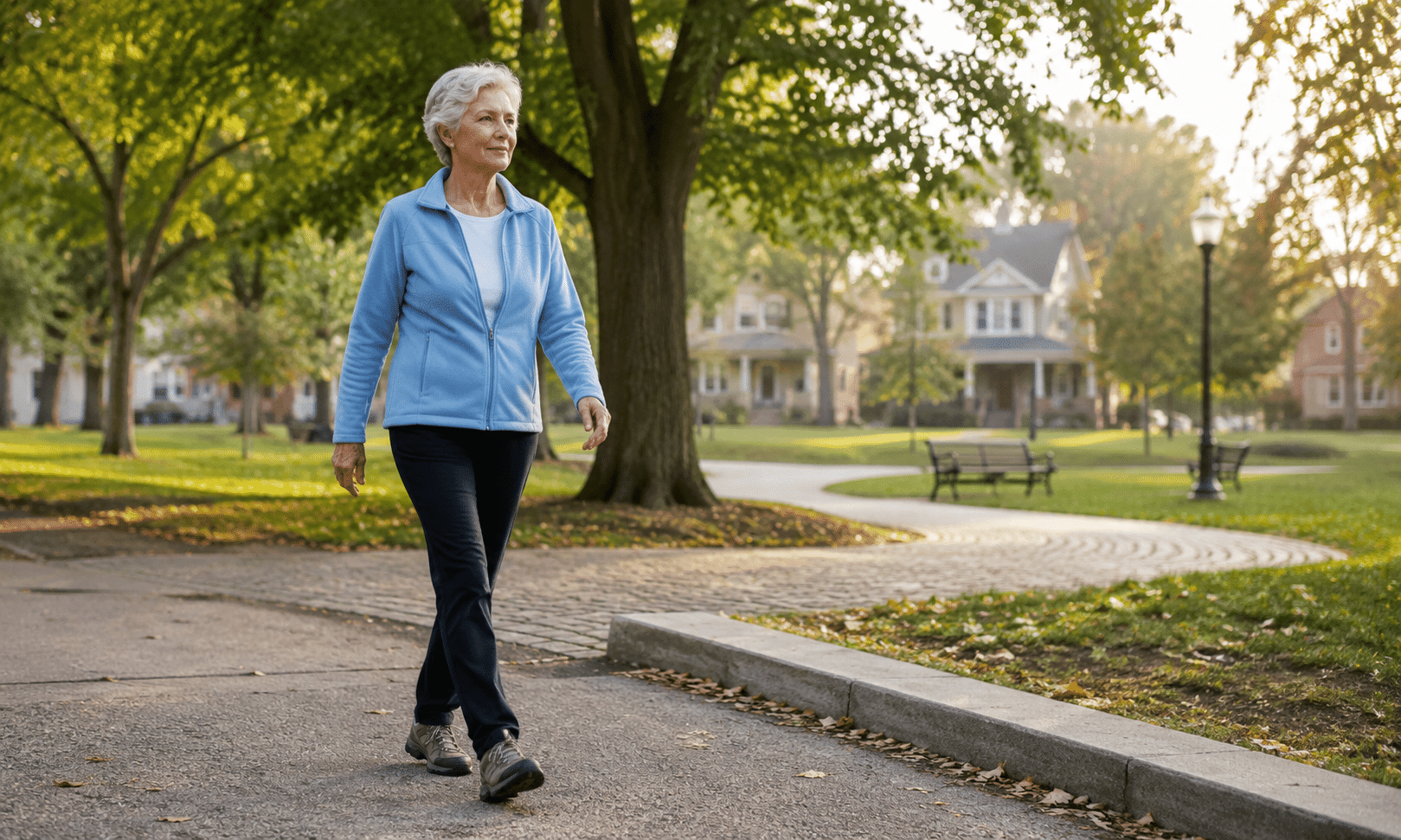
Did you ever wonder why two people of the same age can have dramatically different mobility, confidence, and resilience—even when their imaging, injury histories, and exercise habits appear similar?
The difference is rarely explained by strength alone.
One person moves with rhythm. The other shortens each step, braces the trunk, watches the floor, and tires sooner. Those adaptations can reveal how well the body coordinates structure, signaling, and load.
At STAR Health, locomotion is viewed as an integrated expression of human function. Walking asks the spine, nervous system, joints, muscles, vision, and balance organs to keep the body upright while transferring it from one foot to the other.
Walking therefore becomes a clinical window into the whole system.
Locomotion Is a Whole-Body Systems Test
Every step creates a rapid sequence of demands:
- The foot and joints accept load.
- The pelvis, trunk, and arms manage rotation.
- The nervous system updates balance and position.
- The body stores and releases energy.
Efficient locomotion does not require every body to look identical. It requires the parts to cooperate for the task, terrain, speed, and individual anatomy.
When coordination changes, the system finds another way forward. A shorter stride, rigid trunk, or wider base may create temporary security. If habitual, the same strategy may increase energy cost or redirect stress.
Gait assessment does not chase a visually “perfect” walk. It asks why a pattern emerged and whether it still serves the person.
That diagnostic-first reasoning guides STAR Health’s Locomotion Class, where retraining is adapted to the individual.
How the Spine Organizes Locomotion
During locomotion, the spine acts as a dynamic bridge between the upper and lower body.
As one leg advances, the pelvis rotates. The trunk counters that motion while the rib cage and arms help manage momentum. This alternating pattern supports cross-body load transfer.
When trunk rotation becomes limited, another region may contribute more. The hip may overwork, the knee may receive force differently, or the shoulders may stop swinging naturally. These observations do not prove where pain originates, but they can shape a testable hypothesis.
That is why locomotion belongs within broader sports medicine and movement analysis when pain, recurrent injury, or performance loss is involved. The painful location may not be the whole story.
Clinical Visualization: When Locomotion Quietly Changes
Picture someone leaving a grocery store. The first few steps look ordinary. Then the sidewalk changes.
The eyes drop. One arm stops swinging. The right step shortens. At the curb, movement pauses—not simply from limited strength, but because the system no longer trusts its timing.
Attention once available for traffic, conversation, and navigation is now spent on every step. Walking feels less automatic. Longer outings begin to disappear, reducing opportunities to challenge balance and coordination.
The apparent problem is “slow walking.” The deeper question is why.
Contributors may include pain, weakness, sensory loss, medication effects, vestibular or neurologic conditions, fear after a fall, or a learned protective pattern. Locomotion shows the compensation; evaluation must investigate the cause.
Reduced speed, shorter steps, asymmetric arm swing, or increased variability can provide useful information. They should not be interpreted in isolation or used to predict one person’s future with certainty.
A pooled analysis of nine cohorts involving 34,485 community-dwelling adults age 65 and older found that gait speed was associated with survival. It supports gait speed as an integrated marker of function; it does not prove that walking faster extends life. See JAMA: “Gait Speed and Survival in Older Adults”.
The practical reveal is important: walking can reflect reserve across multiple systems at once. A change in locomotion may deserve attention before it becomes a larger limitation.
Sudden gait change with one-sided weakness, facial drooping, confusion, severe dizziness, chest pain, or shortness of breath requires prompt medical evaluation. A class is not a substitute for urgent care.
Experience, Expertise, Authority, and Trust
STAR Health approaches locomotion through physician-led, diagnostic-first care. The history explores timing, symptoms, fatigue, falls, and relevant medical conditions.
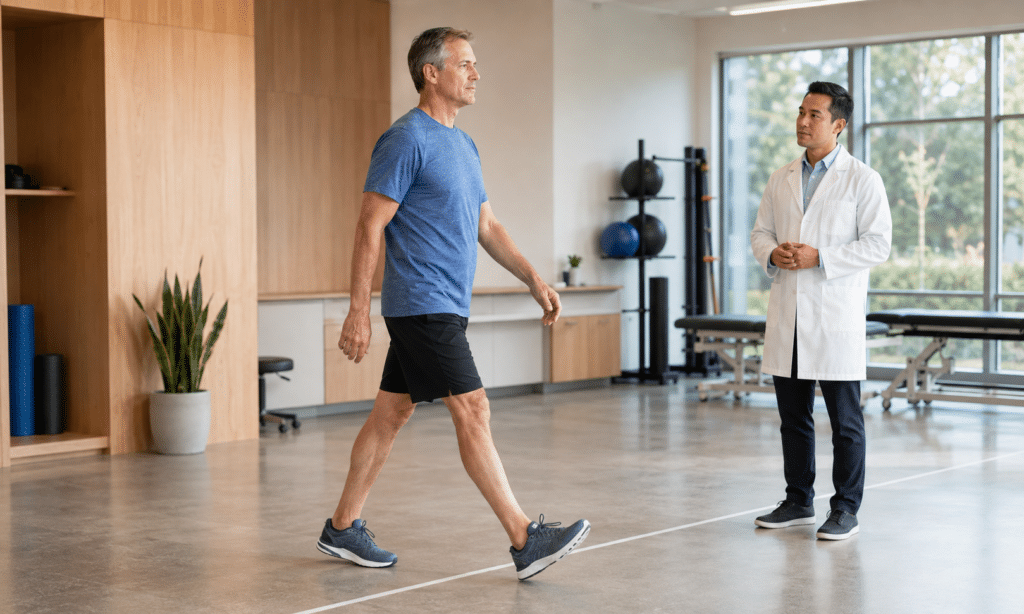
Observation may consider rhythm, balance, trunk-pelvis coordination, symmetry, and load acceptance. Imaging and other tests are used when clinically indicated.
The objective is to determine whether locomotion retraining is appropriate, whether another condition needs attention first, and how movement can progress safely.
Author Block
Joseph Fortin, DO
Board-certified in Physical Medicine & Rehabilitation with subspecialty certification in Interventional Pain Management.
Dr. Fortin integrates biomechanics, diagnostic imaging, neurologic function, pain mechanisms, and nearly four decades of movement analysis. This article is educational and does not replace individualized medical evaluation.
Did You Know? Locomotion Can Change Before Pain Does
People often wait for pain before questioning movement. Yet hesitation, slowing, watching the ground, or avoiding uneven surfaces may appear first.
The National Institute on Aging’s exercise and physical activity guidance describes endurance, strength, balance, and flexibility as complementary. Locomotion draws on all four and requires them to be coordinated in real space.
Capacity matters. Coordination determines how that capacity is used.
Historical Perspective: From Mechanics to Human Locomotion
Person: Giovanni Alfonso Borelli
Place: Italy
Time: 17th century; De Motu Animalium published in 1680–1681
Borelli applied geometry and mechanics to movement, helping establish biomechanics. His work advanced a durable idea: motion depends on leverage, force direction, and timing—not muscle alone.
Observations of active communities, including the Hadza of northern Tanzania, have broadened questions about environment, aging, and function. They do not prove an ideal gait; they illustrate lives shaped by frequent, variable locomotion.
Across centuries, the central question remains the same: how does the body manage force while moving through the world?
Local Care, Global Science
People across Fort Wayne and Northeast Indiana seek gait analysis, balance training, and help with walking-related pain. The starting point depends on why walking changed.
At STAR Health, global research in biomechanics, aging, neuroscience, and rehabilitation informs local care. Locomotion training is physician-directed and individualized according to medical history, capacity, movement, and goals.
The goal may be navigating a store without support, returning to a trail, keeping pace with family, or restoring rhythm for sport. The destination changes. The systems reasoning does not.
Frequently Asked Questions
What does locomotion mean?
Locomotion is movement from place to place. Here, it refers primarily to walking and the coordination of balance, sensation, strength, joint motion, rhythm, and load transfer.
Can locomotion predict independence?
Walking characteristics can inform an assessment of health and functional reserve. They cannot determine an individual outcome with certainty. Locomotion is one signal within a larger clinical picture.
Is Locomotion Class the same as physical therapy?
No. Locomotion Class focuses on gait patterning, rhythm, coordination, and repeated upright movement. It may complement rehabilitation but does not replace individualized therapy or medical care.
Can I participate if walking causes pain?
Pain should be evaluated rather than pushed through. Participation depends on its cause and behavior, along with overall medical safety. Some people need individualized care before joining a class.
Is locomotion training only for older adults?
No. Gait inefficiency can affect athletes, active adults, people recovering from injury, and those concerned about mobility. Training should match need rather than age alone.
How quickly will my walking change?
There is no universal timeline. Progress depends on the underlying contributors, consistency, health status, and individual adaptation. No specific result can be guaranteed.
Take the Next Step With Locomotion at STAR Health
If walking has become tiring, guarded, painful, or less confident, it may be time to understand what the pattern is communicating.
Begin with a diagnostic-first evaluation of the system that carries you forward.
Contact us to schedule a consultation today!