
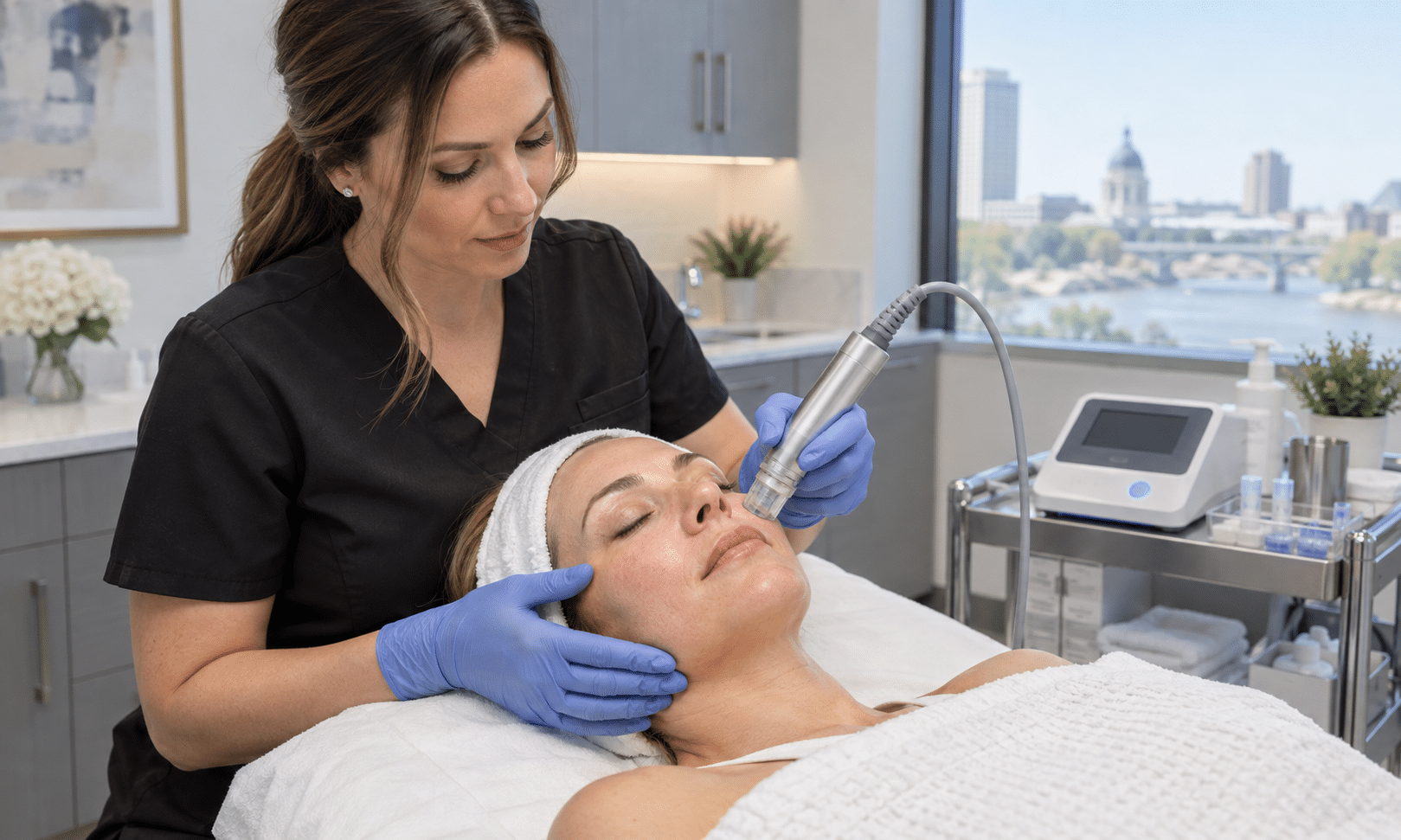
Why the Same Microchanneling Treatment Can Produce Different Responses
Two people can receive a similar skin treatment and have very different experiences. One may move through temporary redness without difficulty. Another may develop prolonged irritation, pigment changes, or disappointing results.
The device matters. Technique matters. But neither acts alone.
Microchanneling delivers a controlled mechanical input to living tissue. The epidermal barrier, dermal matrix, blood vessels, immune mediators, sensory nerves, and repair cells must detect and respond to that input.
That is why STAR Health approaches microchanneling as more than a cosmetic surface procedure. The first question is not, “How aggressive can the treatment be?” It is, “Is this skin—and this person—prepared to respond appropriately?”
Skin Is Not a Surface—It Is a Living Interface
Skin is often judged by tone, texture, pores, fine lines, or scars. Yet appearance reflects several systems working beneath the surface. Skin behavior is shaped by three linked domains:
- Structure: The epidermis provides a barrier; the dermis contains collagen, elastin, fibroblasts, and extracellular matrix.
- Signaling: Immune cells, keratinocytes, fibroblasts, vascular cells, and nerves exchange information during repair.
- Load: Sun, friction, facial movement, prior procedures, topical products, and environmental stress influence the tissue.
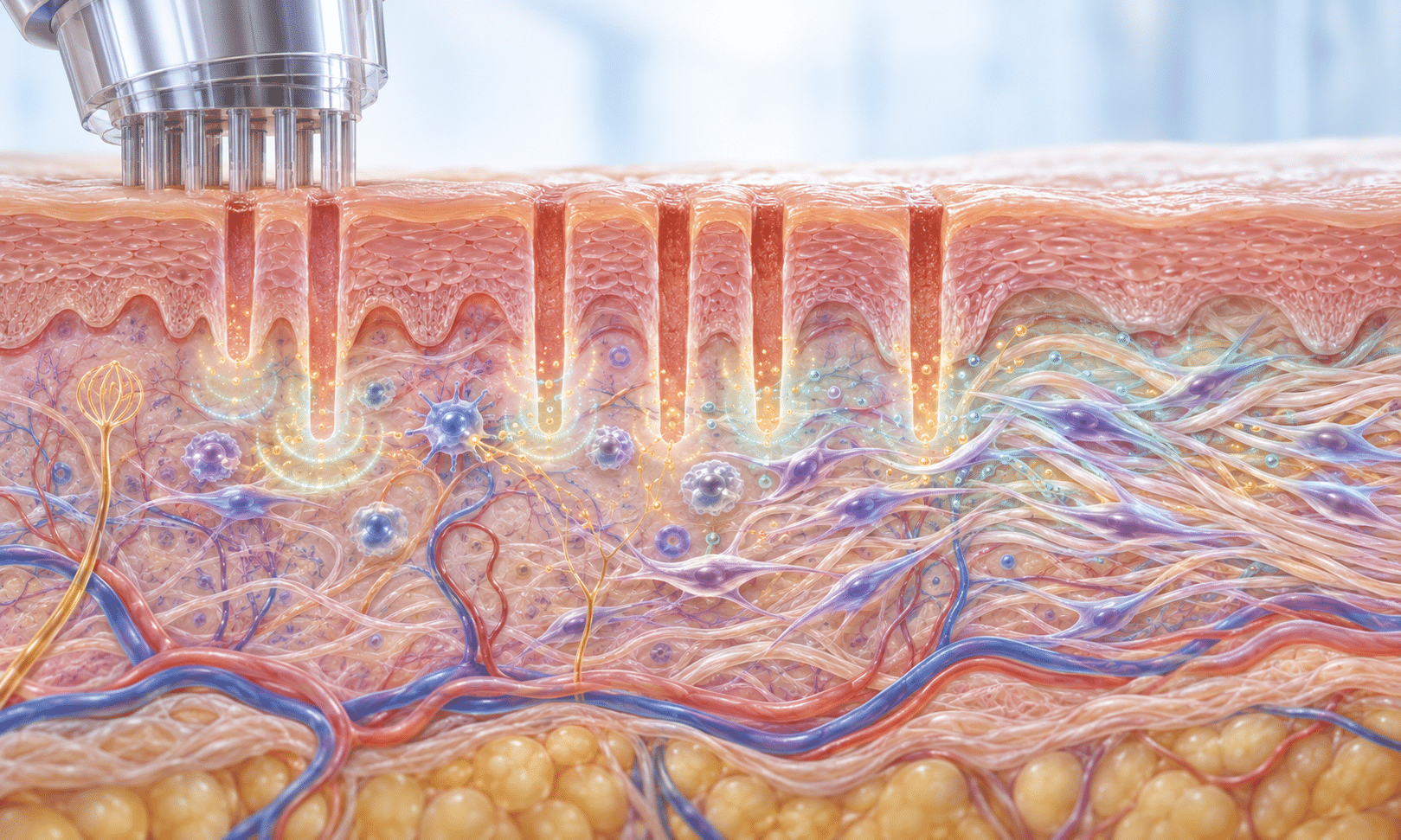
Microchanneling uses fine needles to create microscopic channels. These are controlled injuries intended to initiate a measured repair response while limiting unnecessary disruption outside the treatment path.
Unlike radiofrequency microneedling, standard mechanical microchanneling does not intentionally deliver heat beneath the skin. Its stimulus comes primarily from physical penetration. Adding thermal energy changes the mechanism and risk profile.
Clinical Visualization: What Happens After Microchanneling?
Imagine the treatment as a brief message followed by a much longer conversation.
First, the signal. The device creates microscopic channels at a selected depth. The skin recognizes structural disruption and responds. Redness, tightness, tenderness, pinpoint bleeding, or swelling may occur, depending on the settings, area, and individual.
Then, early repair. Barrier-restoring cells begin closing the channels while inflammatory and vascular signals coordinate the response. Fibroblasts and keratinocytes react to both chemical messages and changes in their mechanical environment.
Finally, remodeling. Extracellular-matrix activity and collagen organization may change over time. This gradual phase cannot be judged by how the skin looks the next morning, and results vary.
This is the central reveal: the procedure ends quickly, but the biologic response unfolds over time. Learn more about STAR Health’s microchanneling approach and why treatment planning must account for more than the device itself.
Clinical Insight: Precision Is More Important Than Aggression
The goal of microchanneling is not maximal injury. It is an appropriately dosed mechanical stimulus matched to the tissue, treatment area, clinical objective, and person receiving it.
More depth, passes, or frequent sessions do not automatically create a better response. Excessive treatment can increase inflammation, extend downtime, and compromise the barrier. Too little stimulus may not meaningfully address the concern.
Before microchanneling, the clinician should consider active skin disease, infection, acne activity, cold sores, abnormal scarring, pigment response, recent procedures, medications, immune status, bleeding risk, and aftercare capacity.
The correct dose is contextual. Precision means selecting the right candidate, settings, interval, and recovery plan—not simply pursuing a stronger treatment.
Experience, Safety, and Integrated Clinical Judgment
A systems-based evaluation cannot promise results. It asks whether the potential benefit is reasonable in relation to the person’s skin, history, goals, and risk.
The U.S. Food and Drug Administration’s microneedling guidance notes that treatment is not suitable for everyone. Possible effects include redness, bruising, bleeding, itching, peeling, pigment change, cold-sore reactivation, and infection. The agency also emphasizes trained care, device hygiene, a new cartridge for each treatment, and individualized risk discussion.
At STAR Health, responsible planning should include:
- Clarifying the concern and setting realistic expectations
- Reviewing skin history, healing, medications, and relevant conditions
- Matching depth and coverage to the anatomy and objective
- Protecting hygiene and barrier recovery, then reassessing before another session
When clinically appropriate, recovery planning may consider photobiomodulation therapy, a distinct intervention with its own dosing and indications—not an automatic add-on or a substitute for proper technique.
Much of the evidence uses the broader term microneedling. Devices, needle configurations, depths, endpoints, and combined products vary. Findings from one protocol cannot automatically be transferred to every device or patient.
Author Block
Dr. Fortin is an interventional pain management specialist and Clinical Professor at Indiana University School of Medicine. His background includes physical medicine and rehabilitation, regenerative and integrative medicine, research, and image-guided care. STAR Health delivers microchanneling within a physician-directed environment emphasizing individualized assessment and informed expectations.
Did You Know?
Did you know that visible change is only one part of the response? In a full-thickness, three-dimensional human skin model, microneedling altered gene expression related to tissue remodeling, epidermal differentiation, inflammation, and extracellular-matrix organization five days after treatment. The model’s epidermal and dermal structures were also nearly restored.
The peer-reviewed PLOS ONE study helps explain why microchanneling is a biologic process, not simple “resurfacing.” Its limitation matters: a laboratory model can reveal mechanisms but cannot predict an individual clinical result.
Historical Perspective: From Scar Release to Controlled Channeling
In 1995, dermatologists David and Norman Orentreich described subcision, a needle-based method for releasing tethered scars and encouraging connective-tissue formation. In 1997, André Camirand and Jocelyne Doucet reported “needle dermabrasion” using tattooing principles to improve scars.
Those methods are not contemporary microchanneling. Their importance lies in the shift they established: a needle could create a controlled physical stimulus that changed tissue behavior.
Today’s stamping systems allow more standardized channel placement. The technology evolved; the responsibility remains—control the stimulus, respect the tissue, and monitor the response.
Local Care, Global Science
Patients seeking microchanneling in Fort Wayne or Northeast Indiana may arrive with acne scars, fine lines, uneven texture, or a skin-rejuvenation goal. The visible concern is not the entire clinical picture.
STAR Health connects published skin science with the details that determine whether treatment makes sense: skin type, barrier condition, prior reactions, health history, recovery capacity, and expectations.
Microchanneling is a tool. Clinical judgment determines when—and how—that tool should be used.
Frequently Asked Questions
What is microchanneling?
Microchanneling uses fine needles to create controlled microscopic channels in the skin. This mechanical stimulus initiates a repair response that may support tissue remodeling.
Is microchanneling the same as microneedling?
The terms overlap. “Microchanneling” often refers to stamping-style delivery, while “microneedling” is the broader category. Device design, needle configuration, depth, speed, and technique differ, so not every procedure is equivalent.
Does microchanneling use heat?
Standard mechanical microchanneling does not intentionally deliver thermal energy. Radiofrequency microneedling combines needles with energy below the skin and has a different mechanism and risk profile.
What concerns may be considered for treatment?
Depending on the device, protocol, and individual, microchanneling may be considered for facial acne scars, fine lines, wrinkles, or uneven texture. Evidence and regulatory clearance are specific to devices and indications.
What are common side effects and downtime?
Redness, tightness, tenderness, swelling, itching, peeling, bruising, or pinpoint bleeding can occur. Less common complications include infection, pigment change, or cold-sore reactivation. Duration varies.
How many microchanneling sessions will I need?
There is no universal number. The plan depends on the concern, severity, depth, healing between visits, and response. Improvement may be gradual, may require multiple sessions, and cannot be guaranteed.
Begin With Skin Readiness—Not a Procedure Package
If you are considering microchanneling in Fort Wayne, begin with an evaluation of your skin, health history, goals, and recovery factors. STAR Health uses a physician-directed, systems-based approach to determine whether treatment is appropriate and how it should be dosed.
Contact us to schedule a consultation today!