
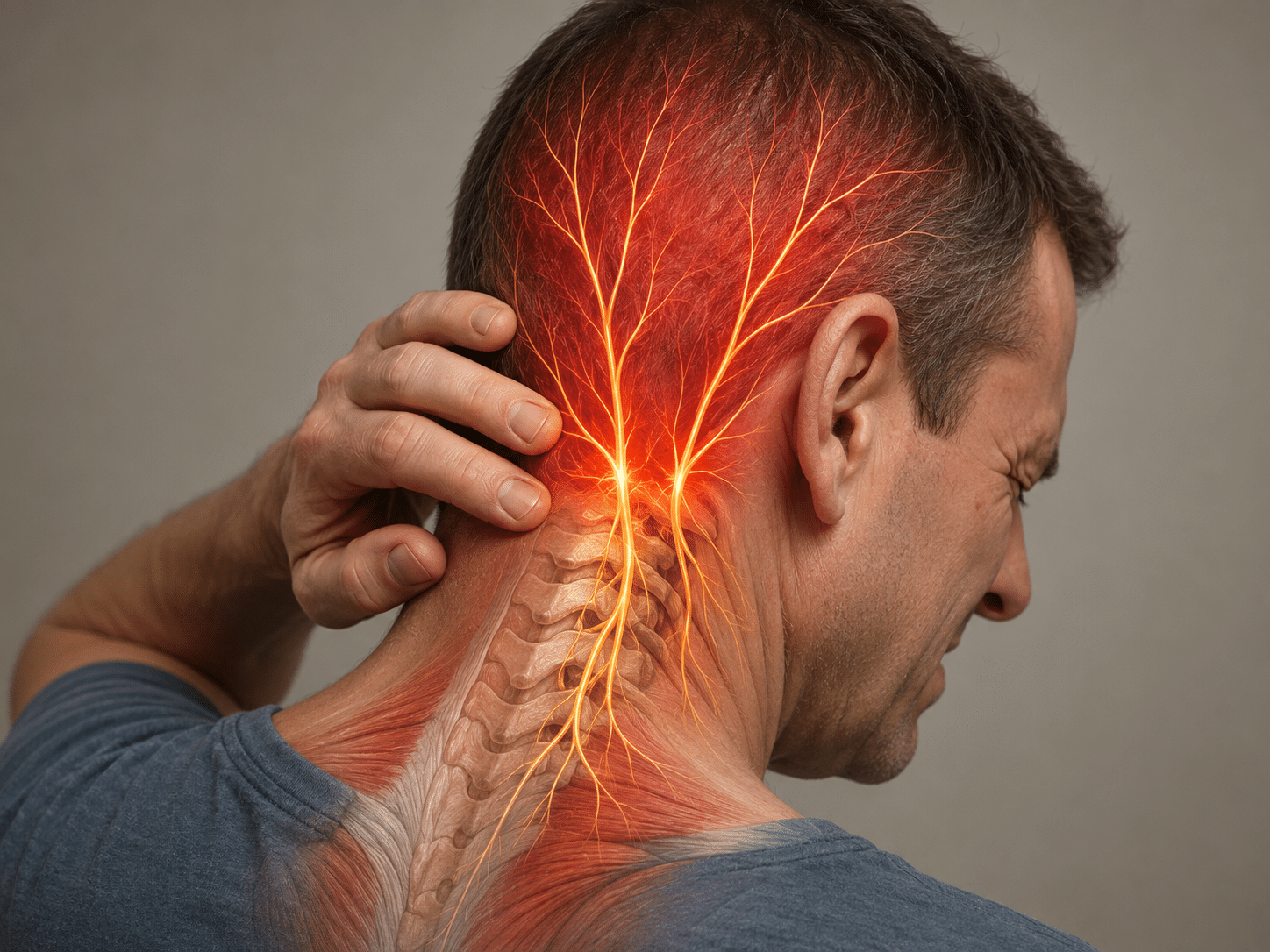
Did you ever wonder why nerve pain can feel electric in the morning, burning by evening, and strangely distant from the place where the problem began?
For many people living with nerve pain in Fort Wayne, the unsettling part is the mismatch. The sensation can be severe, yet an MRI may be described as mild. Medication may quiet it briefly, only for the pain to return along a different path.
If the scan has not changed, why has the pain changed?
A scan and a pain signal are not measuring the same thing. Imaging describes anatomy. Pain reflects information being generated, transmitted, filtered, and interpreted across a living system.
The phrase “nerve pain” describes an important symptom pattern, but it is not a complete diagnosis. The task is to determine what is disturbing the signal—and why it persists.
Systems Explanation of Nerve Pain: Structure, Signaling, and Load
Nerves are often compared with electrical wires, but the comparison is incomplete. A wire is passive. A nerve is living tissue with its own blood supply, connective-tissue layers, immune interactions, and changing sensitivity.
A diagnostic model examines three connected domains:
- Structure: the spine, nerve root, peripheral nerve, joint interfaces, fascia, scar tissue, and tissues surrounding the pathway
- Signaling: how impulses are generated, conducted, amplified, inhibited, and interpreted
- Load: the mechanical, positional, repetitive, inflammatory, and metabolic demands placed on the nerve
A disc protrusion may irritate a nerve root, but scan severity does not automatically predict pain severity. A peripheral nerve may remain continuous while repeated pressure, inflammation, reduced mobility, or altered local circulation lowers its tolerance.
Signaling can change too. After persistent irritation, peripheral fibers may become more excitable. The spinal cord and brain may respond more strongly to incoming information. This does not make pain imaginary. It means the protection system has become easier to trigger.
Load completes the picture. A nerve moves relative to surrounding tissues as the body bends, reaches, walks, and rotates. When posture, gait, muscle timing, joint motion, or scar restriction concentrates stress along one pathway, symptoms may appear only in certain positions or after activity.
Diagnostic-first care therefore asks:
- Where does the sensation begin, travel, and stop?
- Which positions increase or reduce it?
- Are numbness, weakness, reflex changes, or coordination changes present?
- Does the pattern suggest a nerve root, peripheral nerve, metabolic process, or sensitized pain system?
- Which finding is meaningful, and which may be incidental?
At STAR Health, the nerve pain evaluation can be integrated with a broader pain management assessment when symptoms cross structural, neurologic, and movement boundaries.
Nerve Pain Clinical Visualization: When the Scan and the Signal Disagree
Picture a patient with burning pain that starts near the low back, crosses the outer thigh, and reaches the foot. The MRI shows mild narrowing, but nothing that appears to explain the intensity. Physical therapy increased the pain. Medication reduced the burning temporarily, yet the leg feels unreliable after prolonged sitting.
A procedure-first model may focus on the most visible abnormality.
A systems-based evaluation slows the story down.
The physician maps the pathway, tests strength and reflexes, observes walking and load transfer, and examines whether spinal position changes the signal. The evaluation also considers mechanical sensitivity, surrounding tissue restriction, and whether prolonged symptoms have lowered the nervous system’s threshold.
The crucial finding may not be a dramatic lesion. It may be the interaction of a modest structural constraint, repeated positional load, and amplified signaling.
That changes the question from “How do we silence this symptom?” to “What is generating, maintaining, or amplifying this signal?
Clinical Insight
Nerve pain becomes confusing when the location of the sensation is treated as the diagnosis. Clarity comes from tracing the pathway, testing the system, and determining whether structure, signaling, load—or a combination—is driving the pattern.
Temporary relief may be valuable, but it does not prove the underlying contributor has been identified.
E-E-A-T: Why Clinical Context Matters
In formal terminology, neuropathic pain means pain caused by a lesion or disease of the somatosensory nervous system. Burning, tingling, electric, or radiating sensations can raise suspicion, but symptom words alone do not establish the cause. The International Association for the Study of Pain terminology provides the general framework.
Research also shows that persistent pain can involve peripheral sensitization, central sensitization, neuroimmune activity, and altered excitability within pain-processing pathways. These mechanisms help explain why symptoms can intensify or spread without a proportionate change in imaging. A specific scientific reference is Ji and colleagues’ review, “Neuroinflammation and Central Sensitization in Chronic and Widespread Pain.”
Evidence informs the evaluation; it does not replace it. History, examination, imaging, electrodiagnostic testing, and laboratory assessment may contribute when indicated. No single test answers every nerve-pain question.
Author Block
Joseph D. Fortin, DO
STAR Health, Fort Wayne, Indiana
Board-certified in Physical Medicine & Rehabilitation, Pain Medicine, and Electrodiagnostic Medicine.
This article is educational and is not a diagnosis or a substitute for an individualized medical evaluation.
Did You Know?
A nerve can remain physically intact and still produce severe symptoms.
Compression, inflammation, altered blood flow, chemical irritation, or reduced movement relative to surrounding tissue may change how it conducts and responds. The absence of a severed nerve does not equal normal nerve function.
Symptoms may therefore fluctuate with position, activity, swelling, metabolic health, sleep, or cumulative load even when imaging appears stable.
A Historical Perspective on Nerve Pain
Before MRI, clinicians followed the story told by the body. They observed whether pain traveled in a recognizable pathway, whether posture changed it, whether touch produced an outsized response, and whether weakness followed a nerve distribution.
Modern imaging and electrodiagnostic medicine added powerful tools without erasing pattern recognition. Structure is meaningful only when it matches the clinical signal.
Pain medicine has gradually moved beyond a simple visible-damage-equals-pain model toward a systems model in which tissue condition, neural excitability, immune signaling, movement, and context interact.
Local Care, Global Science: Nerve Pain in Fort Wayne
Patients across Fort Wayne and Northeast Indiana often seek a nerve pain doctor after hearing that their MRI is “not bad enough” to explain what they feel. Others arrive with burning pain, radiating arm or leg symptoms, suspected nerve entrapment, or neuropathic pain that has not responded predictably to prior care.
STAR Health applies global pain-science and rehabilitation principles locally: listen to the pattern, test the pathway, interpret the structure, and measure the load. The purpose is not to force every patient into the same label. It is to determine which findings belong together.
Frequently Asked Questions
Can nerve pain occur when an MRI looks normal or only mildly abnormal?
Yes. MRI shows anatomy, but it does not directly measure pain, nerve sensitivity, intermittent compression, movement behavior, or every metabolic and inflammatory contributor. Imaging must be compared with the history and examination.
Does burning or tingling always mean peripheral neuropathy?
No. These sensations may occur with a nerve-root disorder, peripheral entrapment, metabolic neuropathy, medication effect, infection, a central nervous system condition, or a sensitized pain pathway. Symptom quality is a clue, not a final diagnosis.
What tests may be considered for nerve pain?
Evaluation begins with a detailed history and neurologic and musculoskeletal examination. Depending on the findings, a physician may consider imaging, electrodiagnostic testing, ultrasound, laboratory studies, or other targeted assessments.
Why can nerve pain move, spread, or change intensity?
Position, tissue load, inflammation, sleep, stress physiology, local circulation, and nervous-system sensitivity can change the threshold at which symptoms appear. A changing pattern deserves interpretation rather than dismissal.
When does nerve pain require urgent medical attention?
Seek urgent evaluation for new or rapidly worsening weakness, loss of bowel or bladder control, numbness in the saddle region, severe symptoms after major trauma, fever with spinal pain, or other sudden neurologic changes.
When nerve pain has never fully matched the explanation you were given, the next step may be a more complete evaluation—not another assumption.
Schedule a physician-led nerve pain evaluation at STAR Health to examine the relationship between structure, signaling, and load.
Understand the signal. Evaluate the system. Build care around the findings.
Contact us to schedule a consultation today!