
Why Tendon Healing Stalls—and How Mechanical Signaling May Restart the Process
Understanding “Biological Silence” in Chronic Tendinopathy
How can a tendon remain painful for months—or years—without a new tear, obvious swelling, or dramatic change on imaging?
Rest may quiet it. Therapy may help until progress stalls. An injection may reduce symptoms without restoring the ability to run, lift, grip, or climb stairs. Then the pain returns when demand rises.
The tendon may not have literally stopped healing. Chronic tendinopathy can persist when tissue structure, cellular signaling, and mechanical load no longer work together. “Biological silence” is a useful metaphor for this reduced responsiveness—not a formal diagnosis and not proof that every painful tendon needs stimulation.
The first task is therefore not to choose a procedure. It is to determine what tissue is painful, why it is being overloaded, and what has prevented adaptation.
Tendinopathy in Load-Transfer Systems
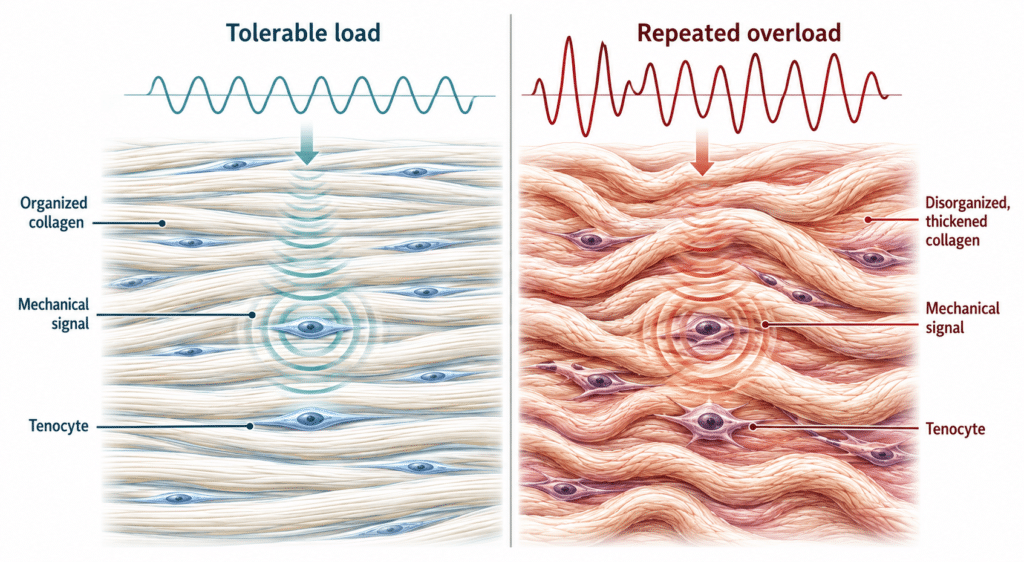
A tendon connects muscle to bone, but it behaves more like a living spring than a passive cable. It transmits force, stores elastic energy, and releases that energy during movement. Tendon cells continuously interpret the forces passing through the collagen matrix.
Three variables shape that response:
- Structure: collagen organization, stiffness, tendon thickness, and the condition of the tendon-bone interface
- Signaling: the cellular conversion of mechanical input into biological activity
- Load: the magnitude, speed, frequency, and recovery time attached to movement
Healthy adaptation occurs when load is meaningful but recoverable. Too little stimulus can reduce capacity. Too much, too soon can increase irritability. Repeated demand without adequate recovery can keep the tendon trapped between attempted repair and renewed overload.
This is why chronic tendinopathy is rarely explained by “weakness” alone. The entire load-transfer system must be examined.
Clinical Visualization: When the Signal and the Load Drift Apart
Clinical Insight: “Abnormal” Imaging Is Not the Whole Diagnosis
Ultrasound and MRI can reveal thickening, altered fiber patterns, fluid, calcification, or tearing. Those findings matter—but they do not measure every aspect of pain, load tolerance, or biological activity.
Some structurally abnormal tendons function well. Some painful tendons show only modest imaging changes. A scan therefore belongs inside a broader evaluation that considers:
- Symptom behavior and duration
- Recent changes in work, sport, footwear, or training
- Strength, range of motion, and force-transfer patterns
- Relevant medications and health conditions
- The response to previous rest, loading, or treatment
A diagnostic-first plan also considers other sources of pain, including joint disease, nerve irritation, stress injury, inflammatory disease, or referred pain. Mechanical reconditioning makes sense only when the working diagnosis supports it.
When chronic tendinopathy is confirmed, appropriately dosed physical rehabilitation remains central. Focused shockwave therapy may be considered as an adjunct when progress has plateaued and the tissue target is appropriate.
What Mechanical Signaling Can—and Cannot—Do
Mechanotransduction is the process by which cells convert physical forces into biochemical activity. In tendon, loading can influence collagen synthesis, matrix organization, and cellular signaling. A foundational review described how prescribed exercise may promote tissue repair through this pathway (Khan and Scott, British Journal of Sports Medicine).
Focused shockwave introduces acoustic pressure waves into a selected tissue region. Proposed effects include changes in local signaling, blood-vessel responses, and pain modulation. Clinical outcomes vary by tendon, protocol, device, diagnosis, and patient selection; shockwave should not be presented as a universal restart button.
It also does not replace progressive rehabilitation. The signal may help change the tissue environment, but rehabilitation supplies the repeated, task-specific information needed to rebuild capacity. Mayo Clinic likewise includes resistance exercise among treatments for chronic tendon conditions and lists shockwave as one possible noninvasive option in selected cases (Mayo Clinic tendinopathy guidance).
Did You Know?
The word “tendinitis” implies inflammation, but long-standing tendon pain can involve far more than inflammation alone. Chronic tendinopathy may include altered collagen, cell behavior, pain processing, and load tolerance. That is why symptom suppression and tendon reconditioning are not always the same goal.
From Rest to Mechanotherapy: How the Model Changed
For much of the twentieth century, persistent tendon pain was commonly framed as inflammation, making rest and anti-inflammatory treatment intuitive choices. Research later identified degenerative and adaptive features that could not be explained by inflammation alone.
By the early 2000s, tendinopathy and mechanotherapy models placed load response at the center of care. The question shifted from “How do we eliminate all stress?” to “What dose of stress can this tendon interpret and recover from?”
Focused shockwave extends that mechanical-signaling concept through technology, but the governing principle remains older and simpler: adaptation depends on the relationship between stimulus, capacity, and recovery.
Frequently Asked Questions
Does chronic tendinopathy mean my tendon is permanently damaged?
No. Chronic describes duration, not hopelessness. Some tissue changes may remain visible even as pain and function improve. Prognosis depends on the tendon involved, severity, health factors, loading history, and the accuracy of the diagnosis.
Is “biological silence” a medical diagnosis?
No. It is an explanatory metaphor for reduced or ineffective tissue responsiveness. A clinician cannot diagnose it from symptoms or imaging alone. The underlying condition and contributing load pattern still need to be identified.
Why can complete rest make the pain return later?
Rest can reduce irritation, but prolonged unloading may also reduce capacity. When normal activity resumes abruptly, demand can again exceed what the tendon tolerates. Relative rest followed by progressive loading is often more useful than indefinite avoidance.
Does focused shockwave heal tendinopathy by itself?
No. Focused shockwave may influence tissue signaling or symptoms in selected tendinopathies, but it does not replace rehabilitation, correct every biomechanical contributor, or guarantee collagen restoration. It is best viewed as a possible adjunct within a coordinated plan.
How long does tendon reconditioning take?
There is no universal timeline. Tendons generally adapt over weeks to months, and progress is rarely linear. The plan should be adjusted according to pain behavior, function, strength, load tolerance, and recovery—not the calendar alone.
Help the Tendon Respond Again
If tendon pain keeps returning despite rest or rehabilitation, schedule an evaluation at STAR Health. A physician-directed assessment can determine whether the problem reflects chronic tendinopathy, another source of pain, or a load-and-signaling mismatch—and whether mechanical reconditioning belongs in your plan.
Local Care, Global Science
At STAR Health in Fort Wayne, persistent tendon pain is evaluated within the demands of the patient’s actual life—work, sport, walking, lifting, and recovery. Global tendon science informs the plan; local, physician-directed assessment determines whether it applies.
The aim is not to chase an image or perform a procedure because pain has lasted a long time. The aim is to identify the limiting system and restore load capacity deliberately.