
Why Soft Tissue Pain Is a System Signal—Not Just a Muscle Problem
Did you ever wonder why the same muscle keeps tightening—even after stretching, rest, exercise, or massage?
Understanding soft tissue pain is crucial for effective treatment strategies.
The shoulder loosens, but the tension returns. The back spasm settles, then reappears after another long day. A sore hip feels better temporarily, yet the same discomfort emerges during the next walk or workout.
It is tempting to blame a stubborn muscle.
But soft tissue pain is often the location where a problem becomes noticeable—not necessarily where it began.
Muscles and fascia respond continuously to movement, joint position, nervous-system signaling, tissue sensitivity, recovery, and physical demand. When those systems lose balance, soft tissue may tighten or become painful in an attempt to protect the body.
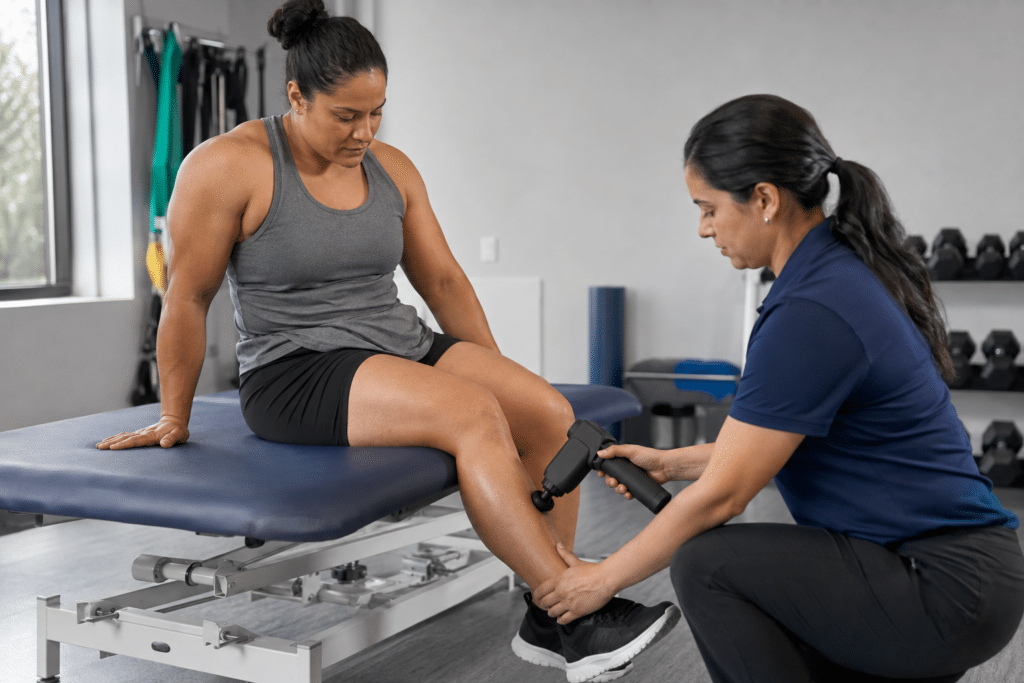
At STAR Health, instrument-assisted therapeutic massage is not treated as a stand-alone comfort service. It is used as an adjunct within diagnosis-informed medical and rehabilitative care.
Soft Tissue Pain Is a System Signal
Muscles do more than produce movement. They stabilize joints, absorb force, transfer energy, and respond to instructions from the nervous system.
That places soft tissue at the intersection of three clinical layers:
- Structure: muscles, fascia, tendons, joints, nerves, and surrounding connective tissue
- Signaling: sensory input, pain modulation, coordination, and protective muscle tone
- Load: the physical demands created by posture, work, exercise, gait, and daily activity
A calf may become tight because it is absorbing more force than the hip can manage. Shoulder muscles may remain guarded because the neck, joint, or nervous system perceives a movement as threatening. Back spasms may appear after prolonged sitting because the tissues are compensating for limited movement variety and reduced load tolerance.
The discomfort is real. But the painful muscle may be the messenger rather than the culprit.
Treating only the tender location can provide temporary relief while leaving the system that produced the tension unchanged.
Common Warning Lights
Patients may notice:
- Neck and shoulder tension during stress or poor sleep
- Back spasms after prolonged sitting or standing
- Hip or thigh tightness during walking or running
- Calf or foot tension despite unrevealing imaging
- Recurring soreness after apparently adequate recover
These regions frequently function as load-transfer zones. When another part of the movement system becomes inefficient, the soft tissue may absorb the difference.
Clinical Visualization: When the Same Symptom Means Two Different Things
Imagine two runners who both report persistent calf tightness.
The first recently increased training volume. Examination shows muscle fatigue and reduced ankle mobility without swelling, neurologic changes, or other warning signs. Carefully selected mechanical input may help the runner tolerate mobility work and gait retraining.
The second runner has sudden calf pain, warmth, and unexplained swelling. That patient does not need stronger massage. The symptom requires medical evaluation before mechanical treatment is considered.
The location is the same. The word “tightness” is the same. The clinical meaning is completely different.
That is why diagnosis and screening must come before treatment intensity.
Clinical Insight: What Instrument-Assisted Massage Actually Does
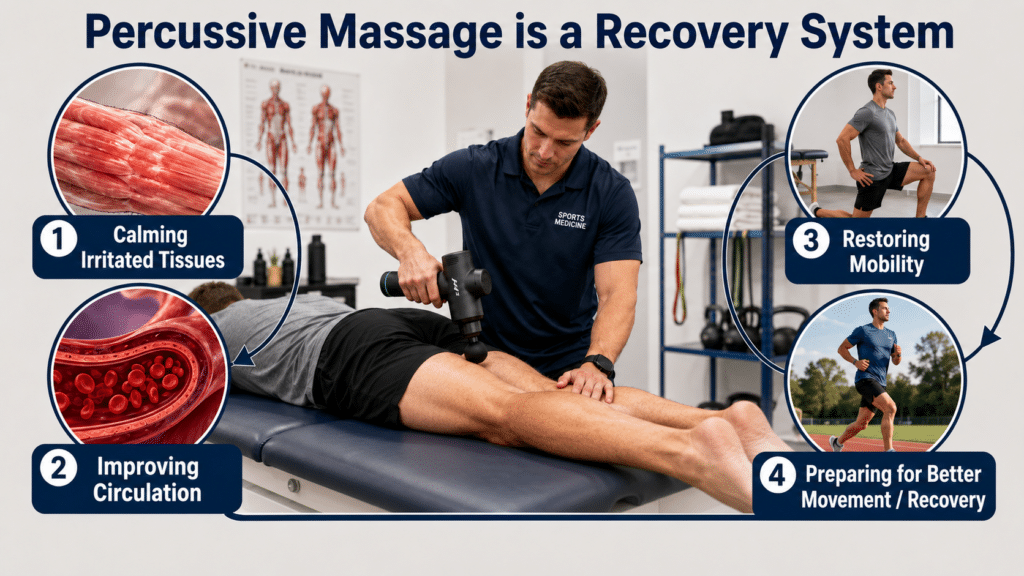
Instrument-assisted therapeutic massage applies controlled percussion or vibration to selected soft tissue.
The clinical “dose” includes:
Soft tissue pain can manifest in various forms, affecting muscle function and mobility.
- Contact pressure
- Frequency
- Amplitude
- Treatment duration
- Size and sensitivity of the treatment region
- Patient response during and after application
Percussive input may temporarily change perceived stiffness, range of motion, soreness, or tolerance for movement. Lower-amplitude vibration may be considered when stronger percussion is poorly tolerated.
The objective is not to crush a “knot,” force tissue to release, or mechanically erase scar tissue. The more useful objective is to create a safe window for purposeful movement.
That window may help a patient participate in mobility training, progressive strengthening, gait correction, or another rehabilitation activity that addresses the underlying load problem.
The Nervous System’s Role
Muscle tone is partly regulated by the nervous system. Pain history, uncertainty, fatigue, stress, and unpredictable loading can all increase protective behavior.
Mechanical stimulation provides sensory input that may temporarily influence how the nervous system interprets the treated region. This can sometimes reduce guarding without aggressive pressure.
However, a temporary change in tone does not prove that the underlying problem has resolved. The patient must still be evaluated for mechanical overload, joint dysfunction, neural irritation, tissue injury, and recovery deficits.
Imaging in Context
MRI, CT, ultrasound, and radiographs answer important structural questions. They may reveal tears, fractures, inflammation, degeneration, or other abnormalities.
But imaging is not a complete measurement of pain, coordination, protective tone, or real-time load tolerance. A scan can therefore be unrevealing even when symptoms remain significant.
Instrument-assisted massage does not “treat what imaging missed.” Instead, it may address a clinically identified soft-tissue response while examination and diagnostics determine why that response developed.
When appropriate, care may be coordinated with Sports Medicine Services or Musculoskeletal & Orthopedic Medicine.
Experience, Expertise, Authority, and Trust
Dr. Joseph Fortin (DO) integrates board-certified Physical Medicine & Rehabilitation (PM&R) expertise with subspecialty certification in Interventional Pain Management, alongside recognized experience in regenerative medicine, sports medicine, and integrative medicine—supporting system-level interpretation of imaging, movement, tissue biology, and pain mechanisms to reduce misdirected care.
National and international speaker on biomechanics, human movement, MRI & CT imaging physics, interventional pain management, and regenerative medicine.
This perspective helps distinguish a treatable soft-tissue response from a symptom that requires deeper investigation.
Did You Know?
More pressure does not automatically produce a better clinical response.
A tolerable mechanical input may briefly improve comfort or movement readiness, while excessive intensity may increase guarding, bruising, or sensitivity. Precision matters more than pressure alone.
The response—not the device setting—helps determine whether treatment should continue.
Historical Perspective: From Manual Pressure to Controlled Percussion)
Massage has been used across cultures throughout recorded history. The National Center for Complementary and Integrative Health describes it as one of the earliest approaches people used in attempts to relieve pain.
Modern percussive therapy is much newer. Its development is commonly traced to mechanical percussion methods used during the twentieth century, followed by the introduction of commercial handheld massage devices in the 2000s.
The technology advanced faster than the evidence.
A 2023 systematic review of massage-gun percussive therapy found possible improvements in flexibility, selected performance measures, and experiences of musculoskeletal pain. However, all 13 included studies had methodological or reporting limitations.
The evidence therefore supports a measured conclusion: percussive therapy may be a useful adjunct, but it is not a stand-alone diagnosis, cure, or recovery system.
Local Care, Global Science
(Beaver Builder: Standard content row | Local relevance + patient expectations)
Patients seeking medical massage in Fort Wayne are often looking for more than temporary relaxation. They want to understand why muscles stay tight, why symptoms return, or why pain persists when imaging appears normal.
STAR Health integrates biomechanics, neuroscience, diagnostics, and rehabilitation science into local, physician-directed care for Fort Wayne and Northeast Indiana.
Patients can expect:
- A clinical, non-spa environment
- Screening for precautions and warning signs
- A clearly defined treatment objective
- Mechanical input adjusted to tissue response
- Coordination with medical and rehabilitation care
- Reassessment based on movement and function
Frequently Asked Questions
Does recurring muscle pain always mean tissue damage?
No. Pain can occur with tissue injury, but it may also reflect guarding, altered load distribution, neural sensitivity, fatigue, or reduced tissue capacity. An examination helps determine which factors are relevant.
Is instrument-assisted massage the same as deep-tissue massage?
Not necessarily. Instrument-assisted therapy uses selected mechanical parameters rather than relying only on manual pressure. Deeper treatment is not automatically safer or more effective.
Educating patients about soft tissue pain can empower them in their recovery journey.
Why does massage help if the pain later returns?
Massage may temporarily change sensory input, perceived stiffness, or movement tolerance. Symptoms may return when the underlying load pattern, movement deficit, or recovery problem remains unchanged.
Effective treatment for soft tissue pain typically requires a comprehensive approach.
Active participation in managing soft tissue pain often leads to better outcomes.
Can massage help when my MRI is normal?
Possibly, depending on the diagnosis. Normal or inconclusive imaging does not mean the pain is imaginary, but it also does not prove that massage is appropriate. Clinical examination remains essential.
Recognizing patterns in soft tissue pain can aid healthcare providers in treatment planning.
Does instrument-assisted massage replace rehabilitation?
No. Its most useful role may be helping a patient participate more comfortably in rehabilitation. Progressive movement, strength, coordination, and load management remain central to durable recovery.
When the Muscle Keeps Sending the Same Signal
If soft tissue pain keeps returning despite rest, stretching, or temporary relief, the next step may not be more pressure. It may be time to investigate the structure, signaling, and load patterns behind the symptom. Chronic soft tissue pain often requires multidisciplinary treatment efforts for effective resolution. Understanding soft tissue pain can help patients in managing their symptoms and improving quality of life. Soft tissue pain is a common complaint that can lead to significant discomfort if not addressed. Addressing soft tissue pain is essential for restoring function and mobility. Strategies to manage soft tissue pain must be tailored to the individual patient’s needs.